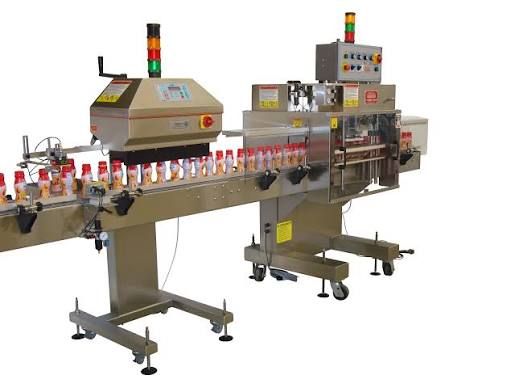
Induction sealing machines are packaging systems designed to create a hermetic seal across the opening of compatible containers using electromagnetic induction.
They are commonly used for bottles, jars, tubes, and other containers in industries such as food and beverage, pharmaceuticals, cosmetics, chemicals, and household products.
The technology uses a controlled electromagnetic field to heat a conductive foil layer positioned beneath or within a container closure. The heated sealing layer bonds to the container opening, creating a secure barrier against moisture, oxygen, leakage, and external contamination.
What Are Induction Sealing Machines?
An induction sealing machine is equipment that uses electromagnetic energy to heat a conductive sealing liner without direct contact between the sealing head and the liner.
A typical induction sealing system includes:
- High-frequency generator
- Induction sealing head
- Conveyor
- Container guide system
- Control panel
- Cooling system
- Sensors
- Power supply
The machine configuration depends on container size, closure type, production speed, liner construction, and packaging requirements.
How Do Induction Sealing Machines Work?
Induction sealing generally follows a straightforward sequence.
1. Container Filling
The product is placed into the compatible container before the sealing process. The container opening must remain suitable for liner placement.
2. Cap and Liner Placement
A closure containing an induction liner is positioned on the container. The liner normally consists of several layers designed to support induction heating and bonding.
3. Container Positioning
The container moves beneath the induction sealing head using a conveyor or indexing mechanism.
4. Electromagnetic Heating
The induction generator creates a high-frequency electromagnetic field. This field induces heat in the conductive foil layer within the liner.
5. Heat Transfer
The heated foil transfers thermal energy to the sealing polymer layer. The polymer softens and bonds to the container lip.
6. Cooling and Bond Formation
After the electromagnetic field is removed, the sealing material cools and forms a bonded barrier around the container opening.
The resulting seal can improve product protection and tamper evidence when the appropriate liner and closure system are used.
Main Types of Induction Sealing Machines
Different configurations are available for different production environments.
Manual Induction Sealers
Manual systems are generally designed for smaller production operations, testing, development, and applications where containers are handled individually.
The operator positions the sealing head over each container and activates the sealing cycle.
Semi-Automatic Induction Sealers
Semi-automatic systems reduce manual handling by integrating container positioning, sealing controls, and timed operation.
They can be suitable for medium-volume packaging processes.
Automatic Induction Sealing Machines
Automatic induction sealers are integrated into conveyor-based packaging lines. Containers pass continuously or intermittently beneath the induction head.
These systems can incorporate:
- Automatic container detection
- Speed synchronization
- Reject mechanisms
- Digital controls
- Sealing monitoring
- Production counters
Continuous Induction Sealers
Continuous systems are designed for packaging lines where containers move continuously through the sealing station. They are particularly useful for high-throughput applications.
Induction Sealing Machine Components
| Component | Primary Function |
|---|---|
| Induction Generator | Produces high-frequency electrical energy |
| Sealing Head | Creates the electromagnetic field |
| Conveyor | Moves containers through the sealing area |
| Sensor | Detects container position |
| Control Panel | Controls operating parameters |
| Cooling System | Manages generator and head temperature |
| Container Guide | Maintains alignment |
| Power Supply | Provides electrical input |
| Reject System | Removes unsuitable containers where integrated |
Component design and specifications vary according to machine configuration and production requirements.
Induction Sealing Materials
Induction sealing liners generally contain multiple layers, with each layer performing a particular function.
Common liner components can include:
- Aluminum foil
- Polymer sealing layer
- Backing material
- Adhesive layer
- Paper or foam support
The sealing polymer must be compatible with the container material.
Container Compatibility
Induction sealing can be used with various container materials, including:
- HDPE
- PET
- PP
- Glass
- Other compatible packaging materials
Compatibility testing is important because the liner must form a suitable bond with the container opening.
Applications of Induction Sealing Machines
Induction sealing technology is used across numerous packaging sectors.
Food and Beverage
Applications include:
- Sauces
- Spreads
- Dairy products
- Nutritional products
- Beverages
- Dry food ingredients
- Condiments
The seal can help reduce exposure to moisture and external contaminants.
Pharmaceutical Packaging
Induction seals are used on compatible medicine containers and healthcare products where controlled container closure and tamper evidence are important.
Packaging materials and sealing processes must meet the applicable requirements of the specific pharmaceutical application.
Cosmetics
Products such as creams, lotions, gels, oils, and personal-care formulations can use induction sealing for container protection.
Chemical Products
Compatible industrial and household chemicals can use induction seals to reduce leakage and provide a barrier beneath the primary closure.
Agricultural Products
Seeds, fertilizers, pesticides, and other compatible agricultural products may use induction-sealed containers, subject to material and regulatory requirements.
Benefits of Induction Sealing
Induction sealing provides several functional advantages.
Hermetic Sealing
When correctly designed and applied, induction liners can create a continuous seal around the container opening.
Tamper Evidence
The bonded liner can provide visible evidence if the package has been opened or disturbed.
Product Protection
The seal can help reduce exposure to:
- Moisture
- Oxygen
- Dust
- External contaminants
- Leakage
Non-Contact Operation
The induction head does not need to physically contact the liner during heating. This supports integration into automated conveyor lines.
High-Speed Packaging
Automatic induction systems can process containers at production-line speeds when properly matched to container geometry and sealing materials.
Important Induction Sealing Parameters
Sealing quality depends on several process variables.
Sealing Power
Generator power determines the electromagnetic energy delivered to the sealing liner. Excessive or insufficient power can affect seal quality.
Conveyor Speed
The time a container spends beneath the induction head influences the energy delivered to the liner.
Sealing Head Height
The distance between the sealing head and liner affects electromagnetic coupling. Consistent container positioning is therefore important.
Container Material
Different plastics and glass containers have different thermal and bonding characteristics.
Liner Construction
Foil thickness, polymer composition, liner structure, and diameter can influence the sealing window.
Cap Torque
The closure must be applied appropriately so that the liner remains correctly positioned against the container lip during sealing.
Quality Control for Induction Sealing
Quality control should evaluate both the sealing process and the finished package.
Visual Inspection
Operators or machine vision systems can check for:
- Incomplete seals
- Wrinkled liners
- Misalignment
- Burn marks
- Contamination
- Damaged closures
Peel Testing
Peel testing can evaluate the strength and consistency of the bond between the liner and container.
Leak Testing
Leak testing can help identify incomplete or discontinuous seals.
Burst Testing
For selected packaging applications, pressure-based testing can evaluate seal integrity under controlled conditions.
Seal Inspection
Automated inspection systems can detect missing liners, incorrect containers, closure problems, and other packaging abnormalities.
Automation in Induction Sealing
Modern induction sealing machines can be integrated with automated packaging lines.
Automation features can include:
- Container sensors
- PLC controls
- Digital power adjustment
- Conveyor synchronization
- Automatic rejection
- Production counters
- Data logging
- Alarm systems
- Remote monitoring
Machine vision can also inspect seal appearance and container positioning.
Common Induction Sealing Problems
Incomplete Seal
An incomplete seal may result from insufficient energy, incorrect liner selection, contamination, poor cap application, or unsuitable container geometry.
Overheating
Excessive induction energy can damage the liner, container, or product. Proper process parameter control is essential.
Uneven Sealing
Uneven seals can result from container misalignment, inconsistent liner placement, variations in container dimensions, or unsuitable head positioning.
Leakage
Leakage can occur when the liner does not bond uniformly to the container lip. Product contamination around the sealing surface can also interfere with bonding.
Liner Sticking to the Cap
Improper liner construction or process settings can cause the liner to remain attached to the closure rather than forming the intended seal on the container.
Maintenance of Induction Sealing Machines
Regular maintenance supports consistent sealing performance.
Important activities include:
- Cleaning the sealing head
- Inspecting conveyors
- Checking sensors
- Inspecting electrical connections
- Cleaning cooling systems
- Checking cooling fans
- Inspecting container guides
- Verifying sealing-head alignment
- Checking generator performance
- Inspecting emergency-stop systems
Maintenance intervals should follow the equipment manufacturer's technical documentation and actual production conditions.
How to Select Induction Sealing Machines
Selection should be based on the complete packaging application.
Consider:
- Container material
- Container diameter
- Closure type
- Liner construction
- Required production speed
- Container shape
- Product characteristics
- Required seal strength
- Tamper-evidence requirements
- Available conveyor configuration
- Automation requirements
- Electrical supply
- Production environment
Compatibility testing should be performed with the actual container, closure, liner, and product combination before large-scale implementation.
Induction Sealing vs Traditional Heat Sealing
| Feature | Induction Sealing | Traditional Heat Sealing |
|---|---|---|
| Heating Method | Electromagnetic induction | Direct or indirect heat |
| Contact With Liner | Non-contact | Often direct contact |
| Automation | Highly suitable | Depends on equipment |
| Container Applications | Bottles, jars, compatible closures | Films, trays, pouches, containers |
| Tamper Evidence | Common with suitable liners | Depends on package design |
| Process Control | Power, speed, head position | Temperature, pressure, dwell time |
The appropriate technology depends on package construction and the required sealing process.
Frequently Asked Questions
What are induction sealing machines used for?
They are used to create a sealed barrier across compatible container openings. Applications include food, beverage, pharmaceutical, cosmetic, chemical, and agricultural packaging.
How does an induction sealer work?
The machine generates a high-frequency electromagnetic field that heats a conductive foil layer in an induction liner. The liner's sealing layer then bonds to the container lip.
Can induction sealing be used on plastic containers?
Yes. Induction sealing can be used with compatible plastics such as HDPE, PET, and PP. The liner and sealing layer must be designed for the specific container material.
What affects induction sealing quality?
Important factors include generator power, conveyor speed, sealing-head height, container material, liner construction, closure application, and cleanliness of the container lip.
How do I select an induction sealing machine?
Evaluate container diameter and material, closure and liner design, production speed, product characteristics, required seal integrity, automation requirements, and packaging-line configuration.
Conclusion
Induction sealing machines provide a controlled, non-contact method for sealing compatible containers using electromagnetic heating. Manual, semi-automatic, automatic, and continuous configurations allow the technology to be integrated into different packaging environments.
Successful induction sealing depends on the relationship between the machine, container, closure, liner, product, and process parameters. Power, conveyor speed, sealing-head position, liner construction, and container compatibility all influence final seal quality.
Modern systems increasingly incorporate PLC controls, sensors, machine vision, automated rejection, data logging, and production monitoring. These technologies can improve process consistency while supporting integration with automated packaging lines.