Industrial centrifuge manufacturing involves designing and producing high-performance separation equipment.
These machines use centrifugal force to accelerate separation compared with conventional gravity-based methods.
Industrial centrifuges are used across chemical processing, pharmaceuticals, food and beverage, wastewater treatment, biotechnology, minerals processing, and other process industries. Machine configuration depends on feed characteristics, separation requirements, throughput, particle size, density differences, and operating conditions.
What Is Industrial Centrifuge Manufacturing?
Industrial centrifuge manufacturing includes the engineering, fabrication, assembly, testing, and quality-control processes used to produce centrifuge systems for industrial applications.
A centrifuge typically contains a rotating bowl or basket. When the feed enters the rotating assembly, centrifugal force causes components with different densities or physical characteristics to separate.
Manufacturing may involve:
- Mechanical engineering
- Precision machining
- Metal fabrication
- Rotor balancing
- Drive-system integration
- Electrical controls
- Instrumentation
- Safety-system integration
- Factory testing
The final equipment configuration varies according to the intended separation process.
How Do Industrial Centrifuges Work?
Industrial centrifuges use rotational motion to generate centrifugal acceleration.
1. Feed Introduction
The process material enters the centrifuge through a controlled feed system.
2. Rotation
A motor and drive assembly rotate the bowl, basket, or rotor at a defined speed.
3. Centrifugal Separation
The increased acceleration causes denser components to move outward while lighter components remain closer to the rotational axis.
4. Separation
Depending on the centrifuge design, separated solids or liquids are collected through dedicated discharge paths.
5. Product Discharge
The separated fractions are discharged continuously or intermittently.
Process parameters such as rotational speed, residence time, feed rate, and differential speed influence separation performance.
Types of Industrial Centrifuges
Different centrifuge designs are manufactured for specific separation requirements.
Decanter Centrifuges
Decanter centrifuges are commonly used for continuous solid-liquid separation.
A rotating bowl separates solids from liquid while an internal conveyor transports accumulated solids toward the discharge area.
Typical applications include:
- Wastewater treatment
- Sludge processing
- Chemical processing
- Mineral processing
- Food processing
Disc Stack Centrifuges
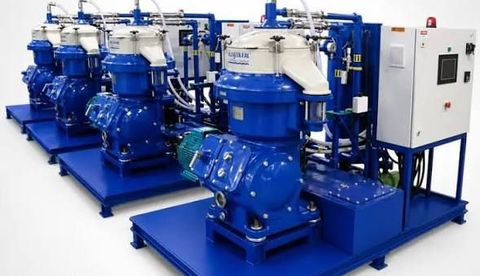
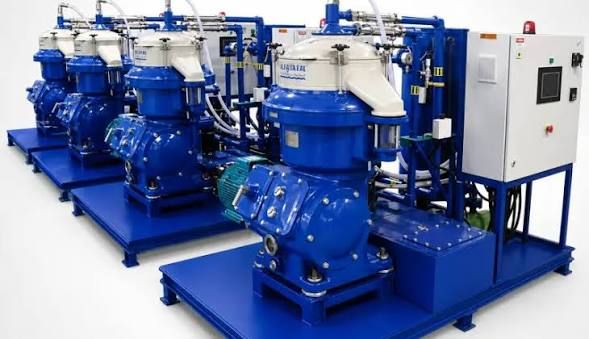
Disc stack centrifuges use a series of closely spaced conical discs to increase the effective separation area.
They are commonly used for:
- Liquid-liquid separation
- Liquid-solid clarification
- Fine-particle separation
- Food processing
- Pharmaceutical processing
Basket Centrifuges
Basket centrifuges use a perforated or solid-walled rotating basket.
They can be configured for filtration or sedimentation applications.
Peeler Centrifuges
Peeler centrifuges are designed for solid-liquid separation and can automatically remove accumulated filter cake.
They are used in selected pharmaceutical, chemical, and specialty-material processes.
Tubular Bowl Centrifuges
Tubular bowl centrifuges have a narrow, high-speed rotating bowl.
They are suitable for applications requiring separation of fine solids or liquid phases.
Pusher Centrifuges
Pusher centrifuges provide continuous solid-liquid separation and mechanical solids discharge.
They are commonly considered for processes involving relatively consistent crystalline solids.
Scroll Centrifuges
Scroll-based centrifuges use an internal conveying mechanism to move separated solids through the rotating bowl.
The conveyor speed can influence residence time and solids discharge characteristics.
Major Components of Industrial Centrifuges
| Component | Primary Function |
|---|---|
| Rotating Bowl | Creates centrifugal separation |
| Rotor | Supports rotating assembly |
| Conveyor | Transports separated solids |
| Drive Motor | Provides rotational power |
| Gearbox | Controls mechanical transmission |
| Bearings | Support rotating components |
| Feed Tube | Introduces process material |
| Discharge System | Removes separated phases |
| Frame | Supports the equipment |
| Control Panel | Controls operating parameters |
| Sensors | Monitor process conditions |
| Safety Guard | Protects rotating components |
Component design depends on centrifuge type and operating conditions.
Industrial Centrifuge Manufacturing Process
Manufacturing a centrifuge generally involves several engineering and production stages.
Engineering Design
Engineers determine:
- Bowl dimensions
- Rotational speed
- Separation requirements
- Material selection
- Drive configuration
- Feed arrangement
- Discharge mechanism
- Control architecture
Design calculations must account for mechanical loads and operating conditions.
Material Selection
Common construction materials include:
- Stainless steel
- Carbon steel
- Duplex stainless steel
- Specialized corrosion-resistant alloys
Material selection depends on chemical compatibility, temperature, pressure, hygiene requirements, and process conditions.
Precision Machining
Critical components such as shafts, rotors, hubs, and rotating assemblies require accurate machining.
Dimensional accuracy is particularly important for rotating equipment.
Rotor Balancing
Rotating assemblies must be balanced appropriately to limit vibration during operation.
Dynamic balancing can help identify and correct mass-distribution variations.
Assembly
Major mechanical and electrical components are assembled according to engineering specifications.
This stage can include installation of bearings, drives, seals, instrumentation, guards, and control components.
Testing
Manufactured centrifuges can undergo inspections and functional testing before installation.
Testing may include:
- Dimensional inspection
- Rotational testing
- Vibration measurement
- Motor testing
- Control-system testing
- Safety-system testing
- Leakage inspection
Factors Affecting Centrifuge Performance
Several operating factors influence separation performance.
Centrifugal Force
Higher rotational speed generally produces greater centrifugal acceleration, although the appropriate operating range depends on machine design and material characteristics.
Feed Rate
Excessive feed rates can reduce residence time and potentially affect separation quality.
Particle Size
Larger and denser particles generally respond differently to centrifugal separation than very fine particles.
Density Difference
The density difference between phases influences separation behavior.
Viscosity
Higher-viscosity fluids can affect settling and separation characteristics.
Differential Speed
In scroll-type centrifuges, the speed difference between the bowl and conveyor can influence solids residence time and discharge.
Industrial Applications
Industrial centrifuges are used in many process industries.
Chemical Processing
Applications can include:
- Chemical slurry separation
- Catalyst recovery
- Crystallized-product separation
- Solids clarification
- Liquid-liquid separation
Pharmaceutical Processing
Centrifuges can be used for selected:
- Active ingredient processing
- Crystallization processes
- Solids separation
- Clarification
- Intermediate processing
Equipment configuration must account for hygiene, containment, material compatibility, and process-control requirements.
Food and Beverage Processing
Industrial centrifuges may support:
- Beverage clarification
- Dairy processing
- Edible-oil separation
- Starch processing
- Yeast separation
- Food ingredient processing
Wastewater Treatment
Decanter centrifuges can separate solids from wastewater sludge.
Applications include sludge thickening and dewatering.
Biotechnology
Centrifugation can support selected biological separation processes involving cells, particles, and process liquids.
Mineral Processing
Centrifugal separation can be used in selected mineral and slurry-processing applications.
The appropriate equipment depends on particle characteristics and slurry properties.
Industrial Centrifuge Automation
Modern centrifuges can incorporate automated control systems to regulate operating parameters.
Automation may control:
- Bowl speed
- Feed rate
- Differential speed
- Torque
- Vibration
- Temperature
- Pressure
- Solids discharge
- Cleaning cycles
PLC Control
A programmable logic controller can coordinate centrifuge operation with upstream and downstream process equipment.
Sensor Monitoring
Sensors can monitor:
- Vibration
- Bearing temperature
- Motor current
- Bowl speed
- Torque
- Feed pressure
- Process temperature
Continuous monitoring can help identify abnormal operating conditions.
Safety in Centrifuge Manufacturing
Industrial centrifuges contain rapidly rotating components and therefore require appropriate mechanical and operational safeguards.
Important safety considerations include:
- Proper rotor balancing
- Mechanical guarding
- Overspeed protection
- Emergency shutdown systems
- Vibration monitoring
- Bearing protection
- Correct assembly
- Structural integrity
- Appropriate electrical protection
- Regular inspection
Safety requirements should be determined according to machine design, process conditions, applicable standards, and the installation environment.
Common Industrial Centrifuge Problems
Excessive Vibration
Potential causes include rotor imbalance, bearing problems, incorrect installation, or accumulated material.
Reduced Separation Efficiency
Poor separation may result from inappropriate rotational speed, excessive feed rate, unsuitable residence time, or changes in feed characteristics.
High Bearing Temperature
Bearing temperature can increase because of lubrication problems, excessive mechanical loads, alignment issues, or bearing deterioration.
Solids Discharge Problems
Discharge issues can result from unsuitable differential speed, excessive solids loading, material buildup, or mechanical problems.
Seal Leakage
Seal degradation, improper installation, pressure conditions, or chemical incompatibility can contribute to leakage.
Maintenance of Industrial Centrifuges
Routine maintenance is important for rotating separation equipment.
Typical maintenance activities include:
- Inspecting bearings
- Checking lubrication
- Monitoring vibration
- Inspecting seals
- Checking drive components
- Inspecting the bowl
- Checking conveyor components
- Cleaning process-contact surfaces
- Testing sensors
- Inspecting electrical systems
- Verifying safety devices
Maintenance intervals should be established according to equipment specifications, operating conditions, duty cycle, and process requirements.
How to Select an Industrial Centrifuge
Selection should begin with the characteristics of the material that needs to be separated.
Consider:
- Feed composition
- Solid concentration
- Particle size
- Particle density
- Liquid viscosity
- Required throughput
- Separation efficiency
- Moisture requirement
- Operating temperature
- Operating pressure
- Corrosive properties
- Required automation
- Cleaning requirements
- Discharge method
- Installation limitations
Pilot testing can be useful for difficult separation processes because actual feed behavior can vary significantly from laboratory assumptions.
How to Evaluate Industrial Centrifuge Manufacturers
When evaluating industrial centrifuge manufacturers, examine their engineering capabilities and machine configurations.
Important factors include:
- Centrifuge technology
- Capacity range
- Bowl design
- Rotor engineering
- Material selection
- Drive configuration
- Dynamic balancing
- Automation
- Safety systems
- Testing procedures
- Process integration
- Technical documentation
- Maintenance requirements
The manufacturer should be able to match the centrifuge configuration with the feed characteristics, separation objective, throughput, and operating environment.
Batch vs Continuous Industrial Centrifuges
| Factor | Batch Centrifuge | Continuous Centrifuge |
|---|---|---|
| Feed Operation | Intermittent | Continuous |
| Production Pattern | Batch processing | Continuous processing |
| Flexibility | Generally high | Suited to consistent processes |
| Solids Discharge | Intermittent or automated | Continuous or near-continuous |
| Automation | High potential | High potential |
| Typical Use | Variable production | High-throughput processes |
The selection depends on process characteristics, throughput, solids loading, and production requirements.
Frequently Asked Questions
What is industrial centrifuge manufacturing?
Industrial centrifuge manufacturing involves engineering, fabricating, machining, assembling, balancing, testing, and integrating centrifuge equipment designed for industrial separation processes.
What are industrial centrifuges used for?
Industrial centrifuges are used for solid-liquid separation, liquid-liquid separation, clarification, dewatering, crystallized-solid separation, and other density-based separation processes.
What are the main types of industrial centrifuges?
Common types include decanter centrifuges, disc stack centrifuges, basket centrifuges, peeler centrifuges, tubular bowl centrifuges, and pusher centrifuges.
What materials are used to manufacture industrial centrifuges?
Stainless steel, carbon steel, duplex stainless steel, and specialized corrosion-resistant alloys can be used depending on process chemistry, temperature, hygiene requirements, and mechanical conditions.
How do I select an industrial centrifuge?
Evaluate the feed composition, particle size, solids concentration, density, viscosity, throughput, separation target, temperature, pressure, materials compatibility, discharge requirements, and automation needs.
Conclusion
Industrial centrifuge manufacturing combines mechanical engineering, precision machining, rotor balancing, material selection, automation, and testing to produce equipment for demanding separation applications. Different technologies, including decanter, disc stack, basket, peeler, tubular bowl, and pusher centrifuges, address different process requirements.
Centrifuge performance depends on factors such as rotational speed, feed rate, particle characteristics, density differences, viscosity, residence time, and solids concentration. Proper machine configuration is therefore important for achieving consistent separation.
For industrial applications, equipment evaluation should consider mechanical design, material compatibility, safety systems, automation, maintenance requirements, and process integration. Pilot testing can also help determine the appropriate centrifuge configuration for complex feed materials.