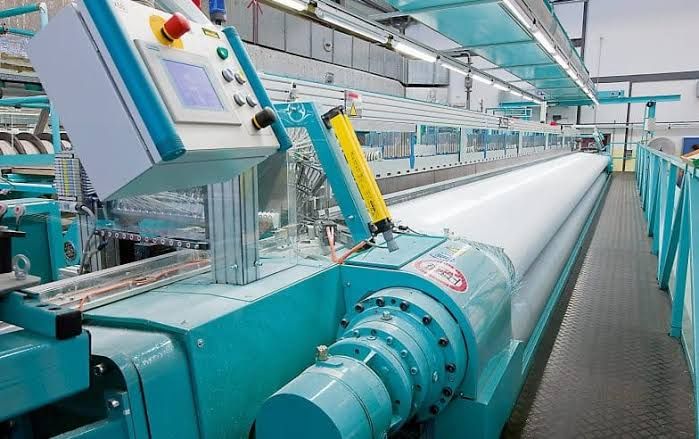
Industrial weaving machines are specialized textile machines used to interlace yarns to create woven fabrics.
These machines automate the controlled interaction of warp and weft yarns, allowing manufacturers to produce fabrics with consistent structure, width, density, and surface characteristics.
Modern weaving equipment can be configured for different yarn types, fabric constructions, production speeds, and end-use requirements. Technology selection depends on fabric design, yarn characteristics, required production capacity, machine width, automation, and quality requirements.
What Are Industrial Weaving Machines?
Industrial weaving machines, commonly known as industrial looms, form fabric by interlacing two primary yarn systems:
- Warp yarns: Run longitudinally through the fabric.
- Weft yarns: Run across the width of the fabric.
The machine controls these yarns through a coordinated sequence of shedding, weft insertion, beat-up, and fabric take-up.
Different loom technologies are designed for different textile applications, including apparel fabrics, home textiles, technical textiles, industrial fabrics, and specialty materials.
How Do Industrial Weaving Machines Work?
The weaving process involves several synchronized operations.
1. Warp Preparation
Warp yarns are prepared and arranged parallel to one another before entering the loom.
Sizing may be applied to selected yarns to improve resistance to abrasion and mechanical stress during weaving.
2. Shedding
The warp yarns are separated into different layers to create an opening known as the shed.
This opening allows the weft yarn to pass through.
3. Weft Insertion
The weft yarn is inserted through the shed using a suitable insertion mechanism.
4. Beat-Up
The reed moves forward and pushes the newly inserted weft yarn against the previously formed fabric edge.
5. Take-Up
The finished fabric is gradually wound or advanced through the take-up system.
6. Let-Off
The warp beam releases yarn at a controlled rate to maintain appropriate warp tension.
These operations repeat continuously at high speed.
Types of Industrial Weaving Machines
Different loom technologies are designed around different production requirements.
Shuttle Looms
Shuttle looms use a shuttle to carry the weft yarn across the shed.
They have a traditional mechanical design and can be suitable for specific heavy or specialty fabric applications.
However, shuttle-based systems generally operate at lower speeds than modern shuttleless technologies.
Rapier Looms
Rapier looms use a rigid or flexible rapier system to carry the weft yarn across the fabric width.
They are highly versatile and can process a wide range of yarns and fabric constructions.
Typical applications include:
- Apparel fabrics
- Home textiles
- Decorative fabrics
- Technical textiles
- Specialty woven materials
Air-Jet Looms
Air-jet looms use compressed air to propel the weft yarn through the shed.
They are widely associated with high-speed production of suitable lightweight and medium-weight fabrics.
Important operating factors include:
- Air pressure
- Nozzle configuration
- Yarn characteristics
- Weft insertion timing
- Air consumption
Water-Jet Looms
Water-jet looms use a controlled water stream to insert the weft yarn.
They are particularly suitable for selected synthetic yarns that are compatible with water-based insertion.
These machines are commonly associated with certain smooth, lightweight synthetic fabrics.
Projectile Looms
Projectile looms use small projectiles to carry the weft yarn across the shed.
They can be suitable for wider and heavier fabrics, including selected industrial and technical textiles.
Jacquard Weaving Machines
Jacquard systems provide individual or highly controlled warp-yarn selection.
They allow complex patterns and intricate woven designs to be produced.
Applications include:
- Decorative textiles
- Upholstery
- Furnishing fabrics
- Patterned apparel fabrics
- Technical textiles
Major Components of Industrial Weaving Machines
| Component | Primary Function |
|---|---|
| Warp Beam | Holds prepared warp yarn |
| Let-Off System | Controls warp yarn release |
| Heald Frames | Control warp movement |
| Jacquard System | Controls complex warp patterns |
| Reed | Controls fabric width and performs beat-up |
| Weft Insertion System | Carries weft yarn across the shed |
| Take-Up System | Advances finished fabric |
| Beat-Up Mechanism | Pushes inserted weft into the fabric |
| Drive Motor | Provides machine motion |
| Control System | Coordinates machine operations |
| Sensors | Monitor machine and yarn conditions |
The component arrangement varies according to loom type and fabric requirements.
Weaving Process Parameters
Several parameters influence fabric quality and machine performance.
Warp Tension
Consistent warp tension helps maintain fabric structure and reduce weaving interruptions.
Weft Density
Weft density determines the number of weft yarns incorporated over a defined fabric length.
Warp Density
Warp density represents the number of warp yarns across a defined fabric width.
Loom Speed
Machine speed influences production throughput and places demands on yarn quality, machine stability, and component durability.
Fabric Width
The required fabric width determines the appropriate loom configuration.
Yarn Characteristics
Yarn count, strength, elasticity, friction, moisture, and surface properties can influence weaving behavior.
Industrial Applications of Weaving Machines
Industrial weaving machines are used to manufacture fabrics for numerous sectors.
Apparel Textiles
Woven fabrics are used for:
- Shirts
- Trousers
- Jackets
- Uniforms
- Dresses
- Workwear
Different loom technologies can produce plain, twill, satin, dobby, and patterned constructions.
Home Textiles
Applications include:
- Curtains
- Upholstery
- Bedding
- Table textiles
- Decorative fabrics
Technical Textiles
Industrial weaving equipment can produce fabrics used for specialized applications.
Examples include:
- Reinforcement fabrics
- Filtration fabrics
- Conveyor-belt fabrics
- Geotextiles
- Protective textiles
- Composite reinforcement
Industrial Fabrics
Heavy-duty looms can process yarns used in applications requiring greater mechanical strength or dimensional stability.
Weaving Machine Automation
Modern industrial weaving machines increasingly use electronic controls and sensors to coordinate operations.
Automation can manage:
- Loom speed
- Warp tension
- Weft insertion
- Fabric take-up
- Yarn monitoring
- Pattern control
- Machine lubrication
- Fault detection
Electronic Control Systems
Electronic controls synchronize machine functions and allow operators to configure production parameters.
Automatic Stop Systems
Sensors can detect selected yarn breaks or abnormal conditions and stop the machine to prevent fabric defects.
Production Monitoring
Integrated monitoring systems can record:
- Machine operating hours
- Production output
- Stops
- Faults
- Yarn breaks
- Operating speed
Production data can help identify recurring process issues.
Fabric Quality Control
Quality control is important throughout the weaving process.
Common checks include:
- Fabric width
- Fabric weight
- Warp density
- Weft density
- Yarn defects
- Broken ends
- Missing picks
- Pattern accuracy
- Surface appearance
- Dimensional stability
Automated inspection systems can also be integrated into selected production lines.
Weaving Machine Maintenance
Regular maintenance helps maintain machine accuracy and reduce unplanned interruptions.
Typical maintenance activities include:
- Inspecting bearings
- Checking drive components
- Inspecting gears
- Checking warp tension systems
- Cleaning sensors
- Inspecting reed condition
- Checking weft insertion components
- Lubricating specified components
- Inspecting electrical systems
- Checking safety devices
Maintenance schedules should follow machine specifications and operating conditions.
Common Industrial Weaving Machine Problems
Warp Breakage
Warp breaks can result from excessive tension, yarn defects, abrasion, poor preparation, or incorrect machine settings.
Weft Breakage
Weft breaks may be associated with yarn quality, insertion settings, excessive tension, or mechanical issues.
Uneven Fabric Density
Variation in warp or weft tension can cause inconsistent fabric density.
Excessive Vibration
Vibration can result from mechanical imbalance, worn components, incorrect installation, or drive-system problems.
Pattern Errors
Pattern defects can arise from incorrect electronic settings, yarn selection problems, mechanical wear, or synchronization issues.
How to Select Industrial Weaving Machines
Machine selection should begin with the intended fabric and yarn characteristics.
Consider:
- Fabric type
- Fabric construction
- Yarn material
- Yarn count
- Yarn strength
- Fabric width
- Fabric weight
- Production volume
- Loom speed
- Weft insertion technology
- Pattern requirements
- Warp tension requirements
- Automation
- Machine footprint
- Maintenance requirements
For specialized textiles, testing representative yarns and fabric constructions can help determine the appropriate loom configuration.
Rapier vs Air-Jet vs Water-Jet Looms
| Feature | Rapier Loom | Air-Jet Loom | Water-Jet Loom |
|---|---|---|---|
| Weft Insertion | Rapier | Compressed air | Water stream |
| Yarn Flexibility | Broad range | Best for suitable yarns | Best for water-compatible yarns |
| Pattern Capability | High | High with suitable systems | Application dependent |
| Typical Speed | High | Very high | Very high |
| Common Applications | Apparel, technical textiles | High-speed fabric production | Selected synthetic fabrics |
| Process Medium | Mechanical | Air | Water |
Actual performance varies according to machine design, yarn characteristics, fabric construction, and operating conditions.
How to Evaluate Industrial Weaving Machine Manufacturers
When evaluating industrial weaving machine manufacturers, consider their technical capabilities and equipment configurations.
Important factors include:
- Loom technology
- Maximum machine width
- Speed range
- Yarn compatibility
- Weft insertion system
- Pattern-control capabilities
- Warp tension control
- Automation
- Sensor systems
- Fabric inspection options
- Spare-component availability
- Technical documentation
- Maintenance requirements
A suitable manufacturer should be able to match the loom configuration with the fabric construction, yarn properties, production requirements, and operating environment.
Energy Efficiency in Industrial Weaving
Energy consumption can be influenced by machine speed, drive technology, compressed-air requirements, auxiliary equipment, and operating efficiency.
Air-jet looms can require substantial compressed air, making nozzle configuration and air-pressure management important considerations.
Efficient motors, optimized machine settings, appropriate lubrication, and regular maintenance can help reduce unnecessary energy consumption.
Frequently Asked Questions
What are industrial weaving machines used for?
Industrial weaving machines are used to manufacture woven fabrics by interlacing warp and weft yarns. They are used for apparel, home textiles, technical textiles, industrial fabrics, and specialty materials.
What are the main types of industrial weaving machines?
Common types include shuttle looms, rapier looms, air-jet looms, water-jet looms, projectile looms, and Jacquard-equipped weaving machines.
Which factors affect weaving machine performance?
Yarn characteristics, warp tension, weft insertion, loom speed, fabric width, fabric construction, machine settings, and maintenance can all influence weaving performance.
What is the difference between rapier and air-jet looms?
Rapier looms mechanically carry the weft across the shed, while air-jet looms use compressed air to propel the weft yarn. Each technology is suited to different yarns, fabrics, and production requirements.
How do I select an industrial weaving machine?
Evaluate the required fabric construction, yarn type, fabric width, fabric weight, production requirements, loom speed, weft insertion method, pattern complexity, automation, maintenance, and machine footprint.
Conclusion
Industrial weaving machines provide automated methods for producing woven fabrics through precise coordination of warp and weft yarns. Technologies such as rapier, air-jet, water-jet, projectile, shuttle, and Jacquard systems address different fabric and production requirements.
Machine performance depends on yarn properties, warp tension, weft insertion, loom speed, fabric density, machine width, and operating conditions. Appropriate automation and monitoring systems can help maintain consistent production parameters and identify selected machine faults.
When selecting industrial weaving equipment, manufacturers and textile processors should evaluate the required fabric construction, yarn characteristics, production volume, machine technology, automation, maintenance requirements, and available production space. Matching the machine configuration to the intended textile application is central to achieving consistent woven-fabric quality.