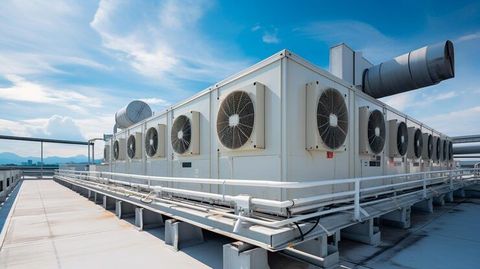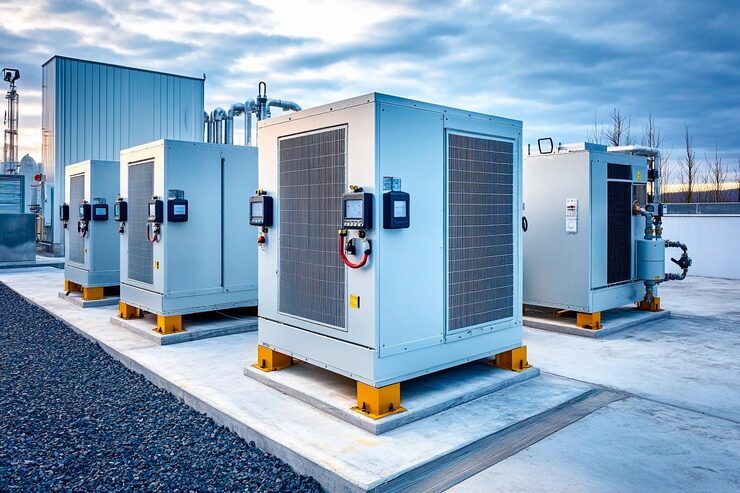
Water-cooled chillers are mechanical cooling systems designed to remove heat from water and produce chilled water for building cooling, industrial processes, and other temperature-control applications. Unlike air-cooled systems, they use water to transfer heat away from the refrigeration cycle.
A typical system contains a compressor, condenser, evaporator, expansion device, condenser-water circuit, chilled-water circuit, and control system. The chilled water circulates through air-handling equipment or process equipment, where it absorbs heat before returning to the chiller.
Water-cooled chillers are commonly found in large commercial buildings, hospitals, hotels, manufacturing facilities, data centers, universities, district cooling networks, and industrial plants.
How Water-Cooled Chillers Work
The cooling cycle generally follows four major stages:
The evaporator absorbs heat from the chilled-water loop.
The compressor raises the pressure and temperature of the refrigerant.
The condenser transfers refrigerant heat into condenser water.
The expansion device reduces refrigerant pressure before the cycle begins again.
The heated condenser water normally travels to a cooling tower, where heat is rejected to the surrounding atmosphere.
This arrangement allows the chiller to concentrate on transferring heat rather than rejecting it directly into outdoor air.
Common Chiller Configurations
Water-cooled chillers can use different compressor technologies and refrigerants. Selection depends on building size, cooling demand, efficiency requirements, climate, available space, and regulatory considerations.
| Chiller Type | Typical Characteristic | Common Application |
|---|---|---|
| Centrifugal | High-capacity continuous cooling | Large buildings and industrial plants |
| Screw | Flexible capacity and compact design | Commercial and industrial facilities |
| Scroll | Smaller capacity configuration | Smaller commercial applications |
| Absorption | Uses heat rather than conventional electric compression | District cooling and facilities with available heat |
Why Water-Cooled Chillers Matter Today
Cooling represents a significant portion of energy consumption in many large buildings and industrial facilities. As global temperatures rise and cooling demand increases, efficient chilled-water systems have become increasingly important.
Water-cooled chillers are particularly relevant to commercial HVAC systems, industrial chillers, central cooling systems, data center cooling, HVAC energy efficiency, and building cooling technology.
Energy Efficiency
Water-cooled systems can achieve strong efficiency under suitable operating conditions because water can transfer heat effectively.
Large installations can also use variable-speed drives, advanced controls, optimized chilled-water temperatures, and cooling-tower coordination to reduce electricity consumption.
Important efficiency measurements include:
COP, or coefficient of performance
EER, or energy efficiency ratio
kW per ton of refrigeration
Integrated part-load value
Seasonal efficiency metrics
Actual performance depends on operating conditions, equipment configuration, water temperature, load profile, maintenance, and control strategy.
Supporting Large Facilities
Large buildings often have changing cooling requirements throughout the day. A central chilled-water plant can coordinate multiple chillers and pumps according to demand.
This approach can help facilities manage peak loads and maintain stable indoor temperatures without operating every chiller at full capacity.
Data Center Cooling
Data centers require continuous thermal management because servers and electrical equipment generate substantial heat.
Water-cooled chillers can form part of a central cooling plant, while newer architectures may combine chilled water with liquid-cooling technologies for high-density computing environments.
Industrial Applications
Manufacturing facilities use chilled water for processes involving temperature-sensitive equipment, production environments, plastics, chemicals, food processing, pharmaceuticals, and other applications.
The required water temperature can vary considerably depending on the industrial process.
Recent Developments in Water-Cooled Chillers
During 2025 and 2026, the cooling industry continued moving toward higher efficiency, lower-emission refrigerants, advanced controls, and integration with building energy systems.
Low-GWP Refrigerant Transition
One of the major global trends is the transition toward refrigerants with lower global warming potential.
The European Union's updated F-Gas Regulation, Regulation (EU) 2024/573, entered into force in March 2024 and establishes a framework for reducing the use and emissions of fluorinated greenhouse gases. Its phased requirements continue to influence refrigeration and cooling equipment during 2025 and 2026.
The United States is also implementing refrigerant-management changes under the American Innovation and Manufacturing Act. The Environmental Protection Agency's Technology Transitions program establishes restrictions on certain high-GWP HFC applications and introduces sector-specific requirements.
These developments encourage manufacturers and facility operators to evaluate refrigerant selection, equipment design, leakage management, and long-term regulatory compatibility.
Smarter Chiller Controls
Modern chillers increasingly use digital controls, sensors, variable-speed drives, and connected monitoring systems.
Control platforms can evaluate:
Chilled-water temperature
Condenser-water temperature
Compressor speed
Pump speed
Cooling-tower performance
Building cooling demand
Energy consumption
Equipment alarms
Advanced control strategies can coordinate multiple pieces of equipment rather than optimizing a chiller in isolation.
AI and Predictive Analytics
Artificial intelligence and machine-learning techniques are increasingly being explored for HVAC optimization.
Data from temperature sensors, pressure measurements, vibration monitoring, electrical consumption, and historical operating conditions can help identify unusual equipment behavior.
Predictive analytics can support earlier investigation of potential problems and help facility teams understand changing performance patterns.
Heat-Recovery Applications
Some modern cooling plants are designed to recover heat rejected by chillers. Recovered heat can potentially support domestic hot-water production, space heating, or industrial processes where suitable temperature requirements exist.
This approach can improve overall energy utilization in facilities that simultaneously require cooling and heating.
Global Laws, Standards and Policies
Water-cooled chillers are influenced by energy-efficiency rules, refrigerant regulations, environmental policies, building standards, and equipment safety requirements.
European Union
The EU's F-Gas Regulation is a major factor in refrigerant selection and equipment planning. The Ecodesign framework also establishes energy-related requirements for certain products and systems.
European facilities may therefore need to consider both refrigerant restrictions and energy-performance requirements when planning cooling-system upgrades.
United States
In the United States, federal refrigerant regulations and energy-efficiency programs influence HVAC equipment selection.
The U.S. Department of Energy establishes energy-conservation standards for certain commercial equipment, while EPA requirements address refrigerants and their environmental impact.
State and local building codes can introduce additional requirements.
United Kingdom
The UK maintains its own framework for fluorinated greenhouse gases following its departure from the European Union. Operators should review current UK requirements alongside building and energy-efficiency regulations applicable to their facilities.
International Standards
International standards also help engineers compare equipment performance and establish testing methods.
Relevant resources can include:
ASHRAE standards and technical guidance
AHRI certification and performance information
ISO standards
IEC standards where electrical equipment requirements apply
Local building and energy codes
Refrigerant-management regulations
Requirements vary by country and equipment configuration, so project teams should verify the rules applicable to the installation location.
Tools and Resources for Water-Cooled Chillers
Engineers and facility teams can use a range of technical tools when designing, evaluating, or monitoring chilled-water plants.
Useful Tools
Chiller sizing calculators: Estimate required cooling capacity from building or process loads.
Psychrometric calculators: Analyze air temperature, humidity, and related properties.
Cooling-load software: Helps estimate building heat loads.
Energy modeling platforms: Compare annual energy performance under different operating conditions.
Chiller performance calculators: Evaluate efficiency at different entering and leaving water temperatures.
BMS platforms: Monitor and control central HVAC equipment.
Thermal imaging cameras: Help identify unusual thermal patterns in equipment and piping.
Flow meters: Measure chilled-water and condenser-water circulation.
Power meters: Track electrical consumption and calculate operating efficiency.
Refrigerant monitoring equipment: Supports leak detection and refrigerant-management activities.
Key Parameters to Monitor
For a large chilled-water plant, useful measurements include:
| Parameter | Why It Matters |
|---|---|
| Chilled-water supply temperature | Indicates cooling delivered to the building |
| Chilled-water return temperature | Helps assess heat absorbed |
| Condenser-water temperature | Influences heat rejection |
| Flow rate | Helps verify hydraulic performance |
| Compressor power | Supports efficiency analysis |
| Cooling capacity | Shows current thermal output |
| COP | Compares cooling output with energy input |
| kW/ton | Useful for plant efficiency tracking |
Regular analysis of these measurements can reveal changes in plant performance and help identify opportunities for optimization.
Frequently Asked Questions
What is a water-cooled chiller?
A water-cooled chiller is a refrigeration system that removes heat from chilled water and transfers that heat to a separate condenser-water circuit. The condenser water commonly rejects the heat through a cooling tower.
Where are water-cooled chillers commonly used?
They are widely used in large commercial buildings, hospitals, hotels, universities, data centers, industrial plants, manufacturing facilities, and district cooling networks.
Are water-cooled chillers energy efficient?
They can provide strong efficiency when correctly sized and operated under suitable conditions. Performance depends on load, water temperatures, equipment design, controls, cooling-tower operation, and maintenance.
What is the difference between water-cooled and air-cooled chillers?
Water-cooled chillers transfer condenser heat to water, which generally moves through a cooling tower. Air-cooled chillers reject heat directly to outdoor air through condenser coils and fans. The appropriate configuration depends on climate, available space, water availability, efficiency objectives, and project requirements.
Why are refrigerants important for modern chillers?
Refrigerants are central to the refrigeration cycle, but some refrigerants have significant environmental impacts. Regulations in regions such as Europe and the United States are encouraging transitions toward refrigerants with lower global warming potential and better environmental characteristics.
Conclusion
Water-cooled chillers remain an important technology for large-scale cooling because they can support substantial building and industrial loads through centralized chilled-water systems.
Their performance depends on more than the chiller itself. Pumps, cooling towers, heat exchangers, controls, sensors, water temperatures, and building demand all influence the overall cooling-plant efficiency.
Recent developments are increasingly focused on low-GWP refrigerants, digital monitoring, variable-speed operation, advanced controls, heat recovery, and data-driven optimization. These trends are particularly relevant as cooling demand grows and energy-efficiency requirements become more stringent in major markets.
For organizations researching water-cooled chiller systems, industrial cooling equipment, commercial HVAC technology, or high-efficiency chiller plants, important evaluation factors include cooling capacity, compressor technology, refrigerant type, efficiency at part load, water requirements, controls, maintenance needs, applicable standards, and long-term regulatory direction.
The global direction of the industry is toward cooling systems that use energy more effectively, provide better operational visibility, and reduce environmental impact while maintaining dependable temperature control.