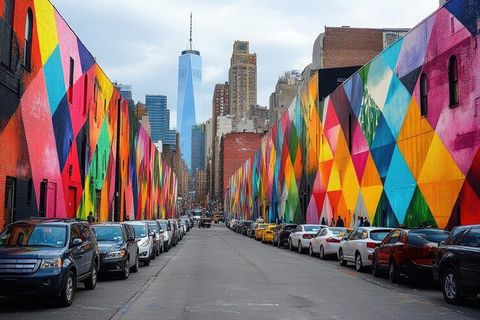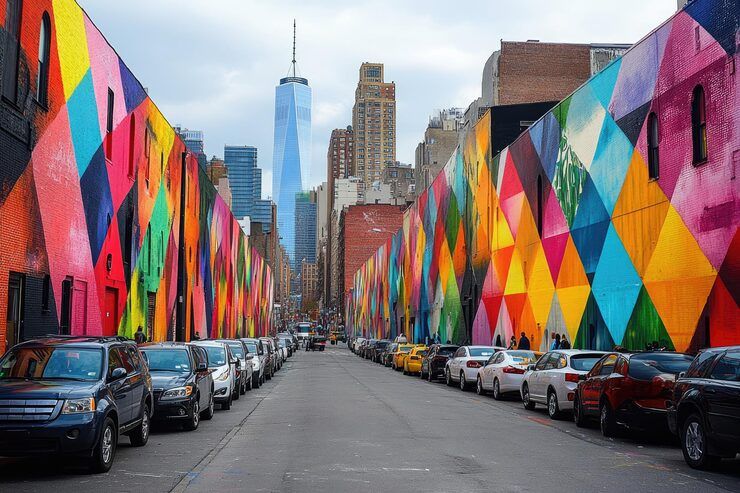
New York City has one of the world's largest and most diverse art landscapes. Its galleries, museums, artist studios, public artworks, cultural organizations, performance spaces, and independent creative communities are spread across all five boroughs.
Rather than being concentrated in one location, New York's art scene has developed through distinct neighborhoods. Chelsea is strongly associated with contemporary galleries, the Lower East Side with experimental and independent spaces, SoHo with its historic relationship to artists and lofts, Bushwick with murals and artist studios, and DUMBO with galleries and public art.
Harlem has a long history of African American cultural production, while Queens and the Bronx contain important museums, community arts organizations, murals, and artist-led initiatives.
The result is an urban art network where commercial galleries, nonprofit institutions, public projects, neighborhood organizations, and artists operate alongside one another.
Major New York City Art Districts
| District | Main Art Characteristics | Typical Experience |
|---|---|---|
| Chelsea | Contemporary galleries and large exhibitions | Gallery walking |
| Lower East Side | Independent galleries and experimental art | Small-space exploration |
| SoHo | Historic loft architecture and galleries | Art and architecture |
| Bushwick | Murals, studios and artist-led spaces | Street art and neighborhood walks |
| DUMBO | Galleries, photography and public art | Waterfront art walk |
| Harlem | African American art and cultural history | Museums and community culture |
| Long Island City | Museums, studios and contemporary art | Institutional and studio art |
| The Bronx | Public art, museums and community projects | Neighborhood-focused culture |
Why New York City's Art Districts Matter
Art districts are important because they connect creative activity with urban neighborhoods.
They provide places where artists can exhibit work, cultural organizations can develop programs, and visitors can encounter different forms of art outside traditional museum settings.
The districts also reflect changes in New York's urban history. Former industrial buildings have become studios and galleries, while warehouses, storefronts, public plazas, and transportation infrastructure have been adapted for cultural activity.
For visitors, art districts can provide a different way to understand New York. Instead of visiting only major museums, travelers can explore streets where architecture, murals, galleries, public sculpture, and local history appear together.
What Visitors Can Explore
A New York art itinerary can include:
- Contemporary painting and sculpture
- Photography exhibitions
- Digital and multimedia art
- Street murals
- Public sculpture
- Artist studios
- Community art projects
- Historic galleries
- Architecture connected with artists
- Cultural festivals
- Museum exhibitions
- Performance and interdisciplinary projects
The city's Department of Cultural Affairs supports cultural activity throughout all five boroughs, including visual arts, performing arts, humanities, and public-oriented cultural institutions.
Art Districts and Urban Identity
Art districts can also contribute to neighborhood identity. Their development, however, is not static.
Rents, zoning changes, redevelopment, transportation projects, changing gallery patterns, and broader economic conditions can influence where artists and galleries operate.
This is why New York's art geography has shifted over several decades. SoHo was once strongly associated with artist lofts, while Chelsea later became a major contemporary gallery center. Bushwick subsequently developed a significant artist-studio and mural culture.
The city's present art landscape therefore reflects both cultural history and ongoing urban change.
Recent Developments in New York's Art Scene
New York City's cultural landscape continued to change during 2025 and 2026, with public-art projects, cultural grants, neighborhood initiatives, and new installations appearing across the five boroughs.
Major Cultural Funding in 2026
On February 26, 2026, the NYC Department of Cultural Affairs announced $74.3 million in Cultural Development Fund grants for 1,171 cultural organizations across the city.
The FY2026 allocation was described by the city as the largest Cultural Development Fund allocation to that point and supported publicly accessible cultural programming across disciplines and boroughs.
The scale of this program demonstrates that New York's cultural infrastructure extends well beyond Manhattan's most recognizable gallery districts.
Queens Arts Fund
On April 8, 2026, the Department of Cultural Affairs and New York Foundation for the Arts announced $493,350 for 129 Queens-based artists, artist collectives, and small nonprofit organizations through the Queens Arts Fund.
The program supports artistic activity across disciplines and highlights the importance of Queens within New York's broader art landscape.
Public Art and the 2026 World Cup
In July 2026, New York City announced a project involving 12 community-designed murals in parks across all five boroughs connected with the 2026 FIFA World Cup.
The project was developed through a partnership involving Groundswell Community Mural Project, NYC Parks, the Department of Cultural Affairs, and the Department of Youth and Community Development.
The project demonstrates how major public events can become opportunities for neighborhood-based art and community participation.
New Public Art Installations
In January 2026, the Department of Cultural Affairs and the NYC School Construction Authority highlighted five permanent public-art installations completed in public schools during 2025 across the Bronx, Queens, and Staten Island.
These installations show that New York's public-art landscape is not limited to traditional gallery districts.
Recent Cultural Developments
| Development | Date | Significance |
|---|---|---|
| FY2026 Cultural Development Fund | February 2026 | $74.3 million for 1,171 organizations |
| Queens Arts Fund | April 2026 | 129 Queens recipients |
| Community mural initiative | July 2026 | 12 murals across five boroughs |
| Public school artworks | January 2026 | Five permanent installations |
| 2025–26 Public Artists in Residence | April 2025 | Artists working with city agencies |
In April 2025, New York City also announced the next cohort of its Public Artists in Residence program, connecting artists with municipal agencies to develop creative approaches to civic challenges.
Laws, Zoning and Cultural Policies
New York City's art districts are affected by zoning regulations, landmark protections, building rules, public-space requirements, and cultural programs.
SoHo and NoHo Zoning
SoHo and NoHo are particularly important examples because their history is closely connected with artist lofts and adaptive reuse.
New York City's Zoning Resolution contains special rules for the SoHo-NoHo area, including provisions concerning an arts fund. The zoning framework requires the Department of Cultural Affairs to report annually on funds deposited into the SoHo-NoHo Arts Fund and their expenditure.
These regulations reflect the relationship between cultural activity and real-estate development in historic neighborhoods.
Landmark Preservation
New York City's Landmarks Preservation Commission regulates designated landmarks and historic districts.
In protected areas, exterior alterations, demolitions, and certain construction activities may require approval.
For art districts, landmark regulations can affect gallery façades, historic industrial buildings, storefronts, signage, and architectural modifications.
This helps preserve historic streetscapes while allowing carefully reviewed changes.
Percent for Art
New York City's Percent for Art program has operated since 1982. The law requires one percent of the budget for eligible City-funded construction projects to be spent on public artwork.
The program has commissioned works using media including sculpture, mosaic, glass, textiles, lighting, painting, and technology.
Public art created through this program can appear in civic buildings, transportation-related infrastructure, schools, plazas, and other public locations throughout the five boroughs.
Public Art in City Spaces
Artwork installed on City-owned property generally goes through established review and approval processes.
The Public Design Commission explains that artwork commissioned through Percent for Art involves the sponsoring City agency, the Percent for Art program, artist selection procedures, and Commission review.
For photographers and visitors, these policies help explain why public artworks may appear in unexpected places rather than only inside museums.
Tools and Resources for Exploring NYC Art Districts
Digital resources can help visitors build an art-focused itinerary.
NYC Department of Cultural Affairs
The Department of Cultural Affairs website provides information about cultural funding, public art, artists, cultural organizations, and citywide programs. It also provides access to historical funding data through NYC Open Data.
Percent for Art Database
The city's Percent for Art resources can help visitors discover permanent public artworks located throughout New York.
The collection includes works integrated into architecture and infrastructure as well as conventional sculpture and other artistic formats.
Digital Maps
Mapping applications are useful when planning gallery walks. Visitors can create routes around:
- Chelsea galleries
- Lower East Side exhibition spaces
- SoHo architecture
- Bushwick murals
- DUMBO galleries
- Harlem cultural institutions
- Long Island City museums
Checking opening hours is important because galleries may have different schedules from museums.
NYC Open Data
NYC Open Data provides datasets that can help researchers explore cultural institutions, public spaces, city projects, and other urban information.
Researchers can combine these datasets with maps to study how cultural activity is distributed across the five boroughs.
Gallery Visit Checklist
Before planning an art-district walk, consider:
- Check gallery opening hours.
- Review current exhibition dates.
- Confirm whether an exhibition requires advance entry arrangements.
- Map several nearby locations together.
- Check public transportation.
- Allow time for walking between galleries.
- Review photography rules.
- Check museum or gallery accessibility information.
- Look for public art along the route.
Frequently Asked Questions
What are the main art districts in New York City?
Chelsea, the Lower East Side, SoHo, Bushwick, DUMBO, Harlem, Long Island City, and parts of the Bronx are among the city's important art areas. Each has a different combination of galleries, museums, murals, artist spaces, public art, and cultural history.
Is Chelsea still an important art district?
Yes. Chelsea remains one of New York's major concentrations of contemporary galleries and exhibition spaces. Its gallery landscape includes large commercial spaces as well as smaller organizations and changing exhibitions.
Where can visitors see street art in New York?
Bushwick is particularly associated with murals and street art, while public artworks can be found throughout the five boroughs. City-supported projects also place permanent and temporary artworks in parks, schools, civic buildings, and other public spaces.
Are New York galleries concentrated in Manhattan?
No. Manhattan contains major concentrations in Chelsea, the Lower East Side, SoHo, and other areas, but Queens, Brooklyn, the Bronx, and Staten Island also have important cultural organizations and artist communities.
Can visitors photograph artwork in New York galleries?
Rules vary by institution and exhibition. Some galleries permit personal photography, while others restrict photography because of copyright, artist preferences, conservation concerns, or exhibition policies. Visitors should follow the specific rules displayed at each location.
Conclusion
New York City's art districts form a broad cultural network rather than a single neighborhood. Chelsea, the Lower East Side, SoHo, Bushwick, DUMBO, Harlem, Queens, and the Bronx each contribute different histories and artistic traditions.
Recent developments in 2025 and 2026 show continued cultural activity across the city. The Department of Cultural Affairs distributed $74.3 million through its FY2026 Cultural Development Fund, while Queens received targeted support through the Queens Arts Fund and public-art projects expanded across the five boroughs.
The city's policies also demonstrate that art is connected with urban planning. Zoning rules influence historic art districts, landmark regulations protect significant buildings, and Percent for Art integrates artwork into eligible City-funded construction projects.
For visitors, exploring New York's art districts is therefore more than a gallery itinerary. It provides an opportunity to see how art, architecture, neighborhood history, public space, and community culture interact across one of the world's largest cities.