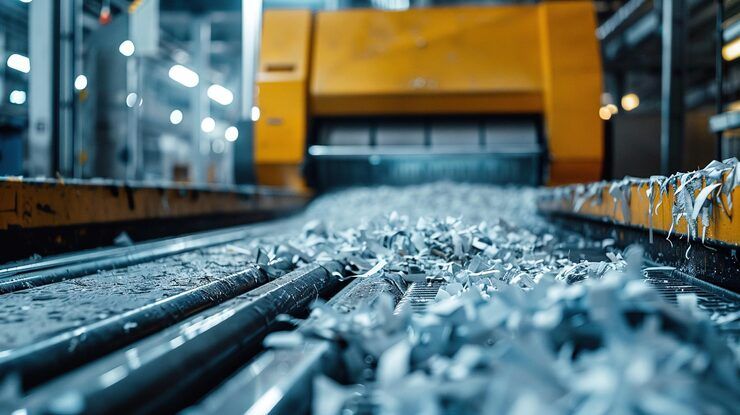
Glass crushing machines are industrial or commercial machines designed to reduce discarded glass into smaller pieces. Depending on the machine configuration, the output can range from coarse fragments to relatively fine glass cullet.
Glass crushing supports material recovery by reducing the volume of discarded glass and preparing it for further processing. Crushed glass can potentially be used as a secondary raw material in glass manufacturing and other applications, provided it meets the required quality specifications.
The equipment used for this purpose ranges from compact bottle crushers to larger industrial glass pulverizers and hammer mills.
How Glass Crushing Works
A typical glass-crushing process involves feeding glass into a controlled crushing chamber. Mechanical force then breaks the glass into smaller pieces.
Different machines use different crushing mechanisms:
Jaw crushing
Hammer crushing
Impact crushing
Roller crushing
Pulverization
Specialized bottle-crushing systems
The appropriate technology depends on the type of glass, required particle size, contamination level, throughput, and intended downstream application.
Main Types of Glass Crushers
Jaw crushers use compressive force between two surfaces and can handle relatively coarse material.
Hammer mills use rapidly moving hammers to break glass into smaller particles and can be configured for different output sizes.
Impact crushers accelerate material against an impact surface and are useful when more controlled particle reduction is required.
Roller crushers pass glass between rotating rollers, allowing controlled reduction.
Glass pulverizers are designed for finer particle sizes and can be useful when crushed glass is intended for specialized applications.
| Machine Type | Crushing Principle | Typical Application |
|---|---|---|
| Jaw crusher | Compression | Coarse glass fragments |
| Hammer mill | Impact | General glass reduction |
| Impact crusher | Impact | Controlled particle reduction |
| Roller crusher | Compression | Uniform reduction |
| Pulverizer | Fine impact/grinding | Fine glass particles |
| Bottle crusher | Specialized crushing | Hospitality and collection points |
Why Glass Crushing Machines Matter Today
Glass is a recyclable material that can be processed repeatedly without fundamentally losing its glass-making properties. However, collection, transportation, sorting, contamination, and particle-size control can influence the effectiveness of recycling systems.
Glass crushing machines help prepare collected material for subsequent handling and processing.
Reducing Material Volume
Whole bottles and other glass containers occupy considerably more space than crushed glass. Crushing can therefore reduce the physical volume that needs to be stored or transported.
This can make material handling more organized in facilities that process substantial quantities of discarded glass.
Preparing Glass Cullet
Cullet is recycled glass that can be used as a raw material in glass manufacturing. Properly processed cullet needs suitable particle characteristics and contamination control.
Depending on the application, recycled glass may require additional sorting, cleaning, screening, and removal of unwanted materials.
Applications of Crushed Glass
Processed glass can be used in several areas, depending on quality and particle specifications:
Glass manufacturing
Aggregate applications
Construction materials
Landscaping materials
Abrasive media
Filtration applications
Decorative applications
Road and infrastructure materials
Foam-glass production
The suitability of crushed glass depends on particle size, glass type, contamination, and applicable technical specifications.
Recent Developments in Glass Recycling
Glass recycling continued to receive attention during 2025 and 2026 as governments and industry groups focused on circular-economy systems, packaging waste, recycled content, and resource efficiency.
European Packaging Regulation
The European Union's Packaging and Packaging Waste Regulation, Regulation (EU) 2025/40, entered into force on February 11, 2025. The regulation establishes requirements intended to reduce packaging waste and improve packaging sustainability and circularity.
Glass beverage and food containers are part of the wider packaging system affected by changes in European packaging policy. Increased attention to packaging recovery can influence collection, sorting, and glass-processing infrastructure.
Recycling and Circular Economy
The European Commission's broader circular-economy framework continues to emphasize keeping materials in productive use and reducing waste generation.
For glass, this supports systems in which discarded containers are collected, sorted, processed into cullet, and returned to manufacturing or other suitable applications.
Automation and Sorting
Modern glass recycling facilities increasingly combine crushing with mechanical screening, magnetic separation, optical sorting, and contamination removal.
Although a glass crusher performs the size-reduction stage, the overall recycling process can include several other technologies.
Common developments include:
Automated sorting
Optical contamination detection
Particle-size screening
Dust-control systems
Automated conveying
Digital machine monitoring
Energy-efficiency improvements
India and Waste Management
India's waste-management framework continues to develop around resource recovery and circular-economy principles. The Central Pollution Control Board provides guidance and regulatory resources related to solid waste management, plastic waste, and other material streams.
Glass crushing can form part of a broader material-recovery operation, but the applicable regulatory requirements depend on the facility, waste category, location, and processing activity.
Laws, Regulations and Policies in India
India provides a useful regulatory example because glass-crushing operations can be affected by environmental approvals, waste-management rules, worker safety requirements, air-emission controls, and local industrial regulations.
Solid Waste Management
The Solid Waste Management Rules, 2016 provide a framework for managing municipal solid waste in India. The framework covers segregation, collection, transportation, processing, treatment, and disposal.
Glass collected as part of municipal or commercial waste can enter a material-recovery system where it is sorted and processed.
The Ministry of Environment, Forest and Climate Change and the Central Pollution Control Board provide regulatory information relating to solid waste management.
Environmental Permissions
The requirements for a glass-crushing facility can vary according to its size, location, waste source, equipment, emissions, and operational characteristics.
Potential areas for regulatory review include:
State Pollution Control Board requirements
Air-emission controls
Dust management
Noise management
Waste handling
Worker safety
Storage of processed material
Water use and wastewater management
A facility should determine its applicable permissions and conditions before beginning operations rather than assuming that a small crusher has the same regulatory requirements as a large recycling plant.
Occupational Safety
Glass crushing creates sharp fragments and potentially airborne particulate matter. Appropriate engineering controls and personal protective equipment are therefore important.
Common controls can include:
Enclosed crushing chambers
Dust extraction
Machine guarding
Emergency stopping systems
Protective eyewear
Cut-resistant gloves
Safety footwear
Hearing protection
Controlled access around machinery
The precise workplace requirements depend on the facility and applicable Indian occupational-safety framework.
Tools and Resources for Glass Crushing
Selecting a glass-crushing machine requires consideration of material type, particle size, production quantity, contamination, and downstream use.
Useful Tools
Particle-size screens: Separate crushed glass into specified size ranges.
Material-flow calculators: Estimate required processing capacity.
Conveyor calculators: Help determine material-handling requirements.
Dust-monitoring equipment: Helps evaluate airborne particulate conditions.
Noise meters: Measure sound levels around crushing equipment.
Magnetic separators: Remove ferrous contaminants from mixed material streams.
Optical sorting systems: Identify and separate selected materials or colors.
Moisture meters: Useful where moisture affects material handling.
Digital weighing systems: Track incoming and processed material quantities.
CAD software: Helps plan crusher layouts and material-flow arrangements.
CPCB resources: Provide Indian environmental and waste-management information.
BIS standards resources: Help identify applicable technical standards.
Important Machine Specifications
When researching industrial glass crushing machines, useful specifications include:
Feed opening dimensions
Maximum feed size
Output particle size
Processing capacity
Motor power
Crushing mechanism
Dust-control configuration
Noise characteristics
Machine dimensions
Feed-system design
Screening capability
Safety controls
Maintenance requirements
Capacity should be evaluated using the actual glass stream rather than only the manufacturer's theoretical maximum. Bottle shape, contamination, moisture, glass thickness, feeding method, and desired output size can influence real-world throughput.
Frequently Asked Questions
What is a glass crushing machine?
A glass crushing machine is equipment designed to break discarded glass into smaller particles or fragments. It can be used in recycling facilities, material-recovery operations, manufacturing environments, and selected commercial applications.
What types of glass can be crushed?
Many machines can process container glass such as bottles and jars. Other glass types may require specialized equipment because laminated glass, tempered glass, mirrors, ceramics, and certain technical glasses can have different processing characteristics.
What is glass cullet?
Glass cullet is processed recycled glass that can be used as a raw material, particularly in glass manufacturing. It normally needs appropriate sorting and contamination control before being introduced into a specific production process.
Is glass crushing hazardous?
Glass crushing can create sharp fragments, noise, mechanical hazards, and airborne particulate matter. Proper machine guarding, dust control, operator training, protective equipment, and safe material-handling procedures are important.
What determines glass crusher capacity?
Capacity depends on the crusher design, glass type, feed size, desired output size, feeding method, motor configuration, contamination, and operating conditions. Actual throughput can therefore differ from the machine's rated maximum.
Conclusion
Glass crushing machines form an important part of material-recovery and recycling operations by reducing discarded glass into manageable particles that can be sorted, transported, and processed further.
The technology ranges from compact bottle crushers to industrial jaw crushers, hammer mills, impact systems, roller crushers, and pulverizers. The appropriate equipment depends on the type of glass and the particle characteristics required for the next stage.
Recent packaging policies, particularly the European Union's Packaging and Packaging Waste Regulation that entered into force in February 2025, demonstrate the continuing international focus on packaging recovery, waste reduction, and circular material use.
In India, glass-crushing facilities may need to consider solid-waste regulations, pollution-control requirements, dust management, workplace safety, and local permissions. The exact requirements depend on the facility and its operating conditions.
For anyone researching industrial glass crushers, glass recycling machines, or glass crushing equipment, the most important factors are feed material, particle-size requirements, processing capacity, dust control, screening, safety, maintenance, and downstream material specifications.
As recycling systems become more automated, glass crushing is increasingly being integrated with sorting, screening, contamination removal, digital monitoring, and material-recovery technologies. This broader approach can help transform discarded glass from a waste stream into a controlled secondary material for suitable industrial applications.