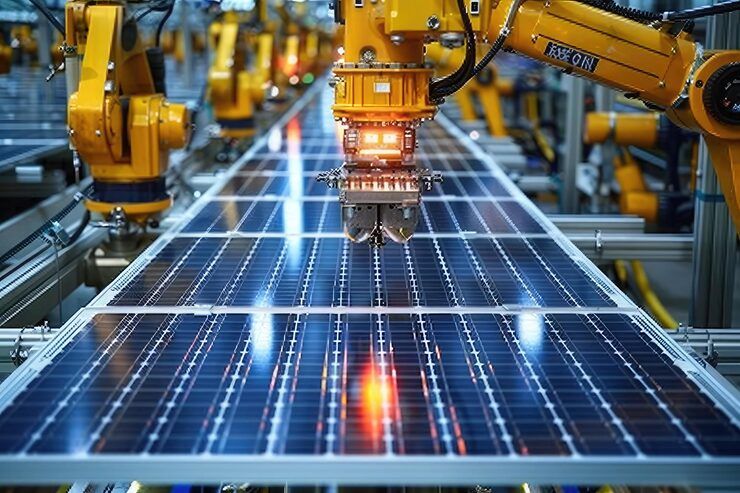
Solar manufacturing equipment includes the machines, systems, testing tools, and production technologies used to turn raw materials into photovoltaic (PV) cells and finished solar modules. A modern solar panel production line may include equipment for wafer processing, cell formation, interconnection, lamination, framing, inspection, and performance testing.
Understanding solar manufacturing equipment helps readers see how solar panels move through different production stages. The equipment selected for each stage depends on the solar technology, factory design, production capacity, quality requirements, automation level, and applicable regulations.
Context
Solar panel manufacturing is part of a wider photovoltaic supply chain. The main stages can include polysilicon production, ingot growth, wafer slicing, solar cell manufacturing, and module assembly. The International Energy Agency describes these as five major segments of the PV manufacturing process.
At the wafer stage, specialized systems shape semiconductor material into thin wafers. Cell manufacturing then uses processes such as surface texturing, diffusion, deposition, metallization, and firing to create the electrical characteristics required for photovoltaic cells.
Module assembly combines individual cells into larger panels. Common equipment includes cell stringers, layup systems, tabbing and interconnection equipment, laminators, framing systems, junction-box equipment, and inspection instruments.
| Manufacturing stage | Common equipment | Main purpose |
|---|---|---|
| Polysilicon | Deposition reactors, purification systems | Produce high-purity silicon |
| Ingot production | Crystal-growth furnaces | Form silicon ingots |
| Wafer production | Wire saws, cleaning systems | Slice and prepare wafers |
| Cell production | Diffusion, coating, printing systems | Form photovoltaic cells |
| Cell inspection | EL and optical inspection | Identify defects |
| Module assembly | Stringers, layup systems | Connect cells into modules |
| Encapsulation | Laminators | Seal and protect module layers |
| Final testing | IV testers, insulation testers | Check electrical performance and safety |
The exact equipment configuration changes as cell architectures and module designs develop.
Importance
Solar manufacturing equipment affects production quality, consistency, energy use, material efficiency, and factory throughput. Accurate process control is particularly important because small variations in temperature, pressure, coating thickness, alignment, or electrical characteristics can influence the final photovoltaic product.
Equipment also affects different groups across the solar sector:
- Manufacturers depend on controlled production processes.
- Engineers use measurement and automation systems to monitor production.
- Quality teams inspect cells and modules for defects.
- Regulators establish requirements related to safety and environmental protection.
- Researchers develop new production methods and cell architectures.
- Solar project developers depend on consistent technical specifications when selecting modules.
Automation has become an important part of modern PV production. The IEA notes that automation and automated guided vehicles have increased productivity in solar PV manufacturing while changing the amount and type of labor required across production stages.
Recent Updates
Solar manufacturing is changing as manufacturers introduce higher-efficiency cell architectures and increasingly automated production lines. Current developments include larger wafer formats, advanced metallization, improved cell interconnection, automated optical inspection, machine-vision systems, and greater use of data monitoring.
The IEA's 2026 analysis reports that China continues to have the largest manufacturing capacity across major solar PV supply-chain stages, while industrial policies in countries such as India and the United States are supporting greater domestic production. The same analysis identifies supply-chain concentration as an ongoing resilience issue.
Manufacturing project pipelines are also being closely monitored. An IEA dataset updated in March 2026 tracks announced solar PV module manufacturing capacity through 2030 and distinguishes between committed and preliminary projects.
Another important development is greater attention to inspection and traceability. Automated electroluminescence imaging, optical inspection, electrical testing, and production data systems can help identify defects earlier in the manufacturing process.
Energy efficiency is also receiving attention. Upstream PV manufacturing can require substantial electricity and high-temperature processing, particularly during polysilicon, ingot, and wafer production.
Laws or Policies
Solar manufacturing facilities must follow the rules applicable to their location, technology, workplace, environmental processes, electrical equipment, and industrial operations. Requirements can differ considerably between countries and even between regions within a country.
In India, the Ministry of New and Renewable Energy implements the Production Linked Incentive scheme for high-efficiency solar PV modules. The programme has an overall outlay of ₹24,000 crore and is intended to develop large-scale domestic manufacturing capacity and a broader PV manufacturing ecosystem.
In the European Union, the Net-Zero Industry Act has entered its implementation phase and includes solar PV among the clean technologies covered by its industrial framework. The IEA's 2026 analysis notes that the EU framework is intended to strengthen domestic clean-technology manufacturing, although implementation and investment conditions remain important factors.
In the United States and other markets, manufacturers may also need to consider environmental permits, worker protection rules, electrical requirements, import and trade rules, and documentation relating to supply-chain traceability.
Because regulations change, manufacturers should consult the relevant national authorities and current technical standards before establishing or modifying a production facility.
Tools and Resources
Several resources can help readers understand solar manufacturing equipment and production processes:
- IEA reports provide information about global PV supply chains and manufacturing trends.
- National renewable-energy agencies publish technical research and manufacturing guidance.
- Government energy departments provide information about domestic manufacturing programmes.
- Standards organizations publish technical requirements for electrical and photovoltaic equipment.
- Factory monitoring systems can track temperature, pressure, production rates, defects, and equipment performance.
- Process calculators and engineering software can help analyze material usage, energy requirements, production capacity, and equipment layouts.
For beginners, it is useful to study the manufacturing process from silicon through module assembly rather than examining individual machines in isolation. This provides a clearer understanding of how each equipment category contributes to the complete production sequence.
FAQs
What equipment is used to make solar panels?
Common equipment includes wafer-processing systems, cell-processing equipment, cell stringers, layup systems, laminators, framing equipment, junction-box systems, electroluminescence inspection equipment, and electrical testing systems.
What is the difference between solar cell and module equipment?
Solar cell equipment creates the photovoltaic cells and controls their electrical properties. Module equipment connects multiple cells and encapsulates them into a finished panel with protective layers, framing, and electrical connections.
Why is inspection equipment important?
Inspection equipment helps identify cracks, alignment problems, electrical irregularities, coating defects, and other manufacturing issues. Methods can include optical inspection, electroluminescence imaging, and electrical performance testing.
Are solar manufacturing lines fully automated?
Automation levels vary. Large industrial facilities can use automated material handling, machine vision, robotic systems, process controls, and automated testing, while other facilities may use a combination of automated and manually supervised processes.
Which factors influence equipment selection?
Important factors include the solar cell technology, module design, planned production capacity, factory layout, automation requirements, energy use, material handling, quality controls, maintenance requirements, and applicable regulations.
Conclusion
Solar manufacturing equipment forms the technical foundation of photovoltaic production, from silicon and wafers to cells and completed modules. Each production stage requires specialized machinery and measurement systems to maintain process consistency and product quality.
Recent developments are emphasizing automation, higher-efficiency cell architectures, advanced inspection, data monitoring, and supply-chain diversification. Government programmes and industrial policies are also influencing where new manufacturing capacity is developed.
Understanding the complete production sequence makes it easier to evaluate the role of individual machines. It also provides useful background for readers researching solar technology, manufacturing processes, equipment categories, and current PV industry developments.