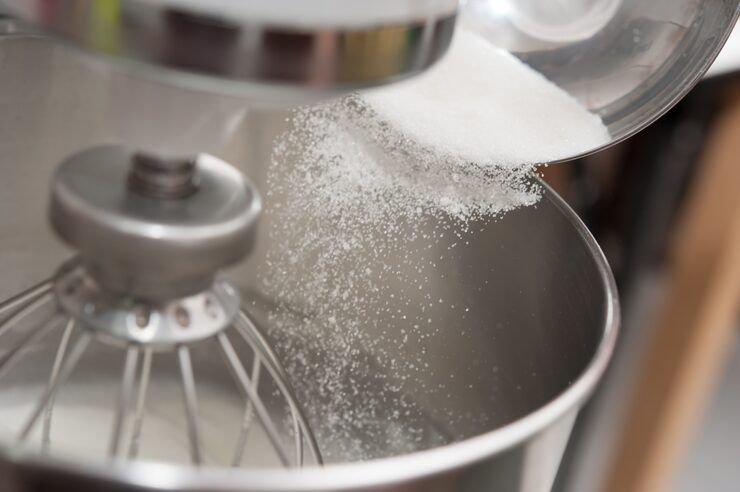
Sugar grinding machines are industrial food-processing systems designed to reduce granulated sugar crystals into finer particles or powdered sugar. They are used in bakeries, confectionery production, beverage manufacturing, food ingredient processing, and other industries that require consistent sugar particle sizes.
The equipment ranges from compact grinders used for small production batches to industrial milling systems designed for continuous processing. Depending on the machine design, sugar can be processed into coarse granules, fine powder, or specific particle-size grades suitable for different recipes and manufacturing processes.
Grinding sugar requires careful control of particle size, temperature, moisture, hygiene, and dust generation. These factors influence product consistency, machine performance, storage stability, and workplace safety.
Understanding Sugar Grinding Equipment
Sugar grinding machines use mechanical force to break sugar crystals into smaller particles. The exact method depends on the equipment design, required output, production capacity, and characteristics of the incoming sugar.
Common types of sugar grinding equipment include:
Hammer mills: Use rapidly rotating hammers to break sugar crystals into smaller particles.
Pin mills: Use rotating pins to achieve finer particle reduction in suitable applications.
Impact pulverizers: Reduce particle size through repeated impacts inside a grinding chamber.
Roller mills: Process material between rollers and are used in selected particle-reduction applications.
Air-classifying mills: Combine grinding with classification to help control the particle-size distribution.
Sieving systems: Separate processed sugar according to particle size.
Some production lines combine multiple machines to achieve the required output. The most suitable arrangement depends on whether the manufacturer needs ordinary powdered sugar, very fine sugar powder, or a tightly controlled particle-size range.
How Sugar Grinding Works
A typical sugar grinding process begins with the inspection and preparation of granulated sugar. The material must be sufficiently dry and suitable for the selected equipment.
The main processing stages include:
Feeding: Sugar enters the grinding chamber through a controlled feeding mechanism.
Size reduction: Rotating components or impact mechanisms break the crystals into smaller particles.
Classification: Screens or air-classification systems separate particles according to the required size range.
Collection: The finished powder is transferred into suitable containers or downstream processing equipment.
Quality inspection: Operators assess particle size, moisture, contamination, and other relevant specifications.
The finished powder may then be incorporated into icing, confectionery, chocolate-related products, dessert mixes, or other food formulations.
Why Sugar Grinding Machines Matter
Sugar grinding equipment supports consistent ingredient preparation across the food manufacturing industry. Particle size affects how sugar blends with other ingredients, dissolves in liquids, and behaves during mixing, coating, and finishing.
Product Quality and Consistency
Powdered sugar is used in products where fine texture and even distribution are important. A controlled grinding process helps manufacturers achieve repeatable results across production batches.
Particle size can influence:
Dissolution speed in beverages and liquid mixtures
Texture in icing and confectionery
Ingredient blending and distribution
Surface finishing for baked products
Flow characteristics during packaging
Consistency in industrial food formulations
The ideal particle size depends on the recipe and intended application. Extremely fine powder is not necessarily appropriate for every product.
Production Efficiency
Industrial sugar milling equipment can process larger quantities than manual methods and integrate with automated production lines. Controlled feeding, particle classification, and dust collection can also reduce unnecessary material handling.
However, overall efficiency depends on machine capacity, sugar characteristics, operating conditions, energy consumption, and maintenance practices.
Choosing Suitable Equipment
Manufacturers evaluating industrial sugar grinders should consider several technical factors:
Required output in kilograms or tonnes per hour
Target particle size and acceptable variation
Moisture content of incoming sugar
Cleaning and sanitation requirements
Compatibility with downstream equipment
Electricity consumption
Dust extraction and explosion protection
Maintenance access and replacement components
A complete assessment should include the entire production line rather than focusing only on the grinder's advertised capacity.
Recent Developments in Sugar Grinding Technology
Developments during 2025 and 2026 reflect broader changes in food-processing machinery, including improved automation, energy monitoring, hygienic equipment design, and industrial dust management.
Automation and Process Monitoring
Modern food-processing facilities increasingly use sensors and automated controls to monitor feeding rates, motor loads, operating temperatures, and production conditions.
When applied to sugar grinding, these systems can help operators identify irregular feeding, excessive vibration, and changes in machine performance. Monitoring does not eliminate the need for inspection, but it can support more consistent operation.
Particle-Size Control
Manufacturers increasingly focus on matching particle size to the needs of individual food applications. Adjustable grinding settings, screening arrangements, and air-classification systems can help produce specific particle-size distributions.
The final result still depends on the incoming sugar, machine configuration, and operating conditions. Production trials and laboratory measurements remain important when a precise specification is required.
Dust Collection and Energy Efficiency
Sugar dust management continues to be an important consideration in industrial processing. Improved extraction systems, enclosed material transfer, and efficient motors can support cleaner production environments and better energy management.
There is no single technology that suits every facility. Equipment selection should reflect actual throughput, building layout, sanitation requirements, and the site's risk assessment.
Laws, Food Safety, and Industrial Policies
Sugar grinding facilities must comply with the food safety, workplace safety, machinery, and environmental requirements applicable in their jurisdiction.
Food Safety Requirements
In the United States, the Food and Drug Administration's current good manufacturing practice regulations under 21 CFR Part 117 establish requirements for relevant food manufacturing activities, including sanitary operations, equipment maintenance, and preventive controls where applicable.
Grinding equipment used in food production should be designed and maintained to minimize contamination risks. Appropriate measures may include food-contact-compatible materials, accessible cleaning points, controlled handling, and documented sanitation procedures.
Food Processing Regulations in India
In India, food businesses are subject to applicable provisions of the Food Safety and Standards Act, 2006, and associated regulations administered by the Food Safety and Standards Authority of India.
Requirements can include hygiene practices, food-contact equipment suitability, contamination prevention, and applicable licensing or registration obligations.
Businesses should confirm which requirements apply to their specific operation with the relevant food safety authority.
Industrial Dust and Fire Safety
Fine sugar dust can create a combustible dust hazard when suspended in air at sufficient concentration and exposed to an ignition source.
Facilities should assess dust accumulation, ventilation, extraction systems, electrical equipment, static electricity, and potential ignition sources.
Depending on the jurisdiction and facility, applicable occupational safety rules and recognized combustible-dust standards may influence equipment design and installation. Appropriate safeguards can include dust collection, grounding and bonding, suitable electrical equipment, housekeeping procedures, and engineered explosion protection where required.
Tools and Resources for Sugar Grinding Operations
Several technical resources can help manufacturers assess equipment performance, production requirements, and compliance.
Equipment Specifications
Machine documentation should identify:
Motor power and electrical requirements
Rated throughput under specified conditions
Supported particle-size ranges
Permitted feed materials
Cleaning procedures
Wear-part replacement intervals
Dust extraction requirements
Safety features and operating limits
Actual production capacity may differ from rated capacity depending on sugar characteristics and the required fineness.
Particle-Size Measurement
Particle-size analysis helps determine whether ground sugar meets the intended specification. Sieve analysis can be suitable for many particle ranges, while laser diffraction may be used when finer measurements or more detailed distributions are needed.
Moisture testing can also help identify conditions that contribute to clumping or poor powder flow.
Production Monitoring
A basic production spreadsheet can track output, operating hours, energy consumption, rejected batches, maintenance activities, and cleaning records.
Performance Measure | What It Indicates |
|---|---|
Throughput | Quantity processed per unit of time |
Energy per tonne | Electricity used relative to production |
Particle-size distribution | Consistency of the finished powder |
Moisture level | Potential influence on flow and storage |
Downtime | Time lost to stoppages or maintenance |
Rejected batches | Material that does not meet specifications |
These measurements help identify trends and support maintenance planning without relying solely on manufacturer estimates.
Frequently Asked Questions
What is a sugar grinding machine used for?
It reduces granulated sugar into smaller particles or powdered sugar for applications such as baking, confectionery, dessert preparation, and industrial food manufacturing.
Which machine is suitable for producing fine powdered sugar?
Hammer mills, pin mills, impact pulverizers, and air-classifying mills can be suitable, depending on the required particle size, production capacity, and product specifications. Testing may be necessary to identify the appropriate configuration.
Why is moisture control important during sugar grinding?
Excess moisture can encourage clumping, reduce powder flow, and affect processing consistency. Appropriate storage, controlled material handling, and suitable operating conditions help maintain product quality.
Are sugar grinding machines safe to operate?
They can be operated safely when properly designed, installed, maintained, and used according to established procedures. Particular attention is needed for rotating machinery, electrical hazards, sanitation, and combustible sugar dust.
How often should a sugar grinder be maintained?
Maintenance frequency depends on machine design, operating hours, material characteristics, and manufacturer recommendations. Regular inspection, cleaning, lubrication where applicable, and examination of wear components help maintain performance.
Conclusion
Sugar grinding machines are important components of modern food-processing operations. They transform granulated sugar into powders with particle sizes suited to different recipes, manufacturing processes, and product requirements.
Selecting the right equipment requires consideration of throughput, particle-size control, moisture, energy consumption, cleaning procedures, and integration with downstream systems. Recent trends in automation, process monitoring, and dust management also highlight the importance of combining production efficiency with consistent quality and workplace safety.
By maintaining appropriate operating procedures, monitoring product specifications, and following applicable food safety and industrial regulations, manufacturers can manage sugar grinding operations more consistently and responsibly.