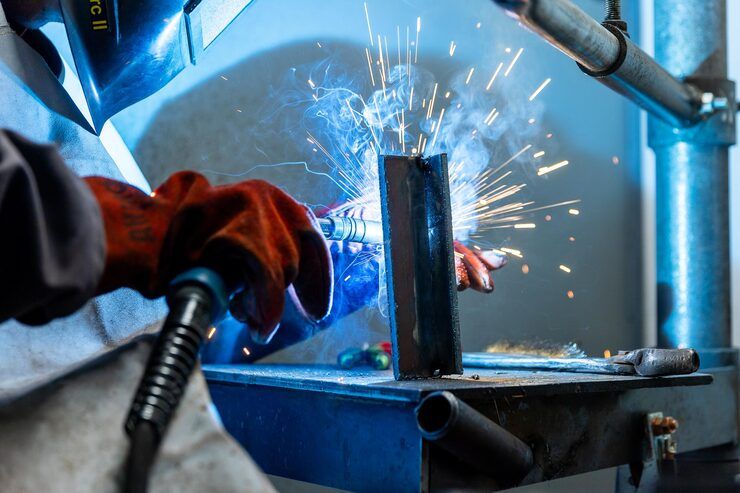
TIG welding machines are specialized systems used to join metal components through a process known as tungsten inert gas welding. The method is also called gas tungsten arc welding (GTAW). It uses a non-consumable tungsten electrode to create an electric arc that generates the heat needed to melt and join metal.
An inert shielding gas, usually argon or an argon-based mixture, protects the heated metal and electrode from atmospheric contamination. When additional material is needed, the welder introduces a separate filler rod into the molten weld pool.
TIG welding is widely used where weld appearance, dimensional accuracy, and control of heat input are important. Common applications include stainless steel fabrication, aluminum components, aerospace structures, automotive parts, food-processing equipment, and precision metalwork.
Understanding TIG Welding Equipment
A TIG welding machine typically includes a power source, torch, tungsten electrode, shielding-gas system, work clamp, and electrical connections. Depending on the machine, additional components may include a foot pedal, water-cooled torch, remote control, pulse settings, and high-frequency arc-starting equipment.
The power source controls the electrical current used to maintain the welding arc. Modern inverter-based machines can provide precise adjustments while reducing equipment size compared with many older transformer-based designs.
Common TIG welding machine types include:
DC TIG welders: Commonly used for stainless steel, carbon steel, and many other ferrous metals.
AC TIG welders: Frequently used for aluminum and magnesium because alternating current supports oxide-cleaning action during welding.
AC/DC TIG welders: Provide both current types for a broader range of materials.
Pulsed TIG welders: Alternate between higher and lower current levels to help manage heat input.
Portable inverter TIG machines: Designed for applications where equipment size and mobility matter.
Water-cooled TIG systems: Help manage torch heat during extended or higher-current welding operations.
The appropriate configuration depends on the metal, thickness, joint design, welding position, production requirements, and operator experience.
How the TIG Welding Process Works
TIG welding begins with preparing the metal surfaces and selecting suitable welding parameters. The operator establishes an arc between the tungsten electrode and the workpiece while shielding gas protects the welding area.
The heat melts the base metal to form a weld pool. Filler metal may be added manually when the joint requires additional material.
The process generally involves several stages:
Cleaning the workpiece to remove contaminants
Selecting the electrode and shielding gas
Setting the appropriate current and polarity
Establishing and maintaining the arc
Controlling torch movement and filler addition
Allowing the weld to cool under suitable conditions
Inspecting the finished joint
Clean surfaces and consistent technique are especially important because contamination can cause porosity, discoloration, and other weld defects.
Importance of TIG Welding Machines
TIG welding machines are important in industries where weld quality, precise heat control, and clean joints are essential. The process gives operators considerable control over the weld pool, making it suitable for thin materials and applications where appearance and dimensional accuracy matter.
Industrial Applications
TIG welding is used across several manufacturing and engineering sectors.
Aerospace manufacturing: Joining selected metal components that require controlled welding procedures.
Automotive manufacturing: Fabricating exhaust components, aluminum parts, and precision assemblies.
Food-processing equipment: Producing stainless steel tanks, pipes, and hygienic equipment.
Construction and architecture: Fabricating selected stainless steel structures, railings, and decorative metalwork.
Energy infrastructure: Joining suitable metal components used in power generation and industrial piping.
General fabrication: Producing accurate joints in stainless steel, aluminum, and other compatible metals.
The process is not always the fastest option for large production volumes. MIG welding and other automated processes may provide higher deposition rates when productivity is the primary requirement.
Advantages and Limitations
TIG welding offers several technical advantages, but it also requires careful operation.
Feature | TIG Welding Characteristics |
|---|---|
Weld control | High control over heat and weld-pool formation |
Weld appearance | Can produce clean, precise welds |
Filler material | Optional, depending on the joint |
Suitable materials | Stainless steel, aluminum, titanium, and other compatible metals |
Operator skill | Requires coordination and practice |
Welding speed | Often slower than some alternative processes |
Surface preparation | Clean surfaces are important |
Shielding gas | Required for normal TIG operation |
Understanding these characteristics helps manufacturers select an appropriate welding process for each application.
Recent Developments in TIG Welding Technology
Developments in welding equipment during 2025 and 2026 reflect broader trends toward digital controls, inverter power sources, automation, and improved process monitoring.
Inverter-Based Welding Systems
Modern inverter technology allows manufacturers to design compact welding machines with adjustable output characteristics. Electronic controls can help maintain stable arc performance and provide more precise settings for different materials and thicknesses.
Many current TIG systems include digital displays, programmable welding parameters, pulse functions, and adjustable starting and stopping characteristics. The exact features depend on the equipment model.
Pulse TIG Welding
Pulse TIG alternates between higher peak current and lower background current. This can help control heat input, particularly when welding thin materials or working in positions where excessive heat could affect the joint.
Pulse settings do not automatically guarantee better weld quality. Correct adjustment still depends on material thickness, joint preparation, travel speed, and operator technique.
Automation and Process Monitoring
Automated welding systems increasingly combine welding power sources with robotic equipment, programmable motion controls, and monitoring technologies.
For suitable production applications, these systems can improve repeatability and help document welding parameters. However, automation requires appropriate programming, fixtures, inspection procedures, and process qualification.
Energy Efficiency and Equipment Design
Manufacturers continue to emphasize compact inverter designs, electronic controls, and improved power management. Actual electricity consumption depends on welding current, operating time, duty cycle, machine efficiency, and standby use.
When comparing TIG welding equipment, technical specifications and measured operating data provide a more reliable basis for evaluation than general efficiency claims.
Laws, Standards, and Workplace Safety
TIG welding operations are affected by electrical safety requirements, workplace regulations, ventilation rules, protective equipment standards, and applicable welding-quality specifications. The exact requirements depend on the country, industry, and type of work.
Welding Safety Regulations
In the United States, the Occupational Safety and Health Administration (OSHA) establishes workplace requirements covering welding, cutting, eye protection, ventilation, and exposure to hazardous substances.
Employers must assess the hazards associated with the materials and working environment. Appropriate controls may include local exhaust ventilation, welding helmets, protective clothing, suitable gloves, and measures to prevent electrical shock and fire.
Welding Quality Standards
International standards provide frameworks for welding procedures, welder qualifications, and quality management.
ISO 9606-1 addresses qualification testing of welders for fusion welding of steels. Other standards cover different materials, welding procedures, inspection methods, and quality requirements.
A particular standard may be required by a project specification, industry regulation, or customer contract. Not every TIG welding task automatically requires the same qualification.
Safe Operating Practices
Important precautions include:
Inspecting cables, connectors, and the torch before operation.
Using suitable eye and face protection.
Providing adequate ventilation and fume control.
Keeping combustible materials away from welding operations.
Securing shielding-gas cylinders appropriately.
Following the machine manufacturer's operating instructions.
Using suitable electrical protection.
Receiving appropriate training before operating the equipment.
Special precautions may be necessary when welding coated metals, working in confined spaces, or handling materials that can produce hazardous fumes.
Tools and Resources for TIG Welding
Several technical resources can help operators, engineers, and manufacturers plan welding work.
Equipment Specifications
Review the manufacturer's technical documentation for information about output current, input voltage, duty cycle, current type, electrode compatibility, gas requirements, and recommended accessories.
Welding Parameter Calculators
Welding calculators can help estimate starting parameters based on material thickness, electrode diameter, filler material, and joint configuration. These calculations should be treated as starting points rather than universal settings.
Inspection and Quality-Control Tools
Common welding inspection resources include:
Weld gauges for measuring weld dimensions.
Calipers for checking component dimensions.
Visual inspection checklists.
Procedure qualification records.
Material identification records.
Equipment maintenance logs.
Welding parameter documentation.
More demanding applications may require nondestructive testing or other inspection methods specified by the relevant engineering standard.
Training and Technical References
Welding education materials from recognized technical institutions, standards organizations, and equipment manufacturers can help operators understand arc behavior, electrode preparation, shielding gas, joint design, and defect prevention.
Frequently Asked Questions
What is a TIG welding machine used for?
A TIG welding machine joins compatible metals using an electric arc and a non-consumable tungsten electrode. It is commonly used for precision fabrication, stainless steel components, aluminum structures, and applications requiring controlled heat input.
What is the difference between AC TIG and DC TIG welding?
DC TIG is commonly used for steel and stainless steel. AC TIG is frequently used for aluminum and magnesium because the alternating current supports oxide-cleaning action. AC/DC machines provide both operating modes.
Is TIG welding suitable for beginners?
Beginners can learn TIG welding through structured training and practice. However, coordinating the torch, electrode, filler rod, and shielding gas requires considerable control. Material preparation and safe operating practices are also essential.
Which factors determine the performance of a TIG welding machine?
Important factors include output current range, duty cycle, current type, arc-starting method, pulse controls, input power requirements, cooling arrangements, and compatibility with the intended material and application.
What safety precautions are necessary for TIG welding?
Operators should use appropriate eye protection, protective clothing, suitable ventilation, and correctly maintained electrical equipment. Gas cylinders must be secured, and additional precautions may be required for confined spaces or materials that generate hazardous fumes.
Conclusion
TIG welding machines are important tools for precision metal fabrication, providing controlled heat input and the ability to produce clean, accurate joints in compatible materials. Their applications range from industrial piping and automotive components to aerospace manufacturing and specialized metalwork.
Recent equipment trends emphasize inverter technology, digital controls, pulse welding, automation, and improved process monitoring. These developments can support greater control and repeatability, although results still depend on correct equipment selection, preparation, and operator skill.
Before choosing a TIG welding system, users should evaluate material compatibility, current requirements, duty cycle, power supply, process controls, maintenance needs, and workplace safety requirements. Combining appropriate equipment with qualified procedures and consistent inspection helps support reliable welding results across a range of industrial applications.