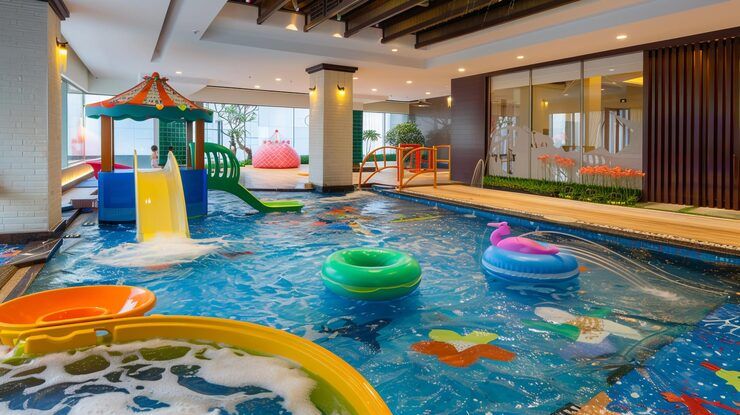
Kid-friendly resort amenities are facilities, activities, and accommodation features designed to make resort stays more comfortable and practical for families traveling with children. They can range from children's swimming pools and playgrounds to supervised activities, family rooms, child-friendly dining areas, and accessible recreational spaces.
Family-oriented hospitality exists because traveling with children creates different planning requirements from traveling alone or as a couple. Parents may need safe recreational areas, suitable sleeping arrangements, age-appropriate activities, child-focused meals, and convenient access to essential facilities.
Modern family resorts often divide amenities by age group. Toddlers, school-age children, and teenagers can have different interests, physical abilities, and supervision requirements.
The concept is relevant across many forms of travel, including luxury family vacations, beach holidays, theme-park trips, cruise destinations, wellness resorts, and international tourism.
Common Kid-Friendly Amenities
A family-oriented resort may include:
Children's swimming pools
Splash areas
Indoor playrooms
Outdoor playgrounds
Sports courts
Arts and crafts areas
Children's activity programs
Family restaurants
High chairs
Baby cots
Family rooms
Teen recreation areas
Game rooms
Nature activities
Child-focused entertainment
Not every property provides all of these facilities. Parents should verify the age range, opening hours, supervision arrangements, accessibility, and safety requirements of each facility.
| Amenity | Main purpose | What parents should check |
|---|---|---|
| Children's pool | Water recreation | Depth and supervision |
| Playground | Physical activity | Age suitability and surface |
| Kids' activity area | Structured recreation | Supervision and schedule |
| Family room | Accommodation | Bed configuration |
| Children's dining | Easier meals | Menu and dietary information |
| Teen area | Independent recreation | Age restrictions |
| Baby facilities | Convenience | Availability and hygiene |
| Sports facilities | Active recreation | Equipment and safety rules |
Why Kid-Friendly Resort Amenities Matter Today
Family travel is a major part of the international tourism market. Parents often need to balance children's activities with adult relaxation, sightseeing, dining, and practical travel requirements.
Well-designed family amenities can make a resort easier to navigate for households with different ages and interests.
Supporting Family Travel
A family-friendly resort can reduce the need to arrange separate activities outside the property. This can be particularly useful in destinations where transportation is difficult or where families prefer to spend more time within the resort environment.
Family travelers may prioritize:
Family hotel accommodation
Children's activities
Swimming facilities
Family travel packages
Safe recreational spaces
Accessible accommodation
Child-friendly dining
Teen activities
Nearby medical facilities
Travel insurance coverage
The importance of each feature varies according to the children's ages.
Safety and Supervision
Safety is one of the most important considerations for children's facilities.
Parents should distinguish between a children's activity area and a professionally supervised program. A playground may simply be available for family use, while an organized children's program may have specific staff, registration procedures, age limits, and operating schedules.
Water facilities require particular attention because drowning risk can exist even where a pool is specifically designed for children.
Parents should review:
Pool depth
Lifeguard arrangements
Age restrictions
Activity supervision
Emergency procedures
First-aid facilities
Child-to-adult ratios where applicable
Rules for independent participation
Accessibility and Different Family Needs
Families may also include children with mobility, sensory, developmental, or dietary requirements.
Useful facilities can include accessible pathways, elevators, adapted rooms, quiet spaces, suitable pool access, and clearly communicated food ingredients.
Accessibility information should be verified directly because the term "family-friendly" does not necessarily mean that every facility is suitable for every child.
Recent Developments in Family Resort Hospitality
Family-oriented hospitality continues to evolve as parents increasingly look for flexible accommodation, technology-enabled planning, wellness, educational activities, and age-specific recreation.
Family Travel Remains a Major Tourism Segment
Recent tourism industry research continues to identify family travel as an important part of international tourism. Resorts have responded by developing more flexible room configurations, children's activities, family entertainment, and multigenerational accommodation.
The trend extends beyond traditional children's clubs. Families are increasingly interested in activities that parents and children can experience together.
Multigenerational Travel
Grandparents, parents, and children increasingly travel together, creating demand for accommodation that works across multiple age groups.
This can influence resort design through:
Connecting rooms
Larger accommodation units
Multiple sleeping areas
Accessible facilities
Family dining spaces
Activities for different age groups
Multigenerational travel also makes accessibility more important because older family members may have different mobility requirements from younger travelers.
Technology in Family Travel
Technology is becoming more integrated into resort planning.
Parents may use mobile applications for:
Activity schedules
Restaurant reservations
Resort maps
Digital room information
Weather forecasts
Transportation planning
Emergency contacts
Some resorts also use digital registration systems and mobile notifications for children's programs.
Technology can improve convenience, but families should still know where physical reception desks, first-aid facilities, emergency exits, and staff assistance are located.
Wellness for Families
Wellness travel is also expanding beyond adults. Family resorts increasingly incorporate outdoor activities, swimming, nature exploration, fitness, mindfulness, and healthier food options.
For children, these activities should remain age-appropriate and should not be presented as medical treatment.
Laws, Regulations and Policies in the United States
The United States provides a useful regulatory example because family resorts are affected by federal accessibility requirements, state safety rules, local building codes, and health regulations.
Accessibility Requirements
The Americans with Disabilities Act (ADA) establishes accessibility requirements for many places of public accommodation, including hotels and other lodging facilities.
The U.S. Department of Justice explains that hotels and similar lodging properties must comply with ADA requirements concerning accessible rooms, routes, communication features, and other facilities.
For family resorts, accessibility can affect:
Guest rooms
Swimming pools
Restaurants
Recreation areas
Parking
Entrances
Pathways
Elevators
Communication systems
Swimming Pool Accessibility
The ADA includes specific requirements for accessible swimming pools and other recreational facilities. Depending on the pool design, accessible means of entry may include a sloped entry or pool lift.
However, accessibility requirements do not replace general pool-safety rules. State and local authorities can establish additional requirements concerning lifeguards, barriers, water quality, signage, and pool operation.
Children's Programs
A resort operating an organized children's activity program may face additional requirements depending on its structure and location. Rules can vary by state and may concern staff qualifications, background checks, child-protection procedures, occupancy limits, and emergency planning.
Parents should therefore ask whether children participate independently or whether an adult must remain present.
Food and Allergy Considerations
Restaurants serving families must comply with applicable food-safety requirements. Parents with children who have allergies should ask about ingredients, preparation practices, and potential cross-contact rather than relying only on general menu descriptions.
Tools and Resources for Family Resort Planning
Families can use several resources to evaluate whether a resort is genuinely suitable for their children's needs.
Accommodation Research
Useful resources include:
Official hotel websites
Destination tourism websites
Hotel comparison platforms
Digital maps
Family travel publications
Accessibility information
Resort activity calendars
Travel insurance documentation
Parents should check official property information because facilities and schedules can change seasonally.
Safety Planning Tools
Useful tools include:
Weather applications
Pool-safety guidance
Digital maps
Emergency contact lists
First-aid references
Medication reminders
Travel document organizers
Families traveling internationally should also research local emergency numbers and the location of nearby medical facilities.
Family Comparison Checklist
A simple comparison table can make resort research easier.
| Category | Resort A | Resort B | Resort C |
|---|---|---|---|
| Children's pool | Yes | Yes | No |
| Playground | Yes | No | Yes |
| Kids' activities | Scheduled | Scheduled | Limited |
| Family rooms | Yes | Yes | Verify |
| Teen facilities | Yes | No | Yes |
| Accessible facilities | Verified | Verify | Verified |
| Nearby medical facility | Yes | Moderate distance | Yes |
| Children's dining | Yes | Yes | Limited |
This approach focuses on practical characteristics rather than broad labels.
Questions to Ask Before Travel
Parents can confirm:
What ages can participate in children's activities?
Is adult supervision required?
Are lifeguards present?
What are the pool rules?
Are baby facilities available?
Are family rooms suitable for the children's ages?
Are accessible facilities available?
How are food allergies handled?
What emergency facilities are nearby?
Frequently Asked Questions
What makes a resort kid-friendly?
A kid-friendly resort generally provides facilities and activities designed for children and families, such as children's pools, play areas, family rooms, age-appropriate activities, and child-focused dining options.
Are children's resort activities always supervised?
No. Supervision depends on the activity and property. Some facilities are designed for family use, while organized children's programs may have staff supervision and registration requirements.
Are kids' pools safer than regular swimming pools?
A children's pool may be designed with shallower water, but it should not be considered automatically safe. Parents should follow pool rules and maintain appropriate supervision.
Should parents check accessibility before booking?
Yes. Families with accessibility requirements should verify room layouts, entrances, pool access, pathways, elevators, restaurants, and recreational facilities directly with the property.
What should families prioritize when choosing a resort?
The most useful factors depend on the children's ages and family needs. Safety, sleeping arrangements, activities, transportation, accessibility, dining, medical facilities, and the location of recreational areas are all worth reviewing.
Conclusion
Kid-friendly resort amenities are designed to address the practical and recreational needs of families traveling with children. The concept extends beyond children's play areas to include accommodation design, water safety, accessibility, dining, supervision, transportation, and emergency planning.
Recent family travel trends have encouraged resorts to create more flexible environments for young children, teenagers, parents, and multigenerational groups. Technology is also becoming more integrated into activity schedules, resort maps, communications, and travel planning.
Safety remains central to the design of children's facilities. Parents should distinguish between general recreational areas and supervised programs, particularly when children may participate independently.
The United States provides an example of how accessibility legislation can influence family resort design. ADA requirements affect lodging facilities, recreational areas, swimming pools, routes, and communication features, while state and local rules can add further safety requirements.
For families, the most useful approach is to evaluate specific facilities rather than relying only on the phrase "kid-friendly." Checking age limits, supervision, accessibility, pool conditions, sleeping arrangements, food information, and emergency facilities can create more realistic expectations.
For the hospitality industry, well-planned family amenities can make resorts more adaptable to changing travel patterns while supporting safer, more inclusive, and more comfortable experiences for households with children.