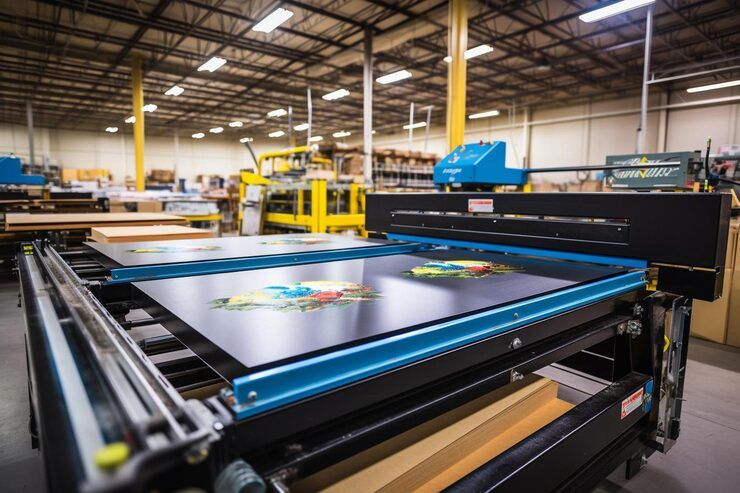
UV printing machines are digital printing systems that use ultraviolet light to cure specially formulated ink immediately after it is deposited onto a surface. Unlike conventional printing methods that may require extended drying, UV-curable ink solidifies rapidly when exposed to the appropriate ultraviolet wavelength.
The technology can print on a broad range of substrates, including coated materials, plastics, acrylic, glass, metal, wood, leather, ceramics, paperboard, and selected flexible materials. The exact compatibility depends on the printer, ink formulation, surface preparation, and intended application.
Modern UV printers can be configured as flatbed, roll-to-roll, hybrid, or specialized systems. Industrial models may incorporate multiple printheads, automated material handling, white ink, varnish, primer, and computerized production controls.
How UV Printing Works
A typical UV printing process involves several coordinated stages:
Digital artwork is prepared using graphic-design or RIP software.
The substrate is positioned on the printer.
Printheads deposit microscopic ink droplets.
UV lamps or UV LED modules expose the deposited ink to ultraviolet radiation.
The ink polymerizes and becomes a solid film.
Additional layers may be printed for white ink, texture, or varnish effects.
The finished material is inspected for color, adhesion, and surface quality.
The immediate curing process allows the printed image to remain relatively stable during subsequent handling.
Main Types of UV Printers
UV flatbed printers use a stationary table to support rigid materials such as acrylic sheets, boards, glass, wood panels, and metal sheets.
UV roll-to-roll printers are designed for flexible materials supplied from rolls.
Hybrid UV printers combine flatbed and roll-fed capabilities, allowing different substrate formats to be processed on the same platform.
UV DTF systems use UV printing technology with transfer films for selected applications where direct printing onto the final object is difficult.
| Printer Type | Typical Substrates | Common Applications |
|---|---|---|
| Flatbed UV | Acrylic, glass, wood, metal | Signage, panels, décor |
| Roll-to-roll UV | Flexible films, vinyl, textiles | Graphics and displays |
| Hybrid UV | Rigid + flexible materials | Mixed production |
| UV DTF | Transfer films | Objects with irregular surfaces |
| Industrial UV | Specialized substrates | Manufacturing and product decoration |
Why UV Printing Matters Today
UV printing has become an important part of industrial digital printing, commercial UV printers, flatbed UV printing, UV LED printing, and custom product decoration.
One reason is substrate flexibility. A UV printer can potentially print directly onto materials that are difficult to process with conventional paper-focused printing methods.
Direct-to-Object Printing
Some UV systems can print directly onto three-dimensional or semi-three-dimensional objects. Applications can include:
Promotional products
Packaging components
Decorative panels
Electronics housings
Furniture surfaces
Glass objects
Acrylic products
Ceramic surfaces
Industrial identification
Interior décor
The ability to print directly onto selected objects can reduce the need for separate labels or intermediate media in certain applications.
White Ink and Special Effects
White UV ink can provide a base layer on dark or transparent substrates. Some systems can also use clear varnish or texture layers to create tactile effects.
A typical multi-layer configuration might involve:
White base layer
CMYK color layer
Additional light colors where supported
Clear varnish or texture layer
This gives designers greater control over appearance, especially on transparent or colored materials.
Important Performance Factors
UV printing quality depends on more than printer resolution. Important variables include:
Ink chemistry
UV wavelength
Lamp intensity
Printhead configuration
Ink adhesion
Substrate surface energy
RIP settings
Color management
Printing speed
Layer thickness
Environmental conditions
A material that appears suitable for UV printing may still require surface treatment, primer, or testing before consistent production.
Recent UV Printing Developments
The printing industry continued moving toward digital workflows, automation, LED curing, higher productivity, and more specialized substrate applications during 2025 and 2026.
Greater Use of UV LED Curing
UV LED curing continues to be important because LED systems can provide controlled curing while avoiding some characteristics associated with older mercury-lamp technologies.
Modern systems increasingly integrate curing modules directly into the print carriage or printing architecture. This can support compact equipment configurations and rapid curing.
Automation and Digital Workflow
Industrial UV printers increasingly incorporate automated calibration, nozzle monitoring, media detection, printhead alignment, color management, and production monitoring.
Software integration is also becoming more important. RIP platforms can control color profiles, layering, white-ink density, varnish effects, nesting, and production queues.
These developments are particularly relevant to industrial UV printing machines where repeatability and workflow control are important.
Sustainable Printing Considerations
UV curing technology can reduce the need for separate drying stages because ink is cured during printing. However, sustainability should be assessed across the complete system, including electricity consumption, ink chemistry, substrate production, waste, cleaning materials, and equipment lifecycle.
The use of UV-curable inks does not automatically make a printed product environmentally preferable.
Developments in Printing-Ink Standards
India's Bureau of Indian Standards continues to develop and review standards related to printing inks. For example, BIS lists IS 7771:2025, a revised specification for black letterpress halftone ink, and maintains a dedicated technical committee covering printing inks, including inks used for packaging and sensitive applications.
Although these standards are not a universal technical specification for every UV ink, they demonstrate continuing standardization activity within India's printing-ink sector.
Laws, Standards and Policies in India
India provides a useful regulatory example because UV printing can involve machinery safety, electrical equipment, chemical handling, emissions, waste management, packaging, and food-contact considerations depending on the application.
There is no single regulation that applies identically to every UV printer.
BIS Standards
The Bureau of Indian Standards provides its Know Your Standard platform, where users can search standards by keyword or Indian Standard number. The platform also provides access to amendments, notifications, testing information, laboratories, and related documents. It was updated in May 2026.
For UV printing equipment, manufacturers and operators should identify standards relevant to the specific machine, electrical system, ink, substrate, and application rather than assuming one standard covers the entire setup.
Printing-Ink Standards
BIS's printing-ink technical committee covers inks used for printing and writing, inks for food, pharmaceutical and hygiene packaging, and coatings and varnishes used in printing and packaging.
BIS also lists IS 15864:2024, covering multicolour-process offset printing inks, illustrating the continuing development of technical specifications for printing materials.
The applicable standard for a UV-curable ink depends on its formulation and intended use.
Food-Contact Applications
If UV-printed materials are intended to come into direct contact with food, additional requirements can apply to inks, coatings, substrates, migration, and production controls.
A UV printing process should therefore not be assumed to be suitable for direct food-contact packaging merely because the printed surface has cured. The complete ink and substrate system must be assessed against the applicable requirements.
Environmental and Plastic-Packaging Rules
Where UV printing is used on plastic packaging, India's Plastic Waste Management framework can become relevant depending on the packaging material and the role of the producer, importer, or brand owner.
CPCB's current guidance includes Extended Producer Responsibility obligations and recycling targets for different plastic-packaging categories. For example, the framework lists increasing minimum recycling levels for several categories from 2024–25 onward.
The environmental requirements depend on the complete packaging structure rather than the printing process alone.
Tools and Resources for UV Printing
A UV printing workflow combines hardware, software, material testing, color management, and maintenance.
Useful Tools
RIP software: Controls color processing, nesting, layering, and print queues.
ICC color profiles: Help manage color reproduction between digital artwork and printed output.
Spectrophotometers: Measure color and support calibration.
Adhesion testing tools: Help evaluate how well cured ink remains attached to a substrate.
UV intensity meters: Help monitor curing-system performance.
Nozzle-check utilities: Identify blocked or misaligned printhead nozzles.
Substrate databases: Help document material characteristics and successful print settings.
CAD software: Useful for preparing designs for shaped objects and industrial components.
Color-calibration charts: Provide repeatable references for printer profiling.
BIS Know Your Standard: Helps identify applicable Indian Standards.
Specifications Worth Comparing
When researching UV printing machines, important technical parameters include:
Print width
Maximum substrate thickness
Printhead technology
Number of printheads
Ink channels
CMYK configuration
White-ink capability
Clear-ink or varnish capability
UV LED curing system
Printing resolution
Maximum production speed
Flatbed dimensions
Roll-to-roll capability
Automatic height detection
RIP compatibility
Maintenance system
Rated speed should not be treated as guaranteed production output. Actual throughput can change according to resolution, number of passes, white ink, varnish, substrate, artwork complexity, and curing requirements.
Frequently Asked Questions
What is a UV printing machine?
A UV printing machine is a digital printer that deposits UV-curable ink onto a substrate and uses ultraviolet light to cure the ink rapidly. The technology can be used on many rigid and flexible materials depending on the printer and ink system.
What materials can UV printers print on?
UV printers can work with materials such as acrylic, glass, metal, wood, plastics, ceramics, coated boards, leather, and selected flexible materials. Compatibility depends on surface characteristics, ink formulation, primer, and printer configuration.
What is the difference between a UV flatbed and roll-to-roll printer?
A UV flatbed printer is designed primarily for rigid sheets or objects placed on a stationary table. A roll-to-roll UV printer feeds flexible material continuously from a roll. Hybrid systems can support both formats.
Is UV printing waterproof?
Once properly cured, many UV inks have strong resistance to water and environmental exposure. However, performance varies according to ink formulation, substrate, curing conditions, and the intended environment. Testing is necessary for applications requiring specific durability levels.
Can UV printers print white ink?
Yes. Many industrial UV printers include dedicated white-ink channels. White ink can be used as a base layer for transparent or dark substrates and can also be incorporated into layered graphic effects.
Conclusion
UV printing machines have become an important part of modern digital printing because they combine rapid UV curing with the ability to print onto a broad range of rigid and flexible substrates.
The technology is particularly relevant to industrial graphics, product decoration, packaging components, interior materials, signage, and specialized manufacturing applications.
Current developments emphasize UV LED curing, automation, digital color management, substrate flexibility, white and clear inks, and integrated production monitoring. At the same time, printing-ink standards and environmental requirements continue to evolve.
In India, the applicable regulatory framework depends on the complete application. BIS standards can be relevant to printing inks and machinery, while food-contact applications may require additional assessment. Plastic packaging applications can also involve CPCB requirements and Extended Producer Responsibility obligations.
For anyone researching industrial UV printing machines, the most important factors are substrate compatibility, ink chemistry, curing technology, printhead configuration, color management, machine dimensions, production requirements, maintenance, and applicable standards.
UV printing is therefore best understood not simply as a printing method, but as an integrated digital manufacturing process in which the printer, ink, substrate, curing system, software, and regulatory requirements all contribute to the final result.