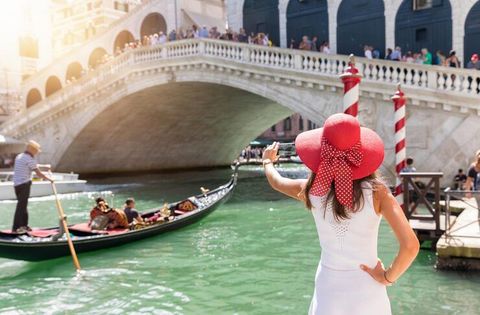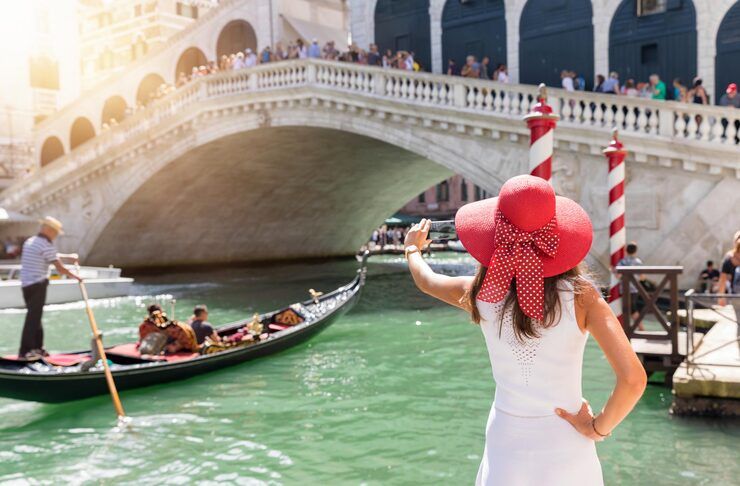
Venice gondola experiences are traditional journeys through the canals of Venice in a narrow, manually rowed boat. The gondola has become one of the city's best-known cultural symbols and remains part of Venice's regulated water transport system.
Unlike large sightseeing vessels, gondolas are designed for Venice's smaller canals and waterways. Their shape, shallow draft, and single-oar rowing technique allow them to navigate areas that are unsuitable for larger boats.
A gondola experience can provide a different perspective of Venice's architecture. From the water, visitors can see historic façades, bridges, courtyards, churches, palaces, and canal entrances from a lower viewpoint.
Common areas associated with gondola routes include:
- Grand Canal
- Rialto area
- Santa Maria della Salute
- San Marco district
- Smaller canals around San Polo
- Dorsoduro waterways
- Cannaregio canals
The exact route can vary according to the departure point, traffic, water conditions, tides, and navigation requirements.
Why Gondola Experiences Matter
Gondolas are closely connected with Venice's cultural identity and maritime history. Their design developed in response to the city's unusual geography, where canals function as streets and waterways connect historic neighborhoods.
A gondola journey also demonstrates how Venice's built environment was shaped by water. Historic buildings often have entrances facing canals, and many architectural details are easier to understand from the water than from a crowded street.
The experience can be useful for:
- Travelers interested in Venetian history
- Architecture enthusiasts
- Photography enthusiasts
- Families exploring historic Venice
- Visitors studying traditional boats
- People interested in European cultural heritage
Gondola navigation is also an example of specialized traditional knowledge. The gondolier uses a single oar positioned on the right side of the boat while standing near the stern.
| Gondola experience | Typical setting | Main interest |
|---|---|---|
| Grand Canal route | Wider central waterway | Palaces, bridges and major views |
| Small canal route | Narrow waterways | Architecture and quieter surroundings |
| San Marco area | Central Venice | Historic landmarks |
| Dorsoduro | Southern Venice | Art, architecture and canals |
| Cannaregio | Northern historic district | Neighborhood atmosphere |
| Sunset or evening route | Various canals | Changing light and waterfront scenery |
Recent Updates for 2026
Venice access contribution continued in 2026
One of the most important tourism-management developments affecting Venice in 2026 was the continuation of the city's experimental Access Contribution system.
The municipality applied the measure on 60 non-consecutive days between 3 April and 26 July 2026, generally between 8:30 a.m. and 4:00 p.m. The system applied to eligible visitors entering Venice's historic city under the conditions established by the municipality. (comune.venezia.it)
For 2026, the municipality established two payment levels based on how early the visitor completed the required process: €5 for earlier registration and €10 for registration during the four days preceding the visit. The municipality reported provisional 2026 results in July after the experiment ended. (comune.venezia.it)
Visitors planning a future gondola experience should therefore check the latest official access rules rather than relying on an earlier year's arrangements.
Updated municipal regulations in 2026
The Municipality of Venice lists its current regulatory framework for 2026, including rules concerning water transport and local navigation. The framework covers gondolas, sandoli, motorized vessels, and other forms of water movement within Venice and the lagoon. (comune.venezia.it)
This is important because Venice's canals are active waterways rather than isolated tourist routes. Gondoliers must navigate alongside other vessels while following local navigation requirements.
Gondola tariff information
The municipality's current published gondola tariff page states that the standard daytime tariff is €90 for 30 minutes, while the nighttime tariff is €110 for 35 minutes, with a maximum of five passengers in a public gondola. The municipality notes that duration can vary slightly because of traffic, tides, and weather conditions. (comune.venezia.it)
Because municipal tariff information can change, visitors should check the official Venice page before planning their itinerary.
Gondola Rules and Navigation Policies
Gondola operations are governed by Italian and regional legislation together with Venice's municipal regulations. The municipality identifies Law No. 21 of 15 December 1992 and Veneto Regional Law No. 63 of 30 December 1993 among the legal foundations for gondola regulation. (comune.venezia.it)
Venice also has a municipal water-circulation framework covering navigation within the lagoon and historic city.
For passengers, some of the most relevant practical requirements are straightforward:
- A public gondola can carry a maximum of five passengers.
- Gondoliers must hold the required municipal authorization.
- Gondola licenses are subject to renewal requirements.
- Passengers should follow the gondolier's instructions while boarding and during navigation.
- Departure and arrival should take place at appropriate authorized locations.
- Visitors should not interfere with navigation or attempt to stand while the boat is moving.
The municipality's FAQ states that gondola licenses must be kept among the boat's documents and that public gondolas may carry a maximum of five passengers. (comune.venezia.it)
These rules help maintain predictable operations on Venice's busy waterways.
Choosing a Gondola Route
There is no single route that represents every aspect of Venice. The departure location can influence the experience considerably.
A route near San Marco can provide access to some of Venice's most recognizable historic architecture. The wider waterways around the Grand Canal can provide views of large palaces and major bridges.
Smaller canals can provide a different perspective. They are generally narrower and can reveal residential façades, smaller bridges, and architectural details that are easy to miss when walking through busy streets.
For visitors interested in architecture, it can be useful to identify landmarks before departure. Examples include:
- Rialto Bridge
- Santa Maria della Salute
- Palazzo Barbarigo
- Ca' Rezzonico
- San Giorgio Maggiore
- Historic palaces along the Grand Canal
Route availability can depend on water traffic, weather, tides, and local navigation conditions, so a particular landmark should not be assumed to be included in every journey.
Best Time and Practical Planning
The visual character of Venice changes considerably throughout the day.
Morning journeys can provide softer light and generally different pedestrian patterns from the afternoon. Late afternoon can provide changing sunlight across historic façades, while evening journeys create a different atmosphere around illuminated buildings.
Weather is also important. Venice is affected by tides, and the municipality specifically notes that traffic, tides, and weather can influence the duration of a gondola journey. (comune.venezia.it)
A simple planning checklist includes:
- Check the official municipal gondola information.
- Confirm the published tariff before departure.
- Check the passenger limit.
- Select a departure area based on the desired sights.
- Allow time to reach the designated landing point.
- Check weather and tide information.
- Keep valuables secure during boarding.
- Follow navigation instructions.
Visitors should also remember that a gondola is a relatively small boat. Seating and movement are limited, so passengers should board carefully and remain seated unless instructed otherwise.
Useful Tools and Resources
Several resources can make planning a Venice gondola experience easier.
- Municipality of Venice: Official information about gondola tariffs, landing points, water regulations, and local policies.
- Venice water-transport regulations: Useful for understanding the legal framework surrounding navigation in the historic city and lagoon. (comune.venezia.it)
- Venice Access Contribution portal: Useful for checking whether the contribution applies on a particular date and understanding the current registration process. (comune.venezia.it)
- Official tourism information: Useful for understanding districts, landmarks, museums, and walking routes.
- Digital maps: Helpful for locating gondola stations and planning connections with nearby attractions.
- Tide information: Useful because changing water levels can affect navigation conditions.
- Weather applications: Helpful for checking rain, wind, temperature, and visibility.
- Offline maps: Useful when navigating Venice's narrow streets and bridges without continuous connectivity.
The municipality publishes a list of gondola stations, including locations such as Danieli, Molo, Dogana, Santa Maria del Giglio, San Tomà, San Beneto, Carbon, Santa Sofia, and San Marcuola. (comune.venezia.it)
Frequently Asked Questions
How many people can ride in one Venice gondola?
The municipality states that a public gondola can carry a maximum of five passengers. This limit applies to the regulated public gondola category. (comune.venezia.it)
How long does a typical Venice gondola journey last?
The municipality's published tariff information specifies a standard daytime duration of 30 minutes and a nighttime duration of 35 minutes. Actual duration can vary slightly because of traffic, tides, and weather. (comune.venezia.it)
What is the published gondola tariff in Venice?
The municipality currently publishes €90 for a 30-minute daytime journey and €110 for a 35-minute nighttime journey. These figures come from the municipal tariff page and should be checked again before travel because regulations and tariffs can change. (comune.venezia.it)
Can a gondola travel through small canals?
Yes. Gondolas are specifically designed for Venice's narrow waterways, although the exact route depends on navigation conditions, traffic, tides, and local requirements. A gondolier determines the appropriate route during the journey.
Does the Venice Access Contribution apply to every gondola passenger?
Not necessarily. The contribution is linked to entry into Venice's historic city under specific dates, times, and eligibility rules rather than being a gondola-specific charge. The 2026 experiment had defined dates and exemptions, so visitors should check the municipality's current rules for their travel date. (comune.venezia.it)
Conclusion
Venice gondola experiences combine traditional boat design, historic waterways, architecture, and the distinctive geography of the Venetian lagoon. They provide a perspective of the city that differs from walking through its streets and crossing its bridges.
The experience is also part of a regulated transport system. Passenger limits, gondola licenses, tariffs, navigation rules, and authorized landing points are all part of the framework governing these journeys. (comune.venezia.it)
Recent developments in 2026 have also reinforced the importance of checking current information. Venice continued its experimental Access Contribution programme, maintained its regulated gondola framework, and published current municipal information for water transport and gondola tariffs. (comune.venezia.it)
For travelers, the most useful approach is to choose a departure area based on the architecture or canals they want to see, check current municipal information, consider weather and tides, and follow passenger and navigation rules.
A gondola journey can then become more than a sightseeing activity: it can provide a practical introduction to Venice's waterways, historic architecture, maritime traditions, and carefully managed urban environment.