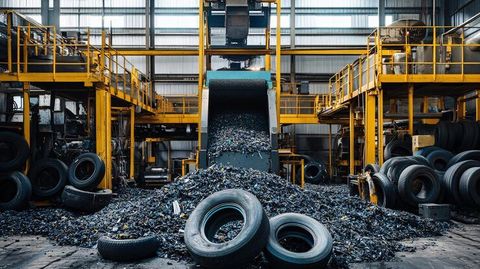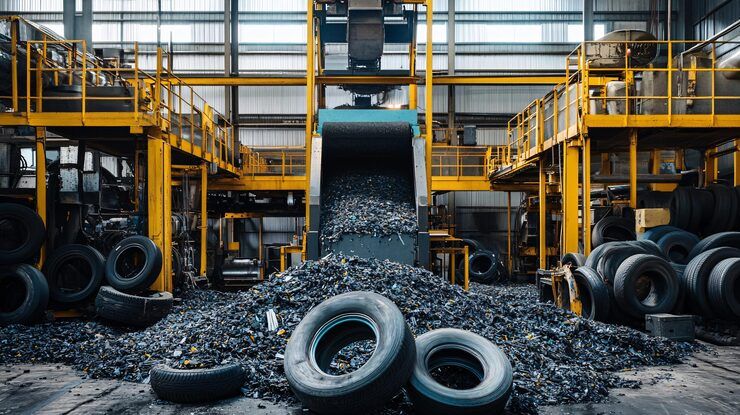
Rubber recycling machines are industrial systems designed to process discarded rubber products into reusable materials. These machines help transform end-of-life tires, manufacturing offcuts, rubber mats, conveyor belts, and other rubber waste into smaller particles or recovered materials that may be used in new industrial applications.
Rubber is widely used in transportation, construction, manufacturing, agriculture, and consumer products. Its durability is useful during product life, but it also makes discarded rubber difficult to manage through conventional waste disposal methods.
Rubber recycling technology addresses this challenge through mechanical processing, material separation, size reduction, and, in some cases, chemical or thermal treatment. The appropriate method depends on the type of rubber, its composition, contamination level, and the intended application of the recovered material.
Understanding Rubber Recycling Equipment
A rubber recycling system usually consists of several machines that work together. A typical waste tire recycling line may include feeding equipment, primary shredders, secondary granulators, magnetic separators, screening systems, and material conveyors.
Some facilities process rubber into coarse chips, while others produce finer crumb rubber or rubber powder. More specialized systems may separate steel wire and textile fibers from end-of-life tires.
Common equipment includes:
Tire shredders: Reduce whole tires or large rubber components into smaller pieces.
Rubber granulators: Produce more uniform particles through additional size reduction.
Rubber pulverizers: Process rubber into finer powder.
Magnetic separators: Remove ferrous metal, including steel recovered from tires.
Screening machines: Separate particles according to size.
Fiber separation systems: Remove textile contamination from processed rubber.
Conveyors and feeding systems: Move materials between processing stages.
Not every facility requires every machine. Equipment selection depends on production capacity, incoming material, particle-size specifications, and the quality requirements of the final output.
How the Recycling Process Works
A conventional mechanical tire recycling process generally follows several stages.
Collection and inspection: Discarded tires or rubber components are examined, and unsuitable materials or obvious contaminants are removed.
Primary shredding: Large rubber items are cut into smaller pieces that are easier to process.
Secondary size reduction: Granulators or similar machines reduce the material further to meet the required particle-size range.
Material separation: Magnets remove steel, while air-based or mechanical separation systems help remove textile fibers and other contaminants.
Screening and quality control: Screens classify particles by size. Additional processing may be needed when the output contains excess metal, fibers, or oversized rubber pieces.
The resulting material may be used in applications such as molded rubber products, selected construction materials, sports surfaces, or other industrial products, depending on its composition and quality.
Why Rubber Recycling Machines Matter
Rubber recycling equipment helps reduce the volume of discarded rubber sent to landfills or unmanaged disposal areas. It also enables manufacturers and recycling facilities to recover materials that may replace some virgin raw materials in suitable applications.
Environmental and Industrial Benefits
Discarded tires can create environmental challenges when they accumulate outdoors. Tire piles can retain rainwater, contribute to fire hazards, and provide breeding areas for mosquitoes.
Mechanical recycling helps recover rubber in a form that can be used in selected applications. Depending on the processing method, recovered steel and textile materials may also be separated for further management.
Industries that use recycled rubber include:
Construction and civil engineering
Automotive components
Rubber flooring and molded products
Sports and recreational surfaces
Road construction materials
Industrial rubber manufacturing
Materials research and development
The quality of recycled rubber varies with the original product, processing method, contamination, and particle size. Not every recovered material is suitable for every application.
Selecting Suitable Equipment
Choosing an industrial rubber recycling system requires consideration of several technical factors.
Input material: Passenger tires, truck tires, conveyor belts, and molded rubber products may require different processing configurations.
Processing capacity: The required throughput influences machine size, motor power, feeding arrangements, and plant layout.
Particle size: Coarse rubber chips, crumb rubber, and fine rubber powder require different stages of size reduction.
Material purity: Steel and textile separation may be essential when producing higher-purity rubber granules.
Energy consumption: Motor efficiency and process design influence electricity requirements.
Maintenance: Cutting blades, screens, bearings, and other components require inspection and replacement according to operating conditions.
A technical assessment should consider the entire processing line rather than evaluating a shredder or granulator in isolation.
Recent Developments in Rubber Recycling Technology
Developments reported during 2025 and 2026 show increasing attention to advanced material recovery, recovered carbon black, and the reuse of complex rubber compounds.
Advances in Pyrolysis Technology
On September 3, 2025, Continental announced that its ContiTech group had acquired patent rights for a thermal purification process and commissioned a pilot facility designed to produce purified pyrolysis oil from waste rubber. The approach aims to recover chemical raw materials from rubber compounds that are difficult to recycle mechanically.
Pyrolysis heats rubber in an oxygen-limited environment, producing a mixture of outputs that can include oil, gas, and carbon-rich solids. Their suitability for further use depends on purification, quality control, and the characteristics of the original material.
Chemical Recycling Research
On June 18, 2025, researchers at the Korea Advanced Institute of Science and Technology reported a chemical recycling method that converts waste tires into cyclic alkenes, chemical building blocks relevant to rubber and nylon production. The findings demonstrate a research pathway beyond conventional grinding and size reduction. Broader industrial adoption depends on further development and process validation.
Greater Attention to Recovered Carbon Black
Recovered carbon black is an important output of some tire recycling processes. It can potentially be used in rubber compounds, plastics, and other industrial materials, subject to appropriate performance and purity requirements.
Industry discussions during 2025 increasingly emphasized improving recovered carbon black quality and developing consistent specifications for industrial applications.
These developments illustrate a shift toward evaluating recycled materials by their technical performance and suitability for new manufacturing applications, not only by the quantity of waste processed.
Laws, Regulations, and Environmental Policies
Rubber recycling facilities must comply with environmental and industrial requirements that vary by country, state, and municipality. Relevant areas include waste handling, air emissions, wastewater management, fire prevention, occupational safety, and transportation of waste materials.
Waste Tire Regulations in India
India introduced the Extended Producer Responsibility (EPR) framework for waste tires in 2022 through amendments to the Hazardous and Other Wastes (Management and Transboundary Movement) Rules.
The framework establishes responsibilities for producers and defines requirements related to waste tire recycling and authorized recycling operations. India's Central Pollution Control Board provides information about registration, EPR obligations, and recognized recycling activities.
Businesses planning a rubber recycling facility in India should review current requirements with the Central Pollution Control Board and the relevant State Pollution Control Board.
United States Waste Tire Management
In the United States, waste tire management involves federal and state requirements. The US Environmental Protection Agency provides information on waste regulations and environmental risks associated with abandoned tire piles.
On March 20, 2026, the EPA announced a proposal concerning the cleanup of abandoned scrap tires and their potential use as fuel in cement kilns. This was a proposal, not a final nationwide rule, and its implementation depends on the applicable regulatory process.
Workplace and Environmental Safety
Rubber recycling facilities should assess hazards associated with rotating machinery, dust, noise, hot surfaces, fire, and material handling.
Appropriate safeguards may include machine guards, emergency stops, dust extraction, fire prevention systems, personal protective equipment, and documented maintenance procedures.
Facilities using thermal processing require additional attention to emissions control, gas handling, temperature monitoring, and fire protection.
Tools and Resources for Rubber Recycling
The following resources can help with technical research, compliance planning, and equipment evaluation.
Government and Industry Resources
Central Pollution Control Board (CPCB), India: Information on waste tire EPR, recycler registration, and environmental compliance.
US Environmental Protection Agency (EPA): Guidance on waste management, scrap tires, and environmental regulations.
International trade and recycling associations: Industry reports and technical discussions about recovered rubber and carbon black.
Manufacturer technical documentation: Equipment specifications, throughput ratings, power requirements, maintenance schedules, and material compatibility.
Equipment Evaluation Checklist
Before selecting a rubber recycling line, document the following requirements.
| Evaluation Factor | Information to Record |
|---|---|
| Feedstock | Tire type or other rubber material |
| Throughput | Required kilograms or tonnes per hour |
| Output | Chips, granules, powder, or recovered materials |
| Particle size | Required output size range |
| Separation | Steel and textile removal requirements |
| Utilities | Electricity, ventilation, and other plant needs |
| Compliance | Environmental permits and safety requirements |
| Maintenance | Blade life, inspection intervals, and spare components |
A spreadsheet can help compare technical specifications and estimate electricity consumption per tonne using measured energy use and actual throughput. Any estimate should be validated against operating data rather than relying only on advertised machine capacity.
Frequently Asked Questions
What are rubber recycling machines used for?
They process discarded rubber products into reusable chips, granules, powder, or recovered raw materials. Applications depend on the type and quality of the resulting material.
What is the difference between a rubber shredder and a granulator?
A shredder performs initial size reduction, usually producing relatively large pieces. A granulator processes those pieces into smaller, more uniform particles.
Can waste tires be converted into new raw materials?
Yes. Mechanical recycling produces rubber particles, while some thermal and chemical processes recover materials such as pyrolysis oil and recovered carbon black. The outputs require suitable quality control before reuse.
Which factors determine the capacity of a rubber recycling machine?
Capacity depends on feedstock type, machine design, motor power, cutting configuration, target particle size, contamination, and the performance of the complete processing line.
What regulations apply to a rubber recycling plant?
Requirements depend on location and process. They can include waste tire management, environmental permits, air-emission controls, workplace safety, fire protection, and rules governing the handling of recovered materials.
Conclusion
Rubber recycling machines play an important role in managing discarded tires and other rubber products. Shredders, granulators, separators, and pulverizers support mechanical recycling, while pyrolysis and chemical recycling technologies provide additional approaches for recovering raw materials from complex rubber compounds.
Developments reported during 2025 and 2026 highlight growing interest in recovered carbon black, improved material purity, and advanced recycling processes. However, the suitability of these technologies depends on technical performance, environmental controls, and the quality requirements of the intended application.
Selecting an appropriate system requires careful assessment of feedstock, processing capacity, particle size, separation needs, energy consumption, maintenance, and local regulations. Combining reliable equipment with effective quality control and responsible waste management can help recycling facilities recover materials for suitable industrial applications.