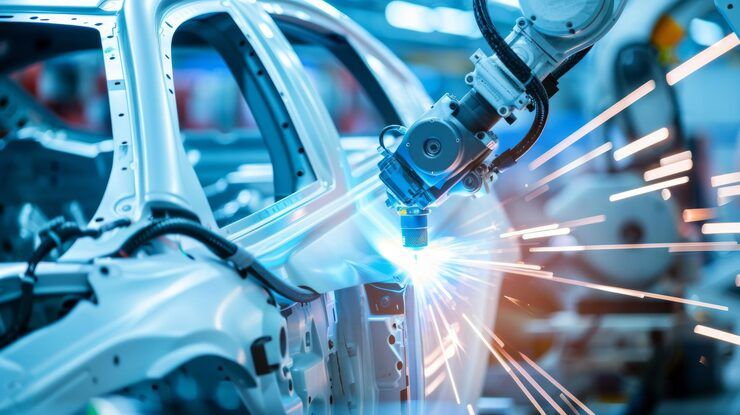
Car body welding robots are automated industrial machines used to join metal components during vehicle manufacturing. They are particularly important in the body-in-white stage, when a vehicle's main structural body is assembled before painting, interior installation, and final assembly.
Modern automotive factories use robotic welding systems to perform repetitive operations with consistent positioning and controlled welding parameters. These systems can work with vehicle panels, floor structures, door frames, roof sections, pillars, and other body components.
Robotic welding combines industrial robots, welding equipment, sensors, fixtures, control software, and safety systems. The exact configuration depends on the vehicle design, materials, production volume, and required joint strength.
Understanding Automotive Welding Robots
An automotive welding robot typically has a multi-axis mechanical arm that moves a welding tool into a programmed position. A controller coordinates the robot's movement with the welding equipment and other production-line components.
The robot may perform spot welding, arc welding, laser welding, or specialized joining operations. Resistance spot welding is especially common in automotive body assembly because it can join overlapping metal sheets rapidly without requiring continuous filler material.
A typical robotic welding cell contains:
Industrial robot: Positions the welding tool accurately.
Welding gun: Applies pressure and electrical current during resistance spot welding.
Robot controller: Coordinates movement, timing, and programmed operations.
Positioning fixtures: Hold body panels in the correct alignment.
Sensors and vision systems: Help identify component positions and detect selected process variations.
Safety equipment: Includes protective fencing, interlocks, emergency stops, and other safeguards.
Quality monitoring systems: Record process information and help identify welding irregularities.
These components work together to support repeatable manufacturing operations. However, the quality of the final joint also depends on material condition, electrode maintenance, fixture accuracy, and appropriate welding parameters.
How Car Body Welding Robots Work
The welding process begins when metal panels or structural components are placed in a fixture. The fixture holds the components in the required position while the robot approaches the designated welding locations.
For resistance spot welding, the welding gun presses two or more overlapping metal sheets together. Electrical current passes through the contact area, generating heat that forms a localized weld. The electrodes maintain pressure while the joint cools.
A programmed sequence can repeat this operation at multiple locations before the body moves to the next station.
The process generally involves:
Loading and positioning the components.
Verifying alignment and fixture conditions.
Moving the robot to the programmed welding point.
Applying the required welding sequence.
Monitoring relevant process parameters.
Inspecting or verifying weld quality.
Transferring the assembly to the next production stage.
Some manufacturing lines use several robots working simultaneously on different sections of a vehicle body. Coordinated movements and carefully designed safety zones help prevent interference between robots and other equipment.
Why Car Body Welding Robots Matter
Automotive welding automation is important because vehicle bodies contain many joints that must meet structural, dimensional, and manufacturing requirements.
Production Consistency
Robots can repeat programmed movements and welding sequences across large production runs. This helps manufacturers maintain consistent component positioning and joint formation when equipment is correctly configured and maintained.
Automation also reduces dependence on repetitive manual operations, although skilled technicians remain necessary for programming, maintenance, inspection, and process improvement.
Structural Quality
Vehicle body joints contribute to stiffness, durability, crash performance, and overall structural integrity. Robotic systems help control welding locations and process parameters, but automated operation alone does not guarantee that every weld meets specification.
Manufacturers use process monitoring, inspection methods, destructive testing where appropriate, and documented quality procedures to verify joint performance.
Flexible Manufacturing
Modern production lines may need to accommodate different vehicle models, body styles, and material combinations.
Reprogrammable robots and adjustable fixtures can support changes in production requirements. However, significant model changes may still require new tooling, robot programming, engineering validation, and production-line adjustments.
Common Welding Technologies
| Technology | Typical Application | Main Consideration |
|---|---|---|
| Resistance spot welding | Overlapping body panels | Electrode condition and current control |
| Arc welding | Structural brackets and selected assemblies | Heat input and weld geometry |
| Laser welding | Selected body joints and precision seams | Joint alignment and process control |
| Laser brazing | Certain visible automotive seams | Surface finish and joint preparation |
| Hybrid joining | Selected mixed-material assemblies | Compatibility and process validation |
The most appropriate technology depends on the body design, sheet thickness, material properties, required appearance, and structural performance.
Recent Developments in Automotive Welding Automation
During 2025 and 2026, automotive manufacturing continued to emphasize flexible automation, digital monitoring, artificial intelligence, and production systems designed for changing vehicle architectures.
AI-Assisted Manufacturing
Artificial intelligence is increasingly being explored for industrial inspection, predictive maintenance, and analysis of production data.
In robotic welding environments, these technologies can help identify unusual process patterns, detect potential equipment problems, or flag welds requiring additional inspection. Their effectiveness depends on sensor quality, training data, validation, and integration with existing control systems.
AI does not replace the need for engineering verification or established welding-quality procedures.
Digital Twins and Simulation
Digital twins and robotic simulation tools allow engineers to model manufacturing cells before physical installation or modification.
These tools can help assess robot reach, cycle times, collision risks, fixture placement, and interactions between multiple robots. Simulation can reduce commissioning difficulties, although actual production conditions must still be tested and validated.
Manufacturing for Electric Vehicles
Electric vehicle production has increased the importance of adaptable automotive manufacturing systems. Vehicle structures may combine high-strength steel, aluminum, and other materials, depending on the design.
Different material combinations can require changes to joining technology, electrode configuration, heat input, and quality verification. Manufacturers therefore evaluate robotic welding alongside other methods such as laser joining, mechanical fastening, and adhesive bonding.
Connected Production Systems
Modern welding cells may collect information about current, voltage, electrode condition, robot movement, cycle time, and equipment alarms.
Analyzing this information can support maintenance planning and help production teams investigate recurring defects. Actual benefits depend on reliable data collection, suitable analytics, and effective responses to identified problems.
Laws, Safety Standards, and Industrial Policies
Car body welding robots operate within a framework of machinery safety, workplace protection, electrical safety, welding standards, and automotive quality requirements. The exact legal obligations depend on the country and facility.
Industrial Robot Safety
International standards such as ISO 10218 address safety requirements for industrial robots and robot applications.
The ISO 10218 series was revised in 2025, updating requirements relevant to industrial robot safety and integration. Manufacturers and system integrators should consult the applicable editions and local adoption requirements when designing or modifying robotic welding cells.
Common safety measures include:
Physical guards and restricted-access zones
Interlocked access doors
Emergency-stop systems
Risk assessments
Safe robot operating modes
Controlled maintenance procedures
Electrical and welding-hazard protection
Training for operators and technicians
Collaborative robot applications require their own risk assessment. A robot described as collaborative is not automatically safe to operate without suitable safeguards.
Welding Quality Standards
ISO 3834 addresses quality requirements for fusion welding of metallic materials. Other standards may apply depending on the joining process, material, component, and industry requirements.
Automotive manufacturers may also use internal engineering specifications and supplier quality procedures. Compliance must be assessed against the actual product and production requirements rather than assumed from the presence of automated equipment.
Workplace Safety in India
In India, industrial facilities must consider applicable occupational safety, electrical safety, factory, and environmental requirements.
The relevant State Directorate of Industrial Safety and Health, pollution control authorities, and other competent bodies may have responsibilities depending on the facility and activity. Manufacturers should verify the currently applicable legislation and state-specific rules before commissioning equipment.
Tools and Resources for Planning
Several technical resources can help manufacturers assess robotic welding systems.
Robot Simulation Software
Simulation tools can model robot reach, movement, cycle time, collision risks, and production-cell layouts. They are useful during system design and when evaluating changes to existing production lines.
Welding Process Monitoring
Monitoring systems record selected welding parameters and equipment conditions. These records can help quality teams investigate defects and establish maintenance schedules.
Preventive Maintenance Records
A maintenance spreadsheet or computerized maintenance management system can track:
Welding electrode condition
Robot calibration
Fixture alignment
Cable and hose inspections
Safety-system testing
Controller alarms
Maintenance dates
Replacement components
Technical Documentation
Useful resources include industrial robot manuals, welding equipment documentation, ISO standards, automotive quality procedures, and applicable national safety regulations.
Before choosing a system, engineers should document the vehicle materials, joint types, required throughput, quality criteria, available floor space, and maintenance capabilities.
Frequently Asked Questions
What are car body welding robots used for?
They automate joining operations during vehicle body manufacturing. Common applications include joining sheet-metal panels, structural sections, brackets, and other body components.
Which welding process is most common in automotive body assembly?
Resistance spot welding is widely used for joining overlapping metal sheets in automotive body structures. Other processes, including arc welding and laser welding, are selected according to joint design and material requirements.
How do welding robots improve production consistency?
Robots repeat programmed movements and welding sequences. Combined with suitable fixtures, process controls, and quality monitoring, this can improve consistency across repeated manufacturing operations.
Can welding robots work with aluminum and high-strength steel?
Yes, but the joining process must be suitable for the material combination. Aluminum and high-strength steel have different physical and metallurgical characteristics, so engineers must validate the welding parameters and joint design.
What factors should manufacturers evaluate before installing welding robots?
Important factors include production volume, robot reach, welding technology, material type, fixture design, safety requirements, quality verification, maintenance needs, and integration with the wider production line.
Conclusion
Car body welding robots are an important part of modern automotive manufacturing. They combine industrial robotics, welding technology, fixtures, sensors, and process monitoring to support repeatable joining operations in vehicle body production.
Recent developments in artificial intelligence, digital simulation, connected manufacturing, and electric vehicle production are creating new requirements for adaptable welding systems. However, reliable results still depend on appropriate engineering, validated process parameters, preventive maintenance, and systematic quality control.
Manufacturers evaluating automotive welding automation should consider the complete production environment, including structural requirements, material compatibility, workplace safety, applicable standards, and long-term equipment maintenance. These factors help establish a sound foundation for consistent and responsible industrial production.