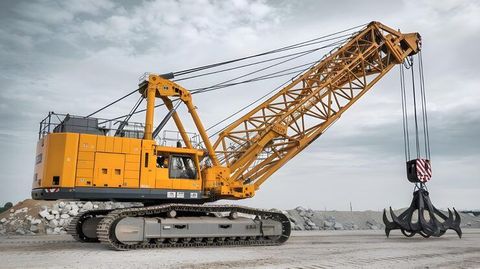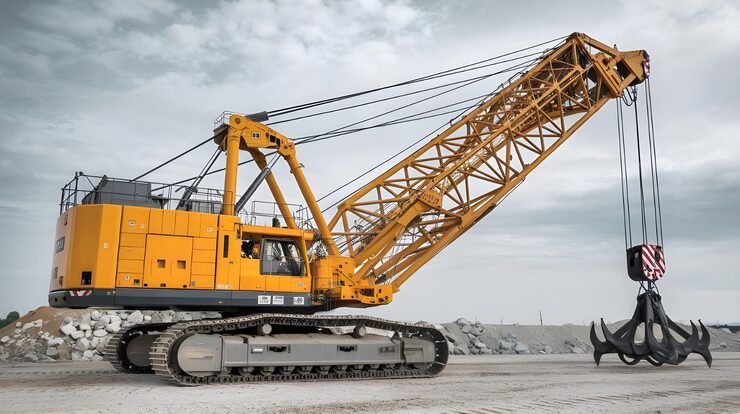
Crawler cranes are heavy lifting machines designed to move and position large loads on construction sites, industrial facilities, infrastructure projects, and energy developments. They use continuous tracks instead of conventional rubber tires, allowing them to travel across suitable ground surfaces while distributing their weight over a relatively large area. Their design makes them particularly useful for projects that require substantial lifting capacity and stability.
A crawler crane typically consists of an undercarriage, rotating upper structure, boom, hoisting system, counterweight, and operator cab. The boom supports lifting operations, while the hoisting system uses wire ropes, drums, and specialized attachments to raise and lower materials. Counterweights help balance the machine during lifting, subject to its approved operating configuration.
These cranes are available in several configurations, including lattice-boom crawler cranes and telescopic-boom models. Lattice-boom designs are widely associated with heavy lifting and long-reach applications, while telescopic-boom configurations use extendable sections to adjust their working reach. The appropriate type depends on the load, lifting height, ground conditions, site layout, and project schedule.
Crawler cranes are important because many modern construction activities involve components that are too heavy or difficult to position using smaller lifting equipment. Examples include bridge sections, industrial modules, wind turbine components, and major structural elements.
Why Crawler Cranes Matter in Modern Construction
Crawler cranes support projects where lifting precision, stability, and equipment movement are essential. Their tracks can help distribute ground pressure compared with some wheeled machines, although actual ground pressure depends on the crane's weight, track dimensions, load, and operating configuration.
Major Applications Across Industries
Crawler cranes are used in a wide range of industrial and infrastructure settings.
Infrastructure construction: Positioning bridge girders, large concrete components, and structural steel.
Energy projects: Lifting wind turbine sections, power-generation equipment, and heavy industrial components.
Industrial facilities: Installing machinery, processing equipment, and prefabricated modules.
Port and marine development: Supporting construction activities around docks, terminals, and coastal infrastructure.
Commercial construction: Handling substantial structural components on large developments.
Mining and heavy industry: Supporting selected equipment installation and maintenance operations.
Advantages and Operational Limitations
The main advantage of a crawler crane is its combination of lifting capability and tracked mobility. Certain models can travel short distances with a suspended load when specifically permitted by the manufacturer's load chart and operating instructions. However, this capability must never be assumed for every crane or configuration.
Other advantages include a rotating upper structure, configurable boom arrangements, and the ability to work on prepared construction surfaces without relying on conventional road tires.
There are also important limitations. Crawler cranes can be difficult to transport because of their size and weight. Some models require substantial assembly and disassembly, specialist transport arrangements, and carefully prepared ground. Their tracks do not make them suitable for every soft, sloping, or uneven surface.
Project planners must evaluate lifting requirements, transport logistics, available working space, ground-bearing capacity, and overhead obstructions before selecting a crane.
Key Factors in Crane Selection
The following factors help determine whether a crawler crane is suitable for a particular project.
Maximum load weight, including rigging and lifting attachments.
Required lifting radius, which is the horizontal distance from the crane's rotation center to the load.
Required hook height and boom length.
Ground-bearing capacity and track support conditions.
Wind conditions and the dimensions of the lifted object.
Assembly space, transport access, and nearby structures.
Availability of qualified operators, riggers, and lifting supervisors.
Selecting equipment based only on its advertised maximum lifting capacity can lead to incorrect planning. Actual capacity varies with boom length, operating radius, counterweight arrangement, track configuration, and other conditions specified by the manufacturer.
Recent Developments and Technology Trends
Crawler crane technology continues to develop alongside wider changes in construction equipment, digital engineering, and industrial safety. Developments during 2025 and 2026 include a growing emphasis on connected equipment, improved monitoring, energy efficiency, and more detailed project planning. Specific features and implementation dates vary by manufacturer and model.
Digital Lift Planning and Simulation
Digital lift planning allows engineers to evaluate crane configurations before equipment arrives at the site. Planning software can model the crane's position, boom geometry, lifting radius, load path, and potential obstructions.
Building Information Modeling (BIM) can also help project teams coordinate lifting activities with temporary structures, permanent installations, and other construction operations.
These tools are particularly useful for complex lifts involving large prefabricated modules, bridge structures, and wind energy components. However, digital simulations must be checked against the manufacturer's approved load charts and actual site conditions.
Telematics and Equipment Monitoring
Telematics systems collect information about equipment operation, operating hours, fuel or energy use, and maintenance indicators. Depending on the model, remote monitoring can help fleet managers identify unusual operating patterns and organize maintenance activities.
Electronic load monitoring and rated capacity limiters can help operators remain within specified operating limits. Such systems support safe operation but do not replace trained personnel, accurate rigging, ground assessments, or approved lifting procedures.
Energy Efficiency and Lower-Emission Equipment
Equipment manufacturers and construction companies are increasingly evaluating fuel efficiency, alternative power systems, and lower-emission machinery. Hybrid and electric technologies are more established in some construction equipment categories than in the largest crawler cranes, so availability should be verified for each specific model.
Fuel consumption depends on engine design, load cycles, idling, site conditions, and maintenance. Project assessments should consider the full operating cycle rather than relying on general claims about efficiency.
Market and Infrastructure Influences
Infrastructure investment, renewable energy development, industrial construction, and major transportation projects continue to influence demand for heavy lifting equipment. These factors create different requirements across regions, including longer boom configurations, higher lifting capacities, improved transport arrangements, and more detailed engineering studies.
There is no single global technology change that applies to every crawler crane in 2026. Project teams should check current manufacturer documentation and applicable regulatory updates when preparing equipment specifications.
Laws, Regulations, and Safety Policies
Crawler crane operations are governed by occupational safety regulations, equipment standards, environmental requirements, and site-specific procedures. The exact rules depend on the country, the industry, and whether the machine is being used for construction, manufacturing, or another activity.
Crane Safety Regulations in the United States
The Occupational Safety and Health Administration (OSHA) regulates crane safety in the United States. Construction activities involving crawler cranes are covered by relevant requirements under 29 CFR Part 1926, Subpart CC. General-industry operations may fall under 29 CFR 1910.180, depending on the work being performed.
Important safety considerations include:
Ensuring that crane operators meet applicable qualification requirements.
Following manufacturer load charts and approved operating procedures.
Inspecting critical components, including wire ropes, hooks, brakes, and boom structures.
Evaluating ground conditions and maintaining safe distances from electrical hazards.
Controlling access to lifting areas and preventing workers from standing beneath suspended loads.
These measures help reduce the risks of overturning, dropped loads, equipment failure, and contact with overhead power lines.
Construction Safety Requirements in India
In India, construction equipment safety is influenced by occupational safety legislation, applicable rules, building regulations, and technical standards. The Occupational Safety, Health and Working Conditions Code, 2020, came into force on 21 November 2025, according to the India Code record. Applicable provisions and associated rules should be checked for the relevant worksite and jurisdiction.
The National Building Code of India 2016 also provides a broad framework for construction safety and building practices. Project teams should determine which provisions, state-level rules, and technical standards apply to their specific crane operations.
Environmental and Site Requirements
Crawler cranes may be subject to additional requirements relating to emissions, noise, road transport, and work near environmentally sensitive locations. Moving oversized crane components can require special transport planning and permissions.
Before beginning work, project managers should verify applicable regulations with the relevant authorities and qualified safety professionals. Compliance should be assessed against current requirements rather than assumed from a general industry checklist.
Tools and Resources for Crane Planning
Several technical resources help engineers, operators, and construction managers plan crawler crane operations and maintain equipment safely.
Essential Planning Tools
Manufacturer load charts: Identify the permitted lifting capacity for particular boom lengths, working radii, counterweights, and configurations.
Lift-planning software: Supports crane positioning, load-path analysis, and identification of potential obstructions.
Ground-bearing pressure calculations: Help engineers evaluate whether the supporting surface can withstand the crane's imposed loads.
Telematics dashboards: Where available, provide operating data, equipment alerts, and maintenance information.
Inspection checklists: Record the condition of lifting equipment, wire ropes, hooks, brakes, and safety systems.
Weather monitoring tools: Help teams assess wind conditions and other environmental factors that may affect lifting operations.
Example of a Crane Planning Checklist
| Planning factor | Information to verify |
|---|---|
| Load weight | Load, rigging, and attachment weights |
| Lifting radius | Horizontal distance from crane rotation center |
| Boom configuration | Approved length and arrangement |
| Ground conditions | Bearing capacity and surface stability |
| Weather | Wind limits and forecast conditions |
| Work area | Power lines, structures, and personnel |
| Equipment condition | Inspection and maintenance records |
This checklist is a starting point, not a substitute for a professionally engineered lift plan or the manufacturer's operating instructions.
Frequently Asked Questions
What is a crawler crane used for?
Crawler cranes lift and position heavy materials on construction sites, industrial projects, energy installations, and infrastructure developments. Common applications include bridge construction, large structural assemblies, and wind turbine installation.
How is a crawler crane different from a mobile crane?
A crawler crane travels on continuous tracks, while many conventional mobile cranes use wheels and may rely on outriggers during lifting. Crawler cranes can offer advantages on appropriately prepared sites, but transport, setup, and operating requirements differ between models.
Can crawler cranes travel while carrying a load?
Some crawler cranes can travel with a suspended load under specifically permitted conditions. The manufacturer's instructions, load chart, ground conditions, boom position, travel route, and site procedures determine whether this operation is allowed.
What determines a crawler crane's lifting capacity?
Capacity depends on factors such as working radius, boom configuration, counterweight, track arrangement, structural limits, and ground stability. The rated capacity for a particular lift must be verified using the applicable manufacturer documentation.
What safety checks are important before operation?
Operators and site teams should check the crane's condition, load chart, lifting accessories, ground support, communication arrangements, weather, and surrounding hazards. Required inspections and checks must follow applicable regulations and manufacturer guidance.
Conclusion
Crawler cranes play an important role in modern construction and heavy industrial operations by supporting the movement of large, difficult-to-handle loads. Their tracked undercarriages, configurable booms, and lifting systems make them useful across infrastructure, energy, and industrial projects.
Successful operation depends on selecting the right configuration, evaluating ground conditions, planning each lift carefully, maintaining equipment, and following applicable safety regulations. Digital planning, telematics, and equipment-monitoring technologies can improve operational visibility, but qualified personnel and sound engineering remain essential.
Understanding crawler crane capabilities and limitations helps project teams make informed decisions, manage lifting risks, and coordinate complex construction activities more effectively.