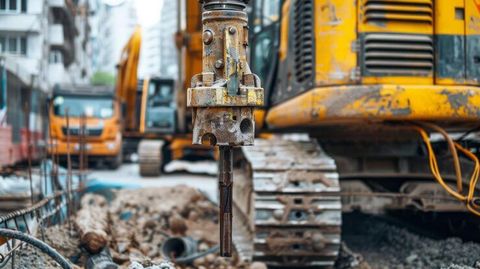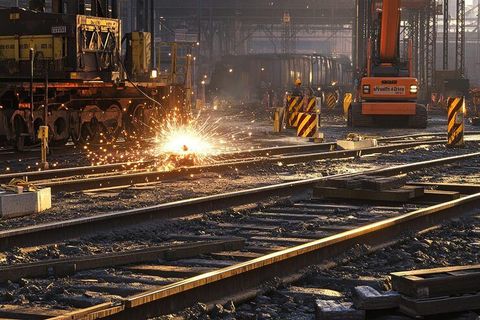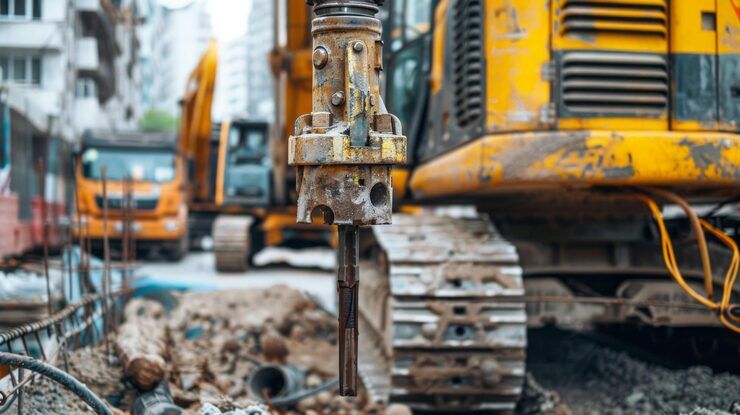
Hydraulic breakers are powerful attachments used with excavators, backhoe loaders, and other compatible construction machinery to break hard materials. They are commonly used to fracture concrete, remove rock, demolish structures, and prepare land for construction or infrastructure development. These attachments use hydraulic pressure to generate repeated impact forces against a working surface.
Unlike conventional excavation buckets, which primarily dig and move soil, hydraulic breakers are designed to penetrate and fracture resistant materials. Their applications range from small construction projects to large mining operations, road development, and quarrying activities.
How Hydraulic Breakers Work
A hydraulic breaker receives pressurized hydraulic fluid from the carrier machine. This fluid operates an internal mechanism that moves a piston back and forth, delivering repeated impacts to a steel tool called a chisel or moil point.
The impact energy travels through the tool into the material, creating cracks that gradually separate the rock or concrete. Depending on the design, a breaker may use hydraulic pressure, gas assistance, or a combination of mechanisms to produce its impact action.
The main components generally include:
Hydraulic cylinder and piston: Generate the repeated impact movement.
Tool or chisel: Transfers impact energy to the material being broken.
Housing: Protects internal components and supports the assembly.
Hydraulic connections: Carry pressurized fluid between the carrier and attachment.
Accumulator or gas chamber: Supports energy delivery in designs that incorporate this component.
Mounting bracket: Connects the breaker to the carrier machine.
Selecting the correct hydraulic breaker requires consideration of the excavator's operating weight, hydraulic flow, working pressure, attachment dimensions, and the hardness of the material.
Importance of Hydraulic Breakers in Modern Construction
Hydraulic breakers are important in construction, mining, and infrastructure development because they help fracture materials that conventional excavation equipment cannot easily remove. They are particularly useful when working with hard rock, reinforced concrete, road surfaces, and compacted geological formations.
Major Industrial Applications
Road construction: Breaking damaged asphalt, concrete pavements, and road foundations during rehabilitation.
Mining and quarrying: Fragmenting rock and reducing oversized material during excavation.
Building demolition: Removing concrete walls, foundations, slabs, and structural sections under controlled conditions.
Utility installation: Creating trenches through hard ground for pipelines, drainage systems, and underground infrastructure.
Tunnel construction: Supporting excavation and localized rock removal where suitable for the geological conditions.
Foundation preparation: Breaking rock formations before installing foundations or other structural elements.
Benefits and Operational Considerations
Hydraulic breakers can improve excavation flexibility by allowing one carrier machine to perform different tasks with compatible attachments. They may also reduce the need for secondary blasting in certain mining and quarrying operations.
However, productivity depends on material strength, breaker impact energy, hydraulic compatibility, operator technique, and equipment condition. Excessive operation in one location, incorrect tool positioning, or unsuitable hydraulic settings can increase wear and damage internal components.
Noise, vibration, flying fragments, and airborne dust are additional concerns. Proper exclusion zones, personal protective equipment, dust suppression, and equipment inspections are essential for safe operation.
Recent Developments in Hydraulic Breaker Technology
During 2025 and 2026, hydraulic breaker technology continued to develop around equipment durability, compact machinery compatibility, automatic lubrication, and improved operating control. Recent product introductions also reflect the need for attachments that suit different excavator sizes and specialized working conditions.
Notable Industry Developments
Several developments illustrate these trends:
March 2025: NPK introduced the GHD-10 hydraulic hammer as the first model in its GHD series, with design changes focused on operating performance and maintenance.
March 2025: Furukawa Rock Drill introduced the FX800 Qtv hydraulic breaker for excavators in the approximately 48.5–83-tonne class, featuring revised hydraulic routing and other design refinements.
2025: Volvo Construction Equipment introduced the HB01 and HB02 compact hydraulic breakers for smaller excavators, including applications involving its ECR18 Electric machine.
2026: Industry demonstrations highlighted hydraulic breakers with automatic greasing and variable-speed technology designed to adjust striking behavior according to material conditions.
These developments represent different approaches to improving attachment performance. Actual capabilities vary by model, carrier machine, and operating environment.
Emerging Technology Trends
Important trends include:
Automatic lubrication: Helps maintain appropriate lubrication at the tool interface and reduce the risk of premature wear.
Variable-speed operation: Adjusts impact frequency or operating behavior to suit selected material conditions.
Compact breaker designs: Support work in confined spaces, urban areas, and smaller construction projects.
Improved vibration management: Design refinements may help manage vibration transmitted through the attachment and carrier.
Condition monitoring: Inspection data and machine sensors can help identify abnormal operating conditions before more serious equipment problems develop.
Technology alone does not guarantee lower emissions, reduced noise, or improved productivity. Outcomes depend on the complete machine configuration, operating practices, and site conditions.
Laws, Regulations, and Safety Requirements
Hydraulic breaker operations are affected by machinery safety requirements, construction regulations, occupational health rules, noise limits, and environmental controls. Requirements vary by country and may also differ between construction sites, mines, and public infrastructure projects.
Regulatory Framework in India
Several Indian laws and regulatory frameworks are relevant to hydraulic breaker operations.
Central Motor Vehicles Rules, 1989: These rules contain requirements relevant to construction equipment vehicles in applicable circumstances, including certain safety and noise provisions. The exact requirements depend on equipment classification and use.
Occupational safety legislation: Applicable workplace safety requirements address machinery hazards, worker protection, and safe working practices. Employers and contractors should determine which provisions apply to their establishment and operations.
Noise pollution requirements: Applicable environmental and local rules may restrict noise levels or operating hours. Hydraulic breaker work near residential areas, hospitals, and other sensitive locations may require additional controls or permissions.
Construction and demolition waste regulations: Concrete and other demolition debris should be managed according to applicable construction and demolition waste requirements. Segregation, transportation, processing, and disposal arrangements depend on local rules.
Practical Compliance Measures
Before beginning hydraulic breaker work, project teams should:
Check equipment documentation and the carrier machine's compatibility requirements.
Inspect hydraulic hoses, couplings, mounting brackets, and tool-retention components.
Establish exclusion zones to protect nearby workers and the public.
Use suitable hearing, eye, head, and other protective equipment.
Control dust through appropriate suppression methods.
Monitor vibration and noise where required.
Handle concrete fragments and other demolition waste responsibly.
Regulatory requirements can change. Operators should verify current central, state, municipal, and industry-specific requirements rather than relying solely on general guidance.
Tools and Resources for Hydraulic Breaker Selection
Choosing and operating a hydraulic breaker involves technical calculations, compatibility checks, inspection procedures, and maintenance planning.
Useful Technical Tools
Hydraulic flow and pressure calculator: Helps compare the carrier machine's hydraulic output with the breaker manufacturer's operating specifications.
Excavator attachment compatibility chart: Supports selection according to machine weight, hydraulic flow, working pressure, mounting arrangement, and approved attachment range.
Breaker productivity estimator: Helps estimate breaking output using material properties, operating hours, fragmentation requirements, and expected downtime. Estimates should be validated against actual site performance.
Maintenance checklist: Records lubrication, tool wear, hydraulic leakage, fastener condition, and other inspection findings.
Noise and vibration assessment tools: Sound-level meters and suitable vibration measurement instruments help assess site conditions and identify the need for additional controls.
Comparison of Common Hydraulic Breaker Categories
Breaker category | Typical application | Main consideration |
|---|---|---|
Compact breaker | Small excavators and confined areas | Carrier compatibility |
Medium-duty breaker | General construction and concrete removal | Impact energy and hydraulic flow |
Heavy-duty breaker | Large excavators, quarrying, and hard rock | Structural durability and material strength |
Specialized breaker | Selected demolition or demanding environments | Application-specific design requirements |
The categories are indicative rather than standardized weight classes. Manufacturers use different model classifications, so technical specifications should guide the final selection.
Frequently Asked Questions
What is a hydraulic breaker used for?
A hydraulic breaker is used to fracture hard materials such as concrete, rock, asphalt, and masonry. It is commonly attached to excavators and backhoe loaders for demolition, excavation, road repair, mining, and foundation preparation.
How do I select the right hydraulic breaker for an excavator?
Check the excavator's operating weight, hydraulic flow, pressure limits, mounting arrangement, and approved attachment specifications. Consider the material hardness, required breaking performance, and working environment. The breaker must be compatible with the carrier machine.
What maintenance does a hydraulic breaker require?
Routine maintenance typically includes checking lubrication, tool wear, hydraulic hoses, connections, retaining components, and the housing. Inspection frequency and lubrication procedures should follow the manufacturer's instructions. Any unusual noise, leakage, overheating, or reduced performance should be investigated promptly.
Are hydraulic breakers suitable for underwater applications?
Some specialized hydraulic breakers are designed for underwater work, but ordinary models should not be assumed suitable. Underwater operation requires equipment specifically approved for the application, appropriate hydraulic arrangements, and suitable inspection and operating procedures.
What safety precautions are important when using hydraulic breakers?
Operators should use the correct attachment configuration, inspect the equipment before operation, maintain a safe exclusion zone, and wear appropriate protective equipment. Dust, noise, flying debris, and vibration must be managed. The breaker should be operated according to the manufacturer's instructions and site safety procedures.
Conclusion
Hydraulic breakers are important attachments for construction, mining, demolition, and infrastructure projects that involve hard materials. Their hydraulic impact mechanisms make it possible to fracture concrete and rock while extending the capabilities of compatible excavators and other carrier machines.
Developments in automatic lubrication, compact attachment design, variable-speed operation, and equipment monitoring reflect the industry's focus on durability, control, and operational efficiency.
Successful hydraulic breaker operation depends on choosing compatible equipment, maintaining hydraulic components, training operators, controlling workplace hazards, and following applicable regulations. Combining appropriate technology with careful maintenance and safe operating practices supports reliable performance across a wide range of industrial applications.