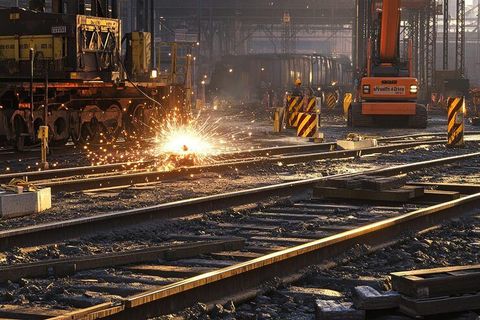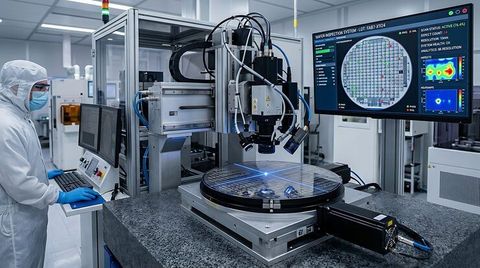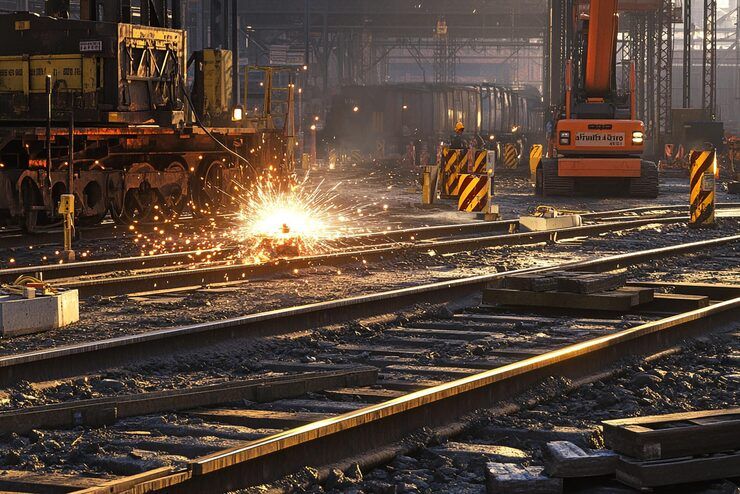
Rail welding machines are specialized equipment used to connect railway rails into continuous lengths or to repair and maintain rail joints. They play an important role in railway construction, track renewal, and infrastructure maintenance. By joining rail sections, these machines help create stable track structures that support the movement of passenger trains, freight trains, and other rail vehicles.
Traditional railway tracks often used mechanical joints with fishplates and bolts. Although these joints remain useful in certain applications, modern railway networks frequently use continuously welded rail (CWR), in which multiple rail sections are joined to create longer, nearly continuous lengths of steel rail.
Rail welding requires careful control of temperature, pressure, alignment, and joint quality. The equipment used depends on the welding method, rail profile, steel grade, working environment, and project requirements.
Main Types of Rail Welding Machines
Several technologies are used in railway track welding, with each suited to different working conditions.
Flash-butt welding machines: Join rail ends using electrical resistance heating and mechanical pressure. They are commonly used in rail manufacturing facilities and track renewal projects.
Mobile flash-butt welding machines: Mounted on specialized rail vehicles or transport platforms, these systems can operate at railway work sites.
Thermite welding equipment: Uses a chemical reaction to produce molten steel that fills a prepared gap between rail ends. It is widely used for field welding and certain repair activities.
Gas pressure welding equipment: Heats rail ends using a fuel gas and oxygen flame before applying pressure to form a joint.
Rail joint finishing machines: Grind and shape the welded area to achieve the required rail profile and surface condition.
Although these technologies share the same general purpose, they use different joining processes and require different inspection procedures.
How Rail Welding Machines Work
The welding process generally begins with rail-end preparation. Workers inspect the rail, remove contamination, and align the ends according to the selected welding procedure.
During flash-butt welding, electrical current generates heat at the rail interface. The machine then applies pressure to join the heated ends. Excess material is removed, and the joint is finished to meet dimensional requirements.
Thermite welding follows a different process. A refractory mould is positioned around the prepared rail gap, and a controlled chemical reaction produces molten steel. The metal flows into the mould and forms the joint as it cools.
Both methods require careful inspection because a weld may appear acceptable externally while containing internal defects.
Importance of Rail Welding Machines in Modern Railways
Rail welding machines support railway safety, track reliability, and infrastructure modernization. A properly executed weld creates a strong connection between rail sections and helps maintain a consistent running surface for train wheels.
Benefits for Railway Infrastructure
Rail welding technology contributes to several important objectives:
Fewer mechanical joints: Continuously welded rail reduces the number of conventional bolted joints along suitable track sections.
Improved riding quality: Smooth, correctly aligned welds help reduce impacts and vibration as wheels pass over rail connections.
Track reliability: Appropriate welding and inspection practices help reduce the risk of defects at rail joints.
Efficient track renewal: Mechanized welding equipment can support planned replacement and upgrading of railway lines.
Infrastructure durability: Properly produced welds can withstand repeated wheel loads when rail selection, installation, and maintenance are correctly managed.
Rail welding is especially important on busy freight routes, passenger corridors, and railway lines designed for higher operating speeds. However, track performance also depends on ballast, sleepers, fastenings, drainage, alignment, and rail temperature management.
Common Challenges
Rail welding operations must address several technical challenges:
Maintaining precise rail-end alignment.
Managing temperature and cooling conditions.
Preventing cracks, inclusions, and incomplete bonding.
Working safely within limited railway traffic blocks.
Inspecting welds before the track returns to operation.
These challenges explain why equipment calibration, trained operators, documented procedures, and independent inspection are essential.
Recent Developments in Rail Welding Technology
Railway infrastructure programs continued to emphasize track renewal, mechanization, and improved defect detection during 2025 and 2026.
International Welding Standards Updated in 2025
In October 2025, the International Organization for Standardization published ISO 23300-2:2025, covering aluminothermic welding of specified railway rails. The standard addresses approval procedures, laboratory testing, welder and contractor approval, and acceptance criteria for welds in track.
Its scope covers butt welding of new rails with specified profiles and grades. Railway authorities must still determine whether the standard applies to their particular track conditions and regulatory framework.
Indian Railways Track Modernization
On January 18, 2026, India's Ministry of Railways reported that 6,851 track kilometres had been renewed during the 2024–25 financial year. More than 7,500 track kilometres of renewal work was underway in 2025–26, with 7,900 track kilometres planned for 2026–27.
On March 11, 2026, the ministry also reported approximately 54,600 kilometres of track renewal between 2014 and February 2026. It identified flash-butt welding, longer rail panels, mechanized track maintenance, and advanced rail inspection as parts of its track modernization approach.
These developments indicate continued emphasis on reliable rail connections and modern inspection practices. They do not mean every railway project uses the same welding equipment or procedure.
Digital Inspection and Mechanized Welding
Railway engineering is increasingly incorporating advanced ultrasonic testing, digital inspection records, and mechanized track equipment.
Important developments include:
Phased-array ultrasonic testing to help identify internal weld defects.
Automated recording of welding parameters and inspection results.
Mobile welding plants that can perform work near the track.
Improved grinding and profile measurement after welding.
Digital maintenance records that support defect tracking and inspection planning.
These technologies can improve consistency, but their effectiveness depends on trained personnel, appropriate procedures, and correctly maintained equipment.
Laws, Standards, and Railway Policies
Rail welding is governed by technical standards, railway engineering manuals, worker safety requirements, and infrastructure-specific procedures. These requirements aim to ensure that welded joints are suitable for the intended rail type, traffic conditions, and operating speeds.
Indian Railway Rules and Technical Requirements
In India, the Indian Railways Permanent Way Manual provides guidance on welded rail installation, inspection, and maintenance. The Research Designs and Standards Organisation (RDSO) develops and publishes technical requirements and approval procedures relevant to railway infrastructure.
Important requirements include:
Approved welding procedures: Welding parameters and methods must follow the applicable railway specifications.
Qualified operators: Personnel must hold the required competency certification for the welding process.
Rail-end inspection: Rails should be checked for visible damage and internal defects before welding.
Weld acceptance testing: Completed joints are examined for dimensional accuracy, surface imperfections, and internal defects.
Ultrasonic testing: Ultrasonic flaw detection is used to identify internal discontinuities that may not be visible externally.
Track safety procedures: Welding activities must follow railway permissions, worksite protection, and operational safety requirements.
RDSO-approved procedures are particularly important for flash-butt and aluminothermic welding on Indian Railways. Requirements can vary according to the process, rail grade, and project conditions.
International Standards
Internationally, ISO 23300-1:2021 establishes general requirements and test methods for rail welding, while ISO 23300-2:2025 addresses aluminothermic welding.
Other national railway authorities may apply their own specifications or standards, including requirements for rail geometry, weld testing, operator qualification, and acceptance limits. Compliance with an international standard does not automatically replace national railway rules.
Tools and Resources for Rail Welding
Railway engineers and maintenance teams use specialized equipment and documentation to plan welding activities, assess joint quality, and maintain accurate inspection records.
Essential Equipment and Inspection Tools
Rail welding machine: Performs flash-butt welding or supports a specific approved welding process.
Rail profile grinder: Removes excess material and restores the required railhead geometry.
Ultrasonic flaw detector: Identifies internal discontinuities in rails and welded joints.
Digital rail measurement tools: Measure alignment, height differences, and rail profile.
Temperature measurement instruments: Help monitor rail temperature during relevant installation and track management activities.
Welding parameter recorder: Records selected process values for quality assurance.
Inspection checklist: Documents preparation, welding, finishing, and acceptance checks.
Useful Technical Resources
Engineering teams can consult the following resources for technical information and planning:
Indian Railways Permanent Way Manual.
RDSO Manual for Flash Butt Welding of Rails.
RDSO Manual for Fusion Welding of Rails by the Alumino-Thermic Process.
ISO 23300 railway welding standards.
Railway inspection logs and weld traceability templates.
Equipment calibration records and preventive maintenance schedules.
The following table compares the two most widely used rail-joining methods.
Feature | Flash-butt welding | Thermite welding |
|---|---|---|
Heat source | Electrical resistance | Chemical reaction |
Joining method | Heating and mechanical pressure | Molten steel fills the rail gap |
Typical application | Rail plants and track renewal | Field welding and repairs |
Main equipment | Welding machine and clamping system | Mould, crucible, and preheating equipment |
Key quality checks | Geometry, ultrasonic and prescribed laboratory tests | Geometry, visual inspection, ultrasonic and prescribed tests |
The correct method depends on the project specifications, rail conditions, available equipment, and railway authority requirements.
Frequently Asked Questions
What is a rail welding machine used for?
A rail welding machine joins rail sections to create continuous track panels or complete approved rail repairs. It is used in railway construction, track renewal, and infrastructure maintenance.
What is the difference between flash-butt and thermite welding?
Flash-butt welding uses electrical resistance heating and mechanical pressure to join rail ends. Thermite welding uses a chemical reaction to produce molten steel that fills a prepared gap. Both methods require process-specific equipment and quality inspections.
How are railway welds tested?
Railway welds undergo visual and dimensional checks, with ultrasonic testing used to detect internal defects. Additional tests, such as hardness or transverse load testing, may be required under the applicable procedure.
Why are long welded rails important?
Long welded rails reduce the number of conventional mechanical joints along suitable track sections. They can improve riding quality and reduce joint-related impacts, but require proper installation, temperature management, and ongoing track inspection.
What factors determine the selection of rail welding equipment?
Selection depends on the rail profile and grade, welding method, location, project volume, available working time, transport requirements, inspection procedures, and applicable railway specifications.
Conclusion
Rail welding machines are an important part of modern railway infrastructure. Flash-butt welding and thermite welding allow rail sections to be joined for new track construction, track renewal, and selected repair applications.
Recent developments in welding standards, mechanized equipment, and ultrasonic inspection reflect the railway industry's continuing focus on track reliability and operational safety. In India, technical guidance from Indian Railways and RDSO helps establish requirements for welding procedures, operator qualifications, and weld acceptance.
Successful rail welding depends on selecting the appropriate equipment, following approved procedures, maintaining accurate rail alignment, and verifying joint quality. When these elements work together, rail welding contributes to reliable railway operations and the long-term performance of track infrastructure.