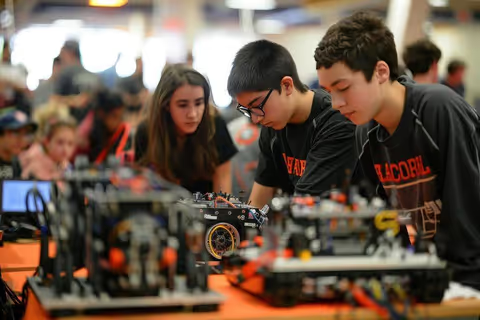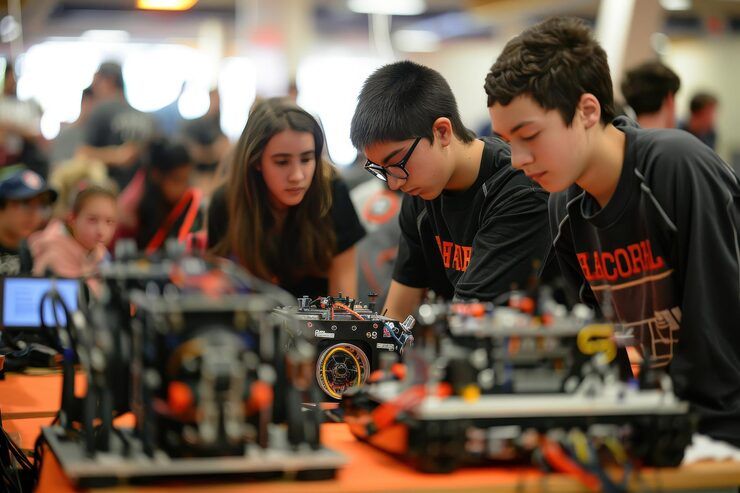
Robotics has become one of the fastest-growing fields in technology, combining mechanical engineering, electronics, programming, and artificial intelligence into systems that can perform tasks with precision and automation. As industries increasingly adopt robotic technologies, the demand for people who understand how robots are designed, programmed, operated, and maintained continues to grow.
Robotics training courses help learners build practical knowledge and technical skills in this multidisciplinary field. Whether someone is a student exploring technology, a professional looking to upgrade skills, or a beginner interested in automation, robotics education provides a structured path to understanding modern robotic systems.
The field is no longer limited to manufacturing plants. Robotics is now used in healthcare, agriculture, logistics, education, construction, research, and even everyday consumer products. Learning robotics helps individuals understand how intelligent machines interact with the physical world and solve real-world problems through automation.
This guide explains what robotics training courses include, why they are important, the latest developments in robotics education, essential learning topics, and how learners can build strong robotics knowledge step by step.
Understanding Robotics Training Courses
A robotics training course is an educational program designed to teach the concepts, technologies, and practical applications of robotics. These courses combine theoretical knowledge with hands-on learning to help students understand how robotic systems function from hardware to software.
A typical robotics course introduces learners to sensors, motors, controllers, programming languages, and communication systems that allow robots to perform automated tasks. Many courses also include simulations and project-based learning to strengthen problem-solving skills.
Rather than focusing on a single technology, robotics education integrates several disciplines into one learning experience. Students learn how mechanical components, electronic circuits, software logic, and intelligent decision-making work together within a robotic system.
Modern robotics courses are available for different learning levels, making the subject accessible to beginners as well as advanced learners.
Why Robotics Skills Matter Today
Automation is transforming industries around the world, creating new opportunities for robotics professionals in manufacturing, logistics, healthcare, transportation, agriculture, and research. Organizations increasingly rely on robotic systems to improve productivity, accuracy, and workplace safety.
Learning robotics provides knowledge that is valuable across multiple technology fields because robotics combines engineering, programming, artificial intelligence, computer vision, embedded systems, and automation.
Robotics education also helps learners develop transferable skills including logical thinking, mathematical reasoning, hardware troubleshooting, software development, and system integration. These abilities are useful in many technology-related careers beyond robotics itself.
As educational institutions introduce robotics into school and university programs, more learners are gaining exposure to robotics concepts at an earlier stage, making robotics literacy an increasingly important technical skill.
What You Learn in Robotics Training Courses
Robotics courses usually begin with foundational concepts before introducing more advanced technologies. Learners gradually understand how different components interact to create autonomous or semi-autonomous machines.
Robotics Fundamentals
The first stage introduces robotics concepts, robot classifications, movement systems, actuators, sensors, controllers, and robotic architectures. Students learn how robots receive information, process decisions, and perform actions.
Programming for Robotics
Programming is one of the core components of robotics education. Learners understand how software controls robotic movement, decision-making, and communication between hardware components.
Programming topics often include variables, loops, conditional logic, object-oriented programming, and robotics-specific libraries used for controlling sensors and motors.
Electronics and Embedded Systems
Robotic systems depend on electronic hardware for sensing and control. Courses explain microcontrollers, circuit design, power management, digital signals, analog sensors, and communication protocols.
Understanding embedded systems helps learners connect software instructions with physical robotic hardware.
Sensors and Actuators
Sensors allow robots to understand their environment, while actuators create movement. Robotics training explains how cameras, ultrasonic sensors, infrared sensors, gyroscopes, encoders, motors, servos, and robotic arms function together.
Artificial Intelligence in Robotics
Many modern robotics courses introduce AI concepts such as machine learning, computer vision, object detection, navigation algorithms, and autonomous decision-making.
AI enables robots to recognize objects, understand environments, and improve task performance through data-driven models.
Different Types of Robotics Training Courses
Robotics education covers several specialized areas depending on learning goals and industry applications.
Industrial Robotics
Industrial robotics focuses on robotic arms, automation systems, programmable logic controllers, production line automation, safety systems, and manufacturing processes.
Learners understand how robots perform repetitive industrial tasks with speed and precision.
Mobile Robotics
Mobile robotics teaches navigation systems, autonomous movement, mapping, localization, obstacle avoidance, and robot mobility across different environments.
AI Robotics
AI robotics combines robotics with machine learning and computer vision to build intelligent robotic systems capable of perception and decision-making.
Educational Robotics
Educational robotics introduces robotics through simplified hardware platforms, programming exercises, sensors, and project-based learning suitable for beginners and students.
Service Robotics
Service robotics focuses on robots used in healthcare, hospitality, logistics, agriculture, retail, and public services where robots interact with people and environments.
Robotics Applications Across Industries
Robotics is no longer limited to factory automation. Training courses often explain how robotics technologies solve challenges in many industries.
Industry | How Robotics Is Used |
| Manufacturing | Assembly, welding, packaging, inspection, and production automation. |
| Healthcare | Surgical assistance, rehabilitation devices, laboratory automation, and medical support systems. |
| Agriculture | Crop monitoring, precision farming, harvesting assistance, and field automation. |
| Logistics | Warehouse automation, autonomous delivery systems, sorting robots, and inventory management. |
| Construction | Site inspection, autonomous equipment, surveying, and building assistance. |
| Education | Hands-on STEM learning, coding education, robotics competitions, and research projects. |
| Research | Autonomous exploration, laboratory automation, drones, underwater robotics, and space robotics. |
Understanding these applications helps learners connect robotics concepts with real-world technologies.
Essential Skills Developed Through Robotics Training
Robotics education develops both technical knowledge and practical engineering skills.
Programming skills improve through writing software that controls robotic behavior. Electronics knowledge helps learners understand sensors, circuits, and controllers. Mechanical understanding explains robot movement, gears, actuators, and structural design.
Problem-solving becomes an important part of robotics because learners regularly diagnose hardware issues, debug software, and improve robot performance through testing.
Robotics projects also encourage systems thinking, where learners understand how multiple technologies work together within one integrated solution.
Tools and Technologies Used in Robotics Learning
Modern robotics training introduces learners to widely used hardware and software tools without focusing on a single platform.
Common learning technologies include microcontrollers, embedded computing devices, robotic operating systems, simulation software, sensor modules, motor drivers, computer vision frameworks, and robotic programming environments.
Simulation tools allow learners to build and test robotic systems virtually before working with physical hardware. This approach helps beginners understand robot behavior while reducing hardware complexity.
Many courses also explain robotic communication protocols that enable different devices and sensors to exchange information within automated systems.
How Robotics Courses Support Beginners
Robotics may seem complex because it combines multiple technical disciplines, but beginner-friendly courses gradually introduce concepts through simple projects and interactive learning.
Students often begin by learning how sensors collect information and how programming controls LEDs, motors, and basic robotic movement. As confidence grows, learners build more advanced projects involving autonomous navigation, robotic arms, or intelligent vision systems.
Practical learning helps beginners understand theoretical concepts more effectively because they see immediate results from programming and hardware integration.
A gradual learning approach makes robotics accessible even for learners without previous engineering experience.
Recent Trends in Robotics Education During 2025–2026
Robotics education has evolved significantly over the past year as new technologies become part of learning programs.
Artificial intelligence has become a larger part of robotics training, with more courses introducing computer vision, intelligent navigation, and machine learning concepts. Simulation-based robotics learning has expanded, allowing students to practice robotics development in virtual environments before using physical robots.
Collaborative robots, often called cobots, are becoming a major learning topic because they are designed to safely work alongside humans in industrial environments. Educational institutions are also integrating robotics with Internet of Things technologies, enabling robots to communicate with connected devices and cloud platforms.
Digital twins and robotic simulation environments are increasingly used for testing robotic behavior, reducing development time, and improving learning experiences through virtual experimentation.
These trends reflect how robotics education continues adapting to modern automation technologies.
Choosing the Right Robotics Learning Path
The ideal robotics learning path depends on a learner's background and interests rather than a single career destination.
Beginners benefit from learning programming fundamentals, electronics, and basic robotics concepts before moving into automation or artificial intelligence. Engineering students often build on mathematics, mechanics, and embedded systems knowledge while exploring robotic applications.
Professionals working in manufacturing may focus more on industrial automation and programmable robotic systems. Learners interested in AI may gradually explore computer vision, autonomous navigation, and intelligent robotics after understanding robotics fundamentals.
A structured progression helps learners connect foundational concepts with advanced robotic technologies more effectively.
Common Challenges While Learning Robotics
Learning robotics involves both software and hardware challenges, making patience and experimentation important parts of the process.
Many beginners initially find electronics and programming difficult because they are learning multiple technologies simultaneously. Hardware troubleshooting can also be challenging when sensors, motors, or communication modules do not behave as expected.
Robotics projects often require testing, debugging, calibration, and repeated improvements before achieving reliable performance. Understanding this iterative process helps learners build confidence instead of expecting immediate results.
Project-based practice is often the best way to strengthen robotics knowledge because it connects theory with practical problem-solving.
Future Scope of Robotics Skills
Robotics continues expanding into new industries as automation technologies become more intelligent and accessible. Autonomous systems, collaborative robots, healthcare robotics, agricultural robotics, warehouse automation, drones, and intelligent service robots are creating new learning opportunities across technology fields.
Future robotics systems are expected to integrate more artificial intelligence, cloud computing, edge computing, and advanced sensor technologies. This means robotics professionals will increasingly work with multidisciplinary technologies rather than standalone machines.
Learning robotics today builds a foundation for understanding future automation systems that combine intelligent software with physical devices operating in real-world environments.
Frequently Asked Questions
What are robotics training courses designed to teach?
Robotics training courses teach learners how robotic systems are designed, programmed, controlled, and applied using mechanical engineering, electronics, sensors, programming, and automation concepts.
Can beginners learn robotics without an engineering background?
Yes. Many robotics courses begin with foundational programming, electronics, and robotics concepts before introducing more advanced technologies, making them suitable for beginners.
Which programming languages are commonly used in robotics?
Robotics education often introduces programming languages used for automation, embedded systems, artificial intelligence, and robotic control depending on the learning level and robotics platform.
What industries use robotics skills?
Robotics skills are used in manufacturing, healthcare, logistics, agriculture, construction, education, transportation, research, and many other industries adopting automation technologies.
What is the difference between robotics and industrial automation?
Robotics focuses on intelligent machines capable of sensing, processing, and performing tasks, while industrial automation includes broader systems that automate industrial processes using controllers, sensors, and robotic equipment.
Conclusion
Robotics training courses provide a structured way to understand one of today's most important technology fields. By combining programming, electronics, mechanics, automation, and artificial intelligence, robotics education helps learners understand how intelligent machines interact with the physical world and solve practical challenges.
As robotics expands into manufacturing, healthcare, logistics, agriculture, education, and research, learning robotics becomes valuable for students, professionals, and technology enthusiasts alike. A strong foundation in robotics concepts, followed by hands-on practice and continuous learning, helps learners build practical skills that remain relevant as automation technologies continue evolving.
Robotics is not only about building machines—it is about understanding how software, hardware, and intelligent systems work together to create solutions that improve efficiency, safety, and innovation across many industries.