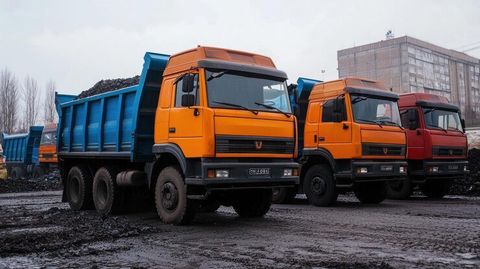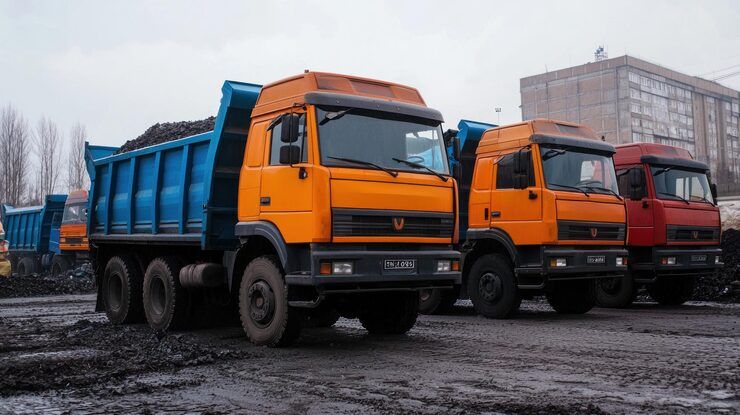
Dump trucks are heavy vehicles designed to transport and unload loose materials such as soil, sand, gravel, rock, construction debris, coal, and other bulk materials. Their defining feature is a hydraulically or mechanically operated body that can be raised to discharge its load.
They are widely used in construction, mining, quarrying, road development, infrastructure projects, agriculture, and material-handling operations.
The basic concept is straightforward: a truck carries material to a designated location and raises its dump body so gravity assists in unloading. Modern heavy-duty dump trucks combine this basic principle with advanced engines, hydraulic systems, electronic controls, cameras, sensors, and increasingly automated technologies.
Main Types of Dump Trucks
Different operating environments require different truck configurations.
Standard dump trucks: General-purpose trucks for construction and road projects.
Articulated dump trucks: Use a pivot between the cab and dump body and are suited to rough terrain.
Rigid dump trucks: Designed for large-scale mining and quarry operations.
Transfer dump trucks: Use separate trailers or containers to increase material-handling flexibility.
Side dump trucks: Discharge material sideways rather than by raising the body vertically.
Underground dump trucks: Designed for restricted mine environments.
Off-highway dump trucks: Built primarily for controlled industrial, mining, and quarry sites.
Key Components
A modern dump truck commonly includes:
Diesel or alternative-power drivetrain
Hydraulic lifting system
Dump body
Chassis and suspension
Axles and heavy-duty tires
Braking system
Steering system
Operator cabin
Electronic control systems
Reversing camera or monitoring equipment
Load and payload monitoring systems
The selection of a truck depends on payload, terrain, haul distance, material density, road conditions, and operating environment.
| Truck Type | Typical Environment | Main Characteristic |
|---|---|---|
| Standard | Construction and road projects | Versatile configuration |
| Articulated | Rough terrain | High maneuverability |
| Rigid | Large mines and quarries | Very high payload capability |
| Side dump | Construction and material handling | Side discharge |
| Underground | Mining | Compact mine-oriented design |
| Off-highway | Mines and large earthworks | Heavy-duty operation |
Why Dump Trucks Matter Today
Dump trucks are a fundamental part of material movement in construction and mining. Excavators, loaders, crushers, road-building equipment, and other machinery depend on effective transportation of bulk material between operating areas.
Construction Applications
Dump trucks are commonly used to transport:
Excavated soil
Sand and gravel
Crushed stone
Construction debris
Asphalt materials
Aggregate
Fill material
Demolition waste
Large infrastructure projects can require continuous movement of material between excavation, processing, storage, and placement areas.
Mining Applications
Mining operations use dumpers and haul trucks to move overburden, ore, coal, and waste rock.
Mining trucks can be substantially larger than road-going dump trucks because they operate within controlled mine environments where roads, loading areas, and traffic systems are designed around heavy equipment.
Payload and Productivity
Payload capacity is one of the most important specifications when evaluating a dump truck. However, maximum payload should not be considered independently.
Operating efficiency can depend on:
Haul distance
Loading time
Dumping time
Travel speed
Road gradient
Material density
Tire condition
Fuel or energy consumption
Operator performance
Maintenance intervals
Traffic management
A simple production estimate can be represented as:
Approximate hourly material movement = Payload × Trips per hour
Actual results will vary because loading, travel, dumping, waiting, and return times are not identical across projects.
Recent Dump Truck and Construction Equipment Developments
The dump-truck sector is closely connected with developments in mining, construction, infrastructure, automation, and heavy equipment manufacturing.
India's Construction Equipment Industry in 2025–26
India's construction equipment industry recorded total sales of 140,191 units during FY2025–26, representing approximately 3% growth from the previous year, according to industry information reported in May 2026. Exports increased 31.5% year over year to 16,885 units. Infrastructure development, mining, roads, railways, urban development, and energy projects were identified as important drivers.
The wider industry is relevant to dump trucks because earthmoving and material-transport equipment form an important part of infrastructure and mining operations.
Greater Automation
Modern heavy dump trucks increasingly incorporate electronic monitoring, GPS-based fleet management, payload measurement, collision-warning systems, cameras, and machine-health monitoring.
Large mining operations are also investigating autonomous haulage systems that can control trucks along predefined routes with limited direct operator input.
These technologies can support:
Fleet tracking
Route optimization
Payload monitoring
Fuel or energy monitoring
Maintenance planning
Collision prevention
Operator awareness
Production analysis
Safety Technology
Safety has become an especially important focus in mining dump-truck operations.
In November 2025, the Directorate General of Mines Safety (DGMS) issued guidance covering heavy earth-moving machinery, including trucks and tippers. The document emphasized fail-safe braking, proximity-warning systems, anti-collision devices, operator-fatigue detection, suitable cabins, separate haul roads for light vehicles, and operator training.
The guidance also referenced the 2024 amendment to IS 17055 Part 6, which addresses safety requirements for dumpers and tippers.
Electrification and Alternative Power
Manufacturers and mining companies are also examining battery-electric and other lower-emission heavy equipment technologies.
Large battery-electric haul trucks can potentially reduce direct exhaust emissions at the operating site, although their overall environmental impact depends on battery production, electricity sources, operating conditions, charging infrastructure, and equipment utilization.
Laws, Regulations and Policies in India
India provides an important regulatory example because dump trucks used in mines can fall under specific mine-safety requirements in addition to general vehicle and workplace regulations.
The applicable rules depend on whether the vehicle operates on public roads, within a mine, at a construction site, or in another controlled industrial environment.
Mining Safety Requirements
The Directorate General of Mines Safety maintains India's mining-safety framework, including the Coal Mines Regulations, 2017 and Metalliferous Mines Regulations, 1961. DGMS also publishes technical circulars relating to heavy earth-moving machinery and wheeled trackless transportation equipment.
For mining operations, dumpers and tippers are therefore subject to specific operational and safety considerations.
2025 DGMS Safety Guidance
DGMS's 2025 guidance emphasized several measures for heavy earth-moving machinery:
Fail-safe braking systems
Proximity-warning systems
Mechanical anti-collision devices
Operator-fatigue detection
Suitable operator cabins
Separate haul roads for light vehicles
Competency-based operator training
Safe operating procedures
The guidance also states that relevant safety systems should be implemented in accordance with applicable BIS requirements and mine regulations.
Haul-Road Safety
DGMS guidance for truck transport in opencast mines emphasizes maintaining haul roads in suitable condition. It also addresses road width, visibility at bends, traffic arrangements, and gradients.
The model precautions state that, where practicable, one-way traffic should be arranged, while road dimensions and gradient should be controlled according to the applicable mining conditions.
2026 Regulatory Developments
DGMS's current legislative resources include the Occupational Safety, Health and Working Conditions (Central) Rules, 2026, as well as draft 2026 regulations for coal and metalliferous mines.
This demonstrates that India's occupational and mine-safety framework continues to evolve, making it important for mine operators to consult the latest official requirements rather than relying only on older operating procedures.
Tools and Resources for Dump Trucks
Evaluating or managing dump trucks requires more than comparing engine specifications. Payload, operating conditions, safety systems, maintenance, and fleet productivity all need consideration.
Useful Tools
Payload calculators: Estimate material movement per trip.
Haul-cycle calculators: Estimate trips per hour from loading, travel, dumping, and return times.
Fleet-management software: Tracks vehicle location, utilization, and operating data.
GPS fleet tracking: Supports route and movement monitoring.
Fuel-consumption calculators: Compare fuel use against operating hours and payload.
Tire-monitoring systems: Track pressure and temperature.
Payload-monitoring systems: Help prevent excessive loading.
Maintenance-management software: Tracks inspections and maintenance intervals.
CAD and site-planning tools: Help design haul roads and material-flow routes.
DGMS resources: Provide current Indian mine-safety legislation and technical guidance.
BIS standards resources: Help identify relevant machinery and safety standards.
Specifications Worth Comparing
When researching heavy-duty dump trucks, useful specifications include:
Rated payload
Body capacity
Engine power
Gross vehicle weight
Turning radius
Ground clearance
Maximum grade capability
Brake configuration
Hydraulic capacity
Tire dimensions
Fuel-tank capacity
Cabin safety features
Payload monitoring
Proximity detection
Camera systems
Fleet-management connectivity
Payload should always be considered alongside the operating environment. A truck designed for a large open-pit mine may not be appropriate for urban road construction, while a road-going dump truck may not be suitable for extreme mining conditions.
Frequently Asked Questions
What is a dump truck?
A dump truck is a heavy vehicle designed to transport bulk materials and discharge them using a raised or tilting body. Dump trucks are widely used in construction, mining, quarrying, infrastructure, and material-handling operations.
What is the difference between a dump truck and a mining haul truck?
A conventional dump truck may operate on public roads and construction sites, while a mining haul truck is generally designed for controlled mine environments. Mining haul trucks can have much larger payload capacities and specialized systems for steep grades, heavy loads, and mine haul roads.
What determines dump-truck payload capacity?
Payload depends on the vehicle's structural design, axle configuration, body capacity, powertrain, braking system, tires, and applicable operating limits. The permitted payload must also comply with relevant road or site requirements.
What safety systems are important for mining dump trucks?
Important systems can include fail-safe brakes, proximity-warning technology, anti-collision systems, cameras, fatigue monitoring, suitable operator cabins, and effective haul-road controls. DGMS specifically highlighted these areas in its 2025 guidance.
Are electric dump trucks available?
Yes. Battery-electric and other alternative-power dump trucks are being developed and deployed in selected construction, quarry, and mining applications. Suitability depends on payload, duty cycle, charging infrastructure, terrain, operating hours, and site conditions.
Conclusion
Dump trucks are essential material-transport machines for construction, mining, quarrying, road development, and large infrastructure projects. Their basic function is simple, but modern machines combine hydraulic systems, advanced drivetrains, electronic controls, monitoring equipment, and increasingly sophisticated safety technologies.
The Indian construction-equipment sector recorded strong activity during FY2025–26, with total equipment sales reaching 140,191 units and exports rising 31.5% year over year. Continued infrastructure and mining activity is supporting demand for advanced earthmoving and transportation equipment.
Safety remains particularly important for mining applications. DGMS has emphasized braking systems, proximity warnings, anti-collision technology, operator monitoring, haul-road management, and competency-based training for heavy earth-moving machinery.
For organizations researching dump trucks, mining dump trucks, heavy-duty construction trucks, or off-highway haul trucks, the most useful evaluation criteria include payload, body capacity, terrain capability, braking, safety technology, operating cycle, maintenance requirements, and regulatory compliance.
The continued development of automation, connected fleet management, alternative powertrains, and advanced safety systems is gradually transforming dump trucks from conventional material carriers into increasingly connected components of modern construction and mining operations.