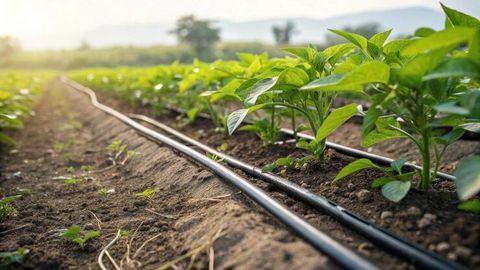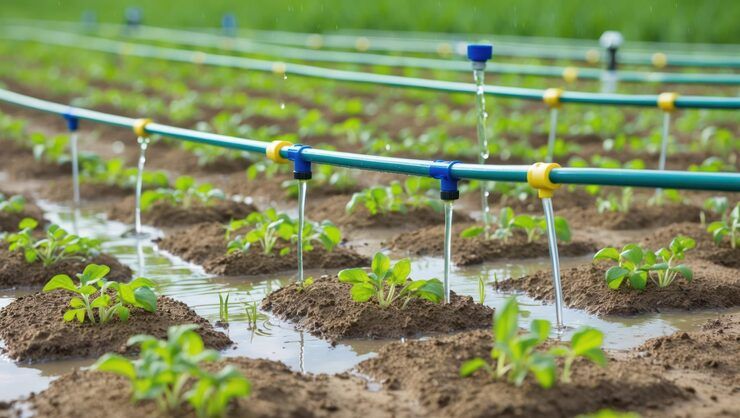
Drip irrigation is an agricultural watering method that delivers water gradually near plant roots through a network of pipes, tubing, valves, and small outlets called emitters. Instead of distributing water across an entire field, the system directs water to selected areas where crops can use it.
Farmers use drip irrigation for vegetables, fruit trees, vineyards, greenhouse crops, and many other agricultural applications. The system can help manage limited water resources, particularly in regions affected by irregular rainfall, high temperatures, or seasonal drought.
Understanding how drip irrigation supports farm water management involves more than installing irrigation equipment. Effective results depend on crop requirements, soil conditions, water quality, system design, maintenance, and the timing of irrigation.
Understanding How Drip Irrigation Works
A typical drip irrigation system begins at a water source, such as a well, reservoir, or agricultural storage tank. Water passes through a pumping or pressure-control arrangement, filtration equipment, and a distribution network before reaching individual plants.
The main components include:
Water source: Supplies water to the irrigation network.
Pump and pressure regulator: Maintain suitable operating pressure when required.
Filters: Remove particles that could block emitters.
Main and lateral pipes: Transport water throughout the field.
Emitters: Release controlled quantities of water near plant roots.
Valves and controllers: Regulate water flow and irrigation schedules.
Monitoring equipment: Measures pressure, flow, or soil moisture.
Some systems operate manually, while others use timers, automated valves, soil moisture sensors, or weather-based controllers.
How Water Moves Through the System
Water travels through the pipes and exits through emitters at a controlled rate. This creates a moist area around the roots, often called the wetted zone.
The shape and size of this zone depend on soil texture, application rate, irrigation duration, and the depth of the root system. Sandy soils generally allow water to move downward more rapidly, while clay-rich soils may spread water differently.
For this reason, irrigation scheduling should be based on field conditions rather than assuming that every crop or soil type needs the same amount of water.
Why Drip Irrigation Matters for Farm Water Management
Agriculture accounts for a substantial share of freshwater withdrawals worldwide. Managing water carefully is important for farms facing changing rainfall patterns, groundwater pressure, competing water demands, and increasing crop production requirements.
Drip irrigation can help farmers direct water more precisely and monitor how much reaches the root zone. However, the actual water savings depend on the previous irrigation method, system design, crop type, soil, climate, and management practices.
Improving Water-Use Efficiency
When irrigation water is applied across an entire field, some may evaporate, run off the surface, or move below the root zone. Drip irrigation can reduce certain losses by applying water near plants at a controlled rate.
Potential benefits include:
More targeted water application
Reduced surface runoff under suitable conditions
Better control over irrigation timing
Lower wetting of areas between crop rows
More consistent soil moisture when properly managed
Drip irrigation does not eliminate water loss. Evaporation, leakage, drainage, and inefficient scheduling can still occur.
Supporting Crop Growth
Plants require different amounts of water at different growth stages. Seedlings, flowering plants, and crops developing fruit may have different water requirements.
A well-managed drip system can help maintain soil moisture within a suitable range for the crop. This reduces the risk of both water stress and excessive irrigation.
Managing Fertilizer Application
Some drip systems support fertigation, which involves delivering suitable soluble fertilizers through irrigation water. This can help place nutrients near active roots and coordinate nutrient application with crop needs.
Fertigation requires careful control of fertilizer concentration, water quality, equipment compatibility, and environmental risks. Poor management can contribute to emitter blockage, nutrient imbalances, or groundwater contamination.
Recent Developments in Drip Irrigation Technology
During 2025 and 2026, agricultural water management continued to emphasize precision irrigation, digital monitoring, and improved water-use planning.
Smart Irrigation Monitoring
Modern irrigation systems increasingly combine soil moisture sensors, flow meters, weather information, and automated controllers. These tools can help farmers adjust watering schedules according to field conditions rather than relying entirely on fixed routines.
Sensor-based irrigation is especially relevant where rainfall is unpredictable or water availability changes during the growing season. Nevertheless, sensors must be positioned correctly and calibrated to provide useful information.
Solar-Powered Irrigation
Solar-powered pumping systems remain an important area of agricultural development, particularly in rural regions with limited electricity access. When integrated with drip irrigation, solar pumps can move water into a distribution network without depending entirely on grid electricity.
System design must still account for seasonal sunlight, pumping depth, water storage, pressure requirements, and crop demand.
Climate-Responsive Agriculture
Increasing attention to drought preparedness and agricultural resilience has encouraged the use of irrigation scheduling, soil moisture monitoring, and water budgeting.
These practices are relevant to farms of different sizes. However, technology alone cannot resolve water scarcity when groundwater extraction exceeds natural replenishment or when available water supplies are insufficient.
Laws, Policies, and Agricultural Programs
Drip irrigation regulations and agricultural support programs vary by country and region. Farmers should check the rules governing water extraction, groundwater use, irrigation equipment, electricity, and agricultural subsidies in their location.
Agricultural Water Management in India
India promotes micro-irrigation through the Pradhan Mantri Krishi Sinchayee Yojana (PMKSY), which includes the Per Drop More Crop initiative. The program has supported micro-irrigation methods such as drip and sprinkler systems to encourage more efficient agricultural water use.
Implementation arrangements and eligibility conditions may vary by state, crop, farmer category, and current program guidelines. Farmers in Gujarat can consult the relevant state agriculture department for current requirements.
Groundwater and Water-Use Regulations
In areas where irrigation relies on groundwater, local authorities may regulate extraction through permits, restrictions, or other management measures.
Farmers should follow applicable requirements for water abstraction, borewells, water storage, and environmental protection. Efficient irrigation should complement responsible groundwater management rather than encourage unsustainable extraction.
Environmental and Equipment Considerations
Filters, pipes, emitters, and irrigation controllers should be selected and operated according to technical specifications. Fertigation systems may also need safeguards to prevent fertilizer solutions from flowing back into water sources.
Used irrigation tubing and plastic components should be managed responsibly according to applicable waste-handling rules.
Tools and Resources for Effective Irrigation
Several practical tools can help farmers understand crop water requirements and evaluate irrigation performance.
Soil Moisture Sensors
Soil moisture sensors estimate the amount of water present in the soil. Readings can help determine when irrigation is needed, provided the sensors are installed at representative locations and appropriate depths.
Weather and Evapotranspiration Data
Weather information can support estimates of evapotranspiration, which describes water lost through soil evaporation and plant transpiration.
Agricultural weather stations and regional forecasting resources can help farmers adjust irrigation schedules for temperature, rainfall, wind, and humidity.
Irrigation Calculations
A basic water-volume calculation is:
For example, a system delivering 20 litres per minute for 30 minutes applies 600 litres of water, assuming the flow rate remains constant.
Measurement | Example |
|---|---|
System flow rate | 20 litres per minute |
Irrigation duration | 30 minutes |
Total applied water | 600 litres |
Operating periods per day | 2 |
Daily applied volume | 1,200 litres |
This calculation estimates the water entering the system. It does not establish whether the quantity is appropriate for the crop or whether the entire root zone receives adequate moisture.
System Maintenance Checklist
Farmers can periodically check:
Filter cleanliness
Pipe leaks
Pressure consistency
Blocked emitters
Soil moisture at root depth
Water flow at the beginning and end of lateral lines
Controller settings
Fertilizer compatibility, where fertigation is used
Regular inspections can help identify problems before they affect a large part of the field.
Frequently Asked Questions
What is the main purpose of drip irrigation?
Drip irrigation delivers water gradually near plant roots. Its main purpose is to control water application, maintain suitable soil moisture, and support crop growth while reducing avoidable water losses under appropriate conditions.
Which crops can use drip irrigation?
Drip irrigation is used for vegetables, fruit trees, vineyards, greenhouse crops, cotton, and many other crops. The system design should match crop spacing, root development, soil conditions, and seasonal water requirements.
How often should a drip irrigation system operate?
Irrigation frequency depends on soil texture, weather, crop growth stage, root depth, and emitter flow rate. Soil moisture readings and crop water requirements can help determine when and how long to irrigate.
Can drip irrigation work with solar-powered pumps?
Yes. Solar-powered pumps can supply water to drip irrigation networks when the pump capacity, available sunlight, water source, and operating pressure are suitable. Water storage may help maintain irrigation availability when sunlight changes.
How can farmers prevent clogged drip emitters?
Appropriate filtration, regular flushing of irrigation lines, water-quality testing, and routine inspections can help prevent blockages. The correct maintenance method depends on whether the water contains sediment, minerals, algae, or other contaminants.
Conclusion
Drip irrigation supports farm water management by delivering controlled amounts of water near plant roots. When properly designed and maintained, it can help reduce certain irrigation losses, improve control over soil moisture, and support more informed decisions about crop watering.
The best results depend on matching equipment to the crop, soil, climate, water source, and available infrastructure. Soil moisture sensors, weather information, flow measurements, and regular maintenance can help farmers evaluate system performance and adjust irrigation schedules.
Government programs and local water regulations also influence how irrigation systems are adopted and operated. Combining suitable technology with responsible water planning can help farms manage limited water resources while supporting productive and environmentally responsible agriculture.