Modern Bottling Machines play an important role in preparing beverages and other liquid products for distribution. These machines automate several stages, including filling, capping, sealing, and labelling containers. Understanding how they work helps readers learn about modern manufacturing processes. This guide explains their components, operating methods, recent developments, and regulatory requirements in India.
Key Takeaways
Modern bottling machines automate filling, capping, labelling, and packaging operations.
Different machine types handle liquids with varying thickness and characteristics.
Sensors and automation help monitor production accuracy and consistency.
Hygiene standards are important when handling food and beverages.
Related Searches
How do modern bottling machines work?
What are the different types of bottling machines?
How does an automatic bottle filling machine operate?
What is the difference between automatic and semi-automatic bottling?
Are modern bottling machines suitable for different liquids?
How do bottling machines maintain hygiene?
In This Guide
Understanding Modern Bottling Machines and Their Development
Why Modern Bottling Machines Matter in Manufacturing
Recent Developments in Bottling Machine Technology
Indian Regulations and Safety Requirements
Types of Bottling Machines: Features and Differences
Tools and Resources for Understanding Bottling Technology
Frequently Asked Questions About Modern Bottling Machines
Conclusion
Understanding Modern Bottling Machines and Their Development
Modern bottling machines are industrial systems designed to place liquids into containers through controlled mechanical or automated processes. They are commonly used in beverage production, pharmaceutical manufacturing, food processing, cosmetics, and household product industries.
The basic concept of bottling developed from manual filling methods. Earlier production facilities relied on workers to fill containers individually, close their openings, and attach labels. As production requirements increased, manufacturers introduced mechanical equipment to handle repetitive activities.
Modern systems combine mechanical components, electrical controls, sensors, and software. Depending on their design, they can process plastic bottles, glass containers, and other packaging formats.
How Does a Modern Bottling Machine Work?
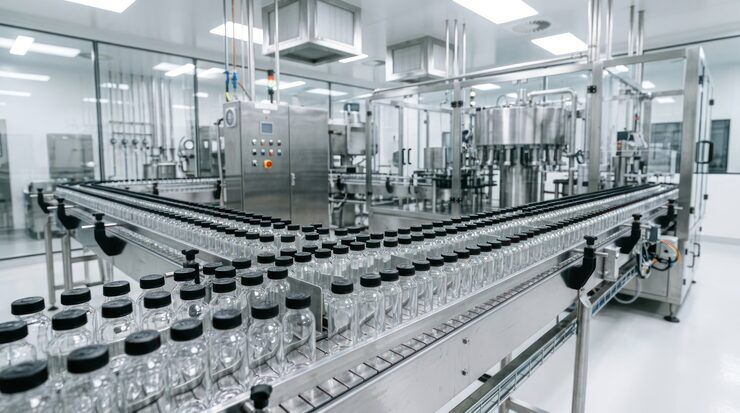
A typical bottling machine follows several connected stages. Containers move through different stations using conveyor belts or automated handling systems.
The general operating process includes:
Bottle feeding: Empty containers enter the production line through an automatic feeding arrangement.
Bottle cleaning: Air or water systems remove dust and unwanted particles, depending on the product and packaging requirements.
Liquid filling: A filling mechanism transfers a measured quantity of liquid into each container.
Capping: Caps or closures are positioned and tightened to secure the opening.
Labelling: Labels containing product information are attached to the containers.
Inspection: Sensors or cameras check filling levels, closures, labels, and visible defects.
Final packaging: Completed containers are grouped into cartons or other transport packaging.
Not every production line contains all these stages. The arrangement depends on the product, container design, hygiene requirements, and production capacity.
Why Modern Bottling Machines Matter in Manufacturing
Bottling equipment has become important because industries need consistent packaging processes across different product categories. Manual handling can create variations in filling quantities, closure tightness, and container presentation.
Automation helps manufacturers manage repetitive operations while maintaining more consistent production conditions. It also allows different machines to operate together as a connected production line.
What Problems Do Bottling Machines Address?
Several everyday manufacturing challenges are addressed through automated bottling equipment.
Filling consistency: Controlled filling mechanisms help maintain the intended liquid quantity in each container.
Product hygiene: Enclosed filling arrangements can reduce unnecessary contact between liquids and the surrounding environment.
Production coordination: Conveyor systems connect different packaging stages, reducing interruptions between operations.
Container protection: Proper handling mechanisms help reduce bottle damage during movement and filling.
Quality monitoring: Sensors and inspection equipment identify certain packaging problems before containers leave the production line.
These functions matter to beverage producers, pharmaceutical companies, food processors, and cosmetic manufacturers. Each industry has different requirements concerning liquid handling, packaging materials, cleanliness, and product protection.
Recent Developments in Bottling Machine Technology
Recent developments between 2024 and 2026 show increasing attention to automation, equipment monitoring, production flexibility, and packaging materials.
How Is Automation Changing Bottling Operations?
Modern systems increasingly use programmable logic controllers (PLCs), touchscreen interfaces, and electronic sensors. These technologies allow operators to monitor production activities and adjust machine settings.
Some systems also use connected monitoring platforms to collect information about operating speed, equipment interruptions, and maintenance requirements.
Artificial intelligence and machine vision are gradually becoming part of industrial inspection systems. Cameras can examine bottle positioning, label placement, cap alignment, and visible packaging defects.
What Role Does Sustainable Packaging Play?
Packaging manufacturers are exploring ways to reduce unnecessary material use while maintaining container strength and product protection.
Current developments include:
Lightweight plastic bottle designs.
Greater attention to recyclable packaging materials.
Improved filling accuracy to reduce product wastage.
Equipment adjustments for different bottle shapes and sizes.
More efficient cleaning and water management systems.
Another development is the growing use of flexible machine configurations. These arrangements allow production facilities to handle different container formats without completely redesigning their production lines.
Indian Regulations and Safety Requirements
Bottling operations in India must consider applicable food safety, packaging, hygiene, and measurement regulations. Requirements vary according to the product category and intended use.
What FSSAI Rules Apply to Bottling Machines?
The Food Safety and Standards Authority of India (FSSAI) regulates food safety requirements under the Food Safety and Standards Act, 2006.
The Food Safety and Standards (Packaging) Regulations, 2018 establish requirements for materials that come into contact with food.
Important considerations include:
Food-contact materials must meet applicable food-grade requirements.
Packaging materials must be suitable for the intended product.
Containers must protect products against contamination.
Sealing materials must be compatible with the container and closure.
Reused glass bottles and certain large plastic containers must meet appropriate durability and cleaning requirements.
FSSAI hygiene requirements also address sanitary practices and food safety management systems in manufacturing and packaging facilities.
What Other Indian Rules Are Relevant?
The Legal Metrology (Packaged Commodities) Rules, 2011 address declarations on applicable packaged products, including net quantity and other prescribed information.
Bottling equipment must therefore support appropriate filling and measurement controls. Product labels must also meet the applicable declaration requirements.
The Bureau of Indian Standards (BIS) develops Indian Standards for various materials and industrial products. Applicable standards depend on the equipment, packaging material, and product category.
Types of Bottling Machines: Features and Differences
Different bottling machines are designed for different production requirements. Their operating methods depend on liquid characteristics, container shapes, filling accuracy, and automation levels.
Machine Type | Main Function | Common Application |
|---|---|---|
Manual filling machine | Uses operator-controlled filling | Small production batches |
Semi-automatic machine | Combines manual handling with automated filling | Small and medium facilities |
Automatic filling machine | Controls filling through automated systems | Beverage production |
Gravity filling machine | Uses gravity to transfer liquids | Water and other thin liquids |
Piston filling machine | Uses a piston mechanism to measure liquids | Thick liquids and creams |
Rotary filling machine | Fills containers through rotating stations | Continuous production lines |
Aseptic filling machine | Fills products under controlled sterile conditions | Certain beverages and pharmaceutical products |
Automatic vs Semi-Automatic Bottling Machines
Automatic machines perform several operations with limited manual intervention. Semi-automatic systems require operators to position containers or initiate certain activities.
The choice depends on production volume, available space, workforce requirements, product characteristics, and operational complexity. Neither arrangement is suitable for every manufacturing environment.
Tools and Resources for Understanding Bottling Technology
Several technical resources help readers understand bottling equipment, operating processes, and packaging requirements.
FSSAI official resources: Provide information about Indian food safety, packaging, and hygiene regulations.
BIS standards database: Contains information about applicable Indian product and material standards.
PLC programming platforms: Tools such as Siemens TIA Portal and Rockwell Automation Studio 5000 help explain industrial automation and machine control.
CAD platforms: Autodesk AutoCAD and SolidWorks are used to understand equipment layouts, mechanical components, and machine designs.
OEE calculators: Overall Equipment Effectiveness calculators help assess equipment availability, operating performance, and production quality.
These resources cover different aspects of industrial bottling, from machine design and automation to regulatory compliance and production monitoring.
Frequently Asked Questions About Modern Bottling Machines
1. How do modern bottling machines work?
They move empty containers through filling, capping, labelling, inspection, and packaging stages using mechanical and automated systems.
2. What are modern bottling machines used for?
They are used to package water, juices, milk, soft drinks, oils, cosmetics, pharmaceutical liquids, and other suitable products.
3. What is the difference between automatic and semi-automatic bottling machines?
Automatic systems perform multiple operations with limited manual intervention, while semi-automatic systems require operators for certain activities.
4. How do bottling machines maintain filling accuracy?
They use controlled filling valves, flow meters, weighing systems, sensors, or piston mechanisms to regulate liquid quantities.
5. Are modern bottling machines suitable for different liquids?
Yes. Different filling technologies are designed for thin, thick, carbonated, and temperature-sensitive liquids, depending on equipment specifications.
Conclusion
Modern bottling machines combine mechanical equipment, electronic controls, and automated inspection systems to package different liquid products. Their processes generally include container preparation, filling, capping, labelling, and final packaging. Developments in sensors, machine vision, and connected monitoring are influencing how bottling facilities operate. In India, applicable FSSAI, Legal Metrology, and BIS requirements form part of the wider packaging and manufacturing environment.