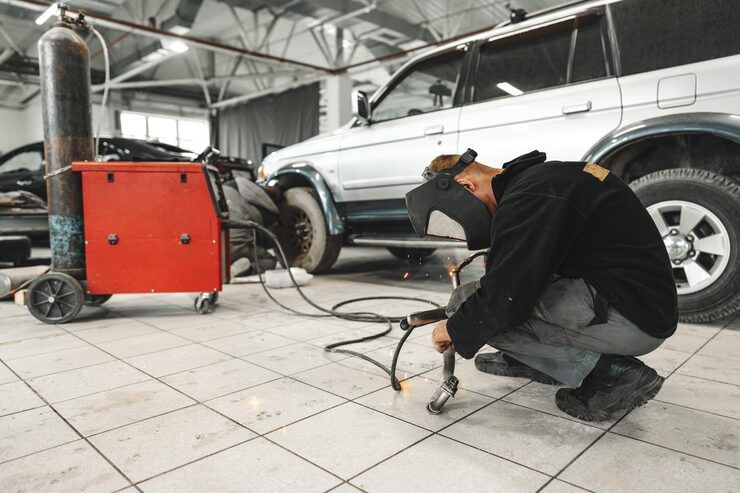
Portable welding units have become important tools for fabrication, maintenance, construction, transportation, agriculture, infrastructure, and industrial repair. Their compact designs allow welding equipment to be moved closer to the work area instead of requiring every component to remain inside a fixed workshop.
Understanding Portable Welding Units
Portable welding units are compact welding power sources designed to be transported between different work areas. Depending on their design, they may operate from electrical power, an internal engine-generator, or rechargeable batteries.
The basic purpose is to provide controlled electrical energy for creating an arc between an electrode and a metal workpiece. The resulting heat melts the joining area and, depending on the welding process, electrode or filler material.
Portable systems are available for several welding processes, including:
Stick or shielded metal arc welding (SMAW)
Gas metal arc welding (GMAW/MIG)
Gas tungsten arc welding (GTAW/TIG)
Flux-cored arc welding (FCAW)
Plasma-based processes in specialized equipment
The appropriate unit depends on the material, thickness, welding position, available power, duty cycle, and required weld characteristics.
Main Types of Portable Welding Units
Electrical inverter welders are among the most compact modern options. They use electronic power conversion to provide controlled welding current while reducing the size and weight of the power source.
Engine-driven welding generators combine welding capability with electrical generation. These units can be useful in locations where grid electricity is unavailable or unreliable.
Battery-powered welding systems represent another developing category. They use rechargeable battery packs and electronic controls to provide welding capability without a continuous connection to a conventional electrical outlet.
Important Specifications
When evaluating a portable welding unit, several technical specifications are relevant:
Welding current range
Input voltage
Duty cycle
Output power
Welding process compatibility
Electrode diameter range
Weight and dimensions
Battery capacity for battery-powered models
Generator capacity for engine-driven systems
Protection ratings
Thermal management
Digital control features
A higher maximum current does not automatically indicate that a unit is appropriate for every application. Material thickness, welding process, duty cycle, electrode selection, and operator technique must also be considered.
Why Portable Welding Units Matter Today
Portable welding equipment supports industries where metal structures, machinery, pipelines, vehicles, agricultural equipment, and infrastructure cannot easily be moved to a conventional fabrication area.
Supporting Mobile Fabrication
A portable welding machine can bring the power source closer to the structure being repaired or assembled. This can reduce unnecessary movement of large components and make certain field operations more practical.
Industries using portable welding technology include:
Construction
Shipbuilding and marine operations
Agriculture
Automotive repair
Heavy equipment maintenance
Metal fabrication
Infrastructure maintenance
Energy infrastructure
Railway maintenance
Industrial plant maintenance
Improving Equipment Flexibility
Modern inverter-based welding machines can provide precise control over current and voltage while maintaining relatively compact dimensions.
Digital controls can allow operators to select welding parameters according to the electrode, material, and process. Some systems also provide programmable settings, fault detection, thermal protection, and digital displays.
Battery-Powered Welding Technology
Battery-powered welding units are attracting attention because rechargeable energy storage can reduce dependence on continuous grid power or large engine generators.
These systems are particularly interesting for short-duration welding operations, remote maintenance, and locations where portability is a major requirement.
However, battery capacity, charging time, output current, ambient temperature, and duty cycle remain important technical considerations.
Portable Unit Comparison
| Unit Type | Main Power Source | Key Strength | Typical Application |
|---|---|---|---|
| Inverter welder | Electrical supply | Compact and efficient | Fabrication and maintenance |
| Engine-driven welder | Fuel-powered generator | Independent electrical generation | Remote industrial work |
| Battery-powered unit | Rechargeable battery | High mobility | Short-duration field welding |
| Transformer welder | Electrical supply | Simple electrical design | Traditional workshop use |
| Multi-process unit | Electrical supply | Multiple welding processes | Flexible fabrication |
Recent Developments in Portable Welding Technology
Portable welding technology continued evolving through 2025 and 2026, particularly around battery operation, digital controls, energy efficiency, electromagnetic compatibility, and automated monitoring.
Updated International Welding Standards
IEC 60974-1:2021 covers safety and performance requirements for arc-welding power sources used for industrial and professional applications. The standard includes welding power sources supplied by electricity, batteries, or mechanical means.
This is particularly relevant to portable equipment because battery-powered welding systems are increasingly included within the broader technical framework for arc-welding power sources.
2026 EMC Update
A notable recent development is IEC 60974-10:2020+AMD1:2026, published as a consolidated version in August 2026. It addresses electromagnetic compatibility for arc-welding equipment and includes requirements relevant to battery-powered equipment and equipment incorporating radio transmitters or receivers.
This reflects the growing use of electronics, digital controls, communication functions, and rechargeable power systems in modern welding equipment.
More Digital Welding Controls
Portable welding machines increasingly use electronic control systems instead of purely mechanical adjustment. Digital interfaces can monitor electrical parameters and provide more repeatable settings.
Some advanced systems can record operating information, detect abnormal conditions, and communicate with external monitoring platforms.
Greater Interest in Energy Efficiency
Energy efficiency is becoming increasingly relevant as manufacturers develop smaller inverter-based systems and battery-powered equipment. IEC 60974-1 includes technical considerations related to welding power-source performance and energy efficiency.
The trend toward efficient power conversion can reduce equipment size while maintaining useful welding output.
Updated Welding Terminology
The American Welding Society released AWS A3.0M/A3.0:2025, updating welding terminology and incorporating newer concepts related to additive manufacturing, nondestructive examination, hybrid welding, plastic welding, and waveform-controlled welding.
For engineers, inspectors, educators, and technical documentation teams, consistent terminology helps reduce confusion across international projects.
Global Laws, Regulations and Standards
Portable welding units are affected by electrical, workplace-safety, environmental, electromagnetic-compatibility, and equipment standards. Requirements differ by country, so manufacturers and operators should verify the rules applicable to their location and application.
United States
In the United States, OSHA addresses welding, cutting, and brazing through specific workplace standards. General Industry requirements include 29 CFR 1910 Subpart Q, covering areas such as fire prevention, oxygen-fuel equipment, and arc welding.
OSHA's arc-welding requirements state that equipment should be selected for safe application, installed safely, and operated by appropriately instructed and qualified personnel.
European Union
Equipment placed on the European market can be affected by applicable EU product-safety, electromagnetic-compatibility, machinery, electrical, and environmental legislation.
The precise requirements depend on the equipment design and intended use. Manufacturers should determine which legislation and harmonized standards apply before placing equipment on the market.
International Standards
IEC standards provide an important technical reference for welding equipment used across international markets. IEC 60974-1 addresses welding power sources, while IEC 60974-10 addresses electromagnetic compatibility.
For structural steel applications, AWS D1.1/D1.1M:2025 establishes requirements covering design, fabrication, qualification, and inspection.
Core Safety Considerations
Portable welding work can involve electrical hazards, intense light, heat, fumes, sparks, fire risks, compressed gases, and hot metal.
Important precautions include:
Inspecting cables and connectors before use
Providing suitable ventilation
Keeping combustible materials away from hot work
Using appropriate eye and face protection
Wearing suitable protective clothing
Checking grounding arrangements
Protecting cylinders from damage and heat
Maintaining adequate fire-prevention measures
Following the equipment manufacturer's technical instructions
Applying additional controls in confined spaces
OSHA specifically identifies fire prevention, protective equipment, ventilation, and equipment handling among important welding-safety considerations.
Tools and Resources for Portable Welding
Several technical resources can help users understand, configure, inspect, and maintain portable welding systems.
Useful Tools
Welding parameter calculators: Help estimate current, voltage, travel speed, and related settings.
Duty-cycle calculators: Help determine how long equipment can operate within its rated operating cycle.
Welding process selection charts: Compare SMAW, GMAW, GTAW, and FCAW according to material and application.
Digital multimeters: Useful for electrical inspection and troubleshooting.
Thermal cameras: Can help identify unusual heat patterns in electrical components.
Weld inspection gauges: Assist with checking weld dimensions and profiles.
Portable fume extraction equipment: Helps manage airborne welding contaminants.
Battery monitoring software: Useful for rechargeable welding systems.
Machine manuals and technical datasheets: Provide rated output, duty-cycle information, connection requirements, and safety instructions.
AWS standards resources: Provide technical references for welding procedures, terminology, inspection, and qualification.
OSHA welding resources: Provide workplace-safety information for welding, cutting, and brazing operations.
Choosing the Right Portable Unit
A practical selection process can begin by identifying:
Material type
Material thickness
Welding process
Required current range
Available power source
Expected duty cycle
Required portability
Environmental conditions
Safety requirements
Applicable technical standards
This approach helps match the equipment's technical characteristics with the actual application rather than selecting a unit based only on maximum output.
Frequently Asked Questions
What are portable welding units?
Portable welding units are compact welding power sources designed to be transported between work locations. They can use electrical power, engine-driven generation, or rechargeable batteries depending on the design.
Are battery-powered welding units practical?
Battery-powered welding units can be practical for selected applications where mobility and independence from continuous grid electricity are important. Their suitability depends on battery capacity, welding current, duty cycle, charging arrangements, and operating conditions.
What is duty cycle in welding?
Duty cycle indicates the proportion of a defined operating period during which a welding machine can operate at a specified output before a cooling period may be required. The rating should always be interpreted according to the manufacturer's stated test conditions.
Which standards apply to portable welding equipment?
Applicable standards vary by market and equipment type. IEC 60974 provides important international requirements for arc-welding equipment, while national workplace rules and regional product legislation may also apply.
What should be checked before using a portable welding unit?
Users should inspect cables, connectors, grounding, electrodes or wire-feed components, ventilation, protective equipment, and the surrounding work area. The machine should also be operated within its rated electrical and thermal limits.
Conclusion
Portable welding units provide a flexible way to perform metal-joining work where conventional stationary equipment is impractical. Inverter technology, digital controls, battery power, and improved monitoring are making modern equipment more compact and adaptable.
Developments during 2025 and 2026 demonstrate that portable welding technology is becoming increasingly connected with electronic control, battery energy storage, electromagnetic compatibility, and digital technical documentation. The 2026 amendment to IEC 60974-10 is particularly relevant to modern equipment incorporating battery systems and communication electronics.
At the same time, workplace safety remains a central consideration. International standards and national regulations address equipment performance, electrical protection, fire prevention, ventilation, protective equipment, and operator competence.
For anyone researching portable welding machines, battery-powered welding equipment, inverter welding machines, industrial welding equipment, or MIG and TIG welding systems, the most important factors include welding process, material, output range, duty cycle, power source, portability, environmental conditions, safety controls, and applicable standards.
As manufacturing, infrastructure maintenance, construction, transportation, and energy industries continue to evolve, portable welding technology is likely to remain an important part of flexible metal fabrication and field maintenance.