Security cameras have changed significantly over the past few years. Traditional surveillance systems were mainly designed to record video continuously and allow users to review footage later. While they helped monitor homes, offices, and public spaces, they often generated large amounts of unnecessary recordings and required manual review to find important events.
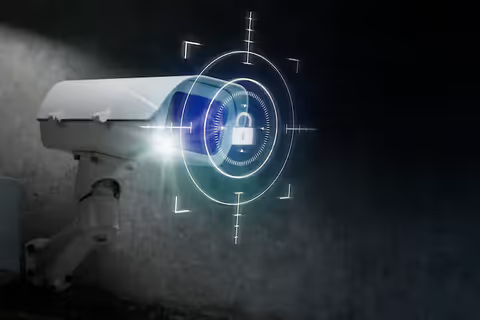
AI security cameras represent a newer generation of surveillance technology. Instead of only recording video, they use artificial intelligence to analyze what the camera sees in real time. These cameras can recognize people, vehicles, animals, packages, and other objects while identifying unusual activity more accurately than conventional motion detection systems.
As homes and businesses become more connected through smart technology, AI-powered security cameras have become an important part of modern security systems. They provide faster alerts, reduce false notifications, improve monitoring efficiency, and help users understand events as they happen. This guide explains how AI security cameras work, why they matter, recent developments, privacy considerations, and what to know before choosing one.
Understanding AI Security Cameras
An AI security camera combines a traditional camera with machine learning and computer vision technology. Computer vision allows the camera to interpret images and videos in a way that helps identify patterns, objects, and activities.
Unlike standard cameras that react to any movement, AI cameras analyze the scene before sending alerts. For example, the camera can distinguish between a person walking near a door and a tree branch moving in the wind. This intelligent analysis helps reduce unnecessary notifications while highlighting events that may require attention.
Most AI security cameras include processors that perform some level of analysis directly on the device. Others combine on-device processing with cloud-based AI services for more advanced detection and video analysis. The balance between these methods depends on the camera's design and privacy approach.
The primary purpose of AI security cameras is to make surveillance smarter rather than simply recording everything.
How AI Security Cameras Work
AI security cameras capture video using high-definition image sensors. Once video is recorded, artificial intelligence analyzes each frame to identify objects, movements, and behaviors.
The system begins by detecting motion. Instead of immediately triggering an alert, AI examines the moving object. It classifies whether the movement belongs to a person, vehicle, pet, bicycle, or another object. Some cameras also recognize faces, license plates, or specific activities depending on available features.
The camera then compares detected activity against predefined rules. For example, it may send alerts only when someone enters a designated area or when a package is placed near the entrance. This selective monitoring makes notifications more relevant.
Many systems continuously learn through software updates that improve recognition accuracy over time. Machine learning models become better at distinguishing everyday events from unusual situations, leading to more reliable monitoring.
Why AI Security Cameras Matter Today
Security concerns have expanded beyond preventing theft. Many people want awareness about deliveries, visitors, pets, elderly family members, or activity around their property. Businesses also need efficient monitoring for workplaces, warehouses, retail stores, and offices.
AI security cameras help address these needs by providing meaningful insights rather than overwhelming users with constant recordings.
For homeowners, AI cameras can identify visitors before they reach the door, monitor driveways, detect package deliveries, and recognize familiar faces if supported.
For businesses, AI cameras can monitor entrances, parking areas, customer traffic, restricted zones, and operational safety without requiring someone to watch live video continuously.
The growing popularity of remote work and smart homes has also increased demand for surveillance systems that integrate with connected devices and mobile applications.
Key Features of Modern AI Security Cameras
Modern AI security cameras include intelligent capabilities that go beyond video recording.
Real-time object detection helps identify people, vehicles, animals, and packages with greater accuracy than basic motion sensors.
Facial recognition, where supported and enabled, can recognize known individuals and differentiate unfamiliar visitors. Availability varies depending on local laws and device capabilities.
Activity zones allow users to monitor selected areas while ignoring movement outside important locations.
Two-way audio enables communication through the camera, making it easier to speak with visitors or delivery personnel remotely.
Night vision provides clear monitoring in low-light environments using infrared or advanced color night vision technology.
Smart notifications prioritize important events so users receive alerts about relevant activity instead of every motion event.
Cloud and local storage options allow recorded footage to be stored securely depending on user preferences and device capabilities.
AI Security Cameras for Homes
AI security cameras have become common in residential environments because they provide awareness without constant monitoring.
Front-door cameras help identify visitors, detect package deliveries, and monitor entry points throughout the day.
Indoor AI cameras can monitor children, elderly family members, or pets while users are away. Many systems allow privacy modes that disable recording when residents are home.
Outdoor cameras monitor gardens, garages, driveways, and property boundaries. AI helps distinguish between people approaching the property and harmless environmental movement such as rain or tree branches.
Apartment residents also use compact AI cameras to monitor entrances, balconies, or indoor spaces where permitted by building policies.
These systems often integrate with smartphones, allowing homeowners to receive alerts and view live video from anywhere with internet access.
AI Security Cameras for Businesses
Businesses use AI surveillance for operational awareness, security, and safety monitoring.
Retail stores use AI cameras to observe entrances, checkout areas, and inventory spaces. Intelligent detection helps identify unusual activity or after-hours movement.
Warehouses benefit from AI cameras that monitor loading docks, restricted areas, equipment movement, and employee safety zones.
Office buildings use AI surveillance to monitor access points, meeting rooms, parking facilities, and visitor entrances.
Industrial facilities increasingly use AI cameras for safety monitoring, equipment observation, and environmental hazard detection alongside existing security infrastructure.
Rather than replacing security personnel, AI systems often help prioritize events that require human attention.
Benefits of AI Security Cameras
AI-powered surveillance offers several practical advantages over traditional camera systems.
Reduced false alerts improve user experience by filtering movement caused by weather, shadows, or animals when appropriate.
Faster event detection allows users to receive notifications shortly after important activity is detected.
Improved search capabilities make it easier to find recorded events based on people, vehicles, or specific activities instead of reviewing hours of footage manually.
Remote monitoring allows users to view live streams and recorded clips through secure applications from different locations.
Better storage efficiency reduces unnecessary recordings because AI can focus on meaningful events instead of recording constant motion.
Enhanced situational awareness helps users understand what happened through event summaries and categorized alerts.
AI Security Cameras and Smart Home Integration
AI security cameras often work alongside other smart home devices to create connected security systems.
Smart doorbells can trigger AI cameras when someone approaches the entrance.
Smart lights may automatically turn on when cameras detect people during nighttime hours.
Smart locks can work with recognized visitors, depending on user settings and supported integrations.
Voice assistants allow users to view camera feeds on compatible smart displays using voice commands.
Automation routines can combine cameras with alarms, sensors, and lighting to improve home awareness without manual intervention.
This integration creates a more coordinated security experience while allowing users to customize notifications and automation rules.
Privacy and Data Security Considerations
Privacy remains one of the most important topics surrounding AI security cameras.
Because cameras collect video and sometimes audio, users should understand where data is processed and stored. Some cameras analyze video directly on the device, while others send encrypted footage to cloud servers for processing.
Strong account security is essential. Using unique passwords, enabling multi-factor authentication, and keeping firmware updated helps protect camera access.
Users should review privacy settings to control facial recognition, cloud uploads, recording schedules, and sharing permissions.
For indoor cameras, privacy modes allow recording to pause during specific hours or when trusted individuals are home.
Businesses using AI cameras should also understand local privacy regulations regarding surveillance, employee monitoring, and public recording requirements.
Choosing transparent privacy settings helps balance security benefits with responsible data protection.
Recent Trends in AI Security Cameras in 2026
Artificial intelligence continues to improve surveillance technology through more efficient processing and smarter automation.
Edge AI has become increasingly common, allowing cameras to analyze video locally without sending every recording to cloud servers. This improves response speed while supporting privacy-focused processing.
Higher-resolution sensors combined with AI provide clearer identification in challenging lighting conditions.
Generative AI features are beginning to create short event summaries, making recorded footage easier to review after important incidents.
Multi-camera intelligence allows connected cameras to understand movement across different locations, improving event tracking around larger properties.
Energy-efficient AI processors also help battery-powered cameras deliver longer operating times while maintaining intelligent detection capabilities.
These developments continue making AI surveillance more practical for everyday users.
Choosing the Right AI Security Camera
Selecting an AI security camera depends on the environment and monitoring goals rather than choosing the most advanced model.
Users should first identify where the camera will be installed. Indoor and outdoor environments require different durability, weather resistance, and viewing angles.
Video resolution affects image clarity, while night vision improves visibility after dark.
AI detection capabilities should match the user's needs, such as person detection, vehicle detection, package detection, or pet recognition.
Storage preferences also matter. Some users prefer local storage for greater privacy, while others choose cloud storage for easier remote access.
Compatibility with existing smart home devices can improve automation and simplify daily use.
Reliable software updates and security features help ensure cameras remain protected against vulnerabilities over time.
Common Misunderstandings About AI Security Cameras
Many people assume AI security cameras constantly recognize every face or understand every situation perfectly. In reality, AI systems operate within the capabilities of their trained models and available features.
AI detection reduces false alerts but does not eliminate them entirely. Weather conditions, lighting changes, and unusual objects can still affect recognition accuracy.
Another misconception is that AI cameras always require cloud processing. Many modern cameras perform significant analysis directly on the device through edge AI technology.
Some also believe AI surveillance replaces human judgment. Instead, AI helps organize information, prioritize alerts, and assist users in reviewing events more efficiently.
Understanding these limitations helps users set realistic expectations and use AI surveillance responsibly.
The Future of AI Security Cameras
AI security cameras are expected to become more intelligent, faster, and more privacy-focused over the coming years.
Future systems may better understand complex activities instead of recognizing only individual objects. Cameras could identify patterns such as unusual movement sequences, safety incidents, or environmental risks with greater accuracy.
On-device AI processing will likely continue expanding, reducing dependence on cloud computing while improving response times and privacy controls.
Integration with smart buildings, connected workplaces, and home automation systems will also become more seamless as AI devices communicate more effectively with each other.
As artificial intelligence evolves, surveillance systems are expected to provide clearer event understanding while giving users greater control over how their data is processed and stored.
Frequently Asked Questions
What is an AI security camera?
An AI security camera is a surveillance camera that uses artificial intelligence to identify people, vehicles, animals, packages, and other activities instead of relying only on basic motion detection.
Do AI security cameras work without the internet?
Many AI security cameras can continue recording and perform basic on-device detection without an internet connection. Internet access is usually needed for remote viewing, cloud storage, and certain smart features.
Are AI security cameras suitable for apartments?
Yes. Compact indoor cameras and door cameras can monitor apartment entrances or indoor spaces where local building policies and privacy rules allow surveillance.
Can AI security cameras record at night?
Most AI security cameras include infrared night vision or advanced low-light technology that allows monitoring in dark environments.
Are AI security cameras secure?
Security depends on device settings and software. Keeping firmware updated, enabling strong passwords, and using multi-factor authentication improves account and camera security.
Conclusion
AI security cameras have transformed surveillance from simple video recording into intelligent monitoring that helps users understand important events more quickly and accurately. By combining computer vision, machine learning, and real-time analysis, these systems reduce unnecessary alerts while providing more meaningful information about activity around homes, workplaces, and public spaces.
As AI technology continues advancing, security cameras are becoming more capable of identifying relevant events, improving privacy through edge processing, and integrating with broader smart home and business ecosystems. Understanding how these cameras work, their features, privacy considerations, and practical applications helps users make informed decisions about modern surveillance technology while using it responsibly and effectively.