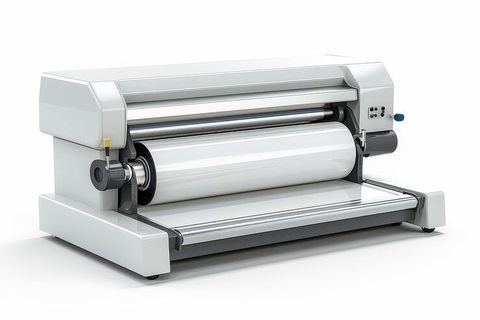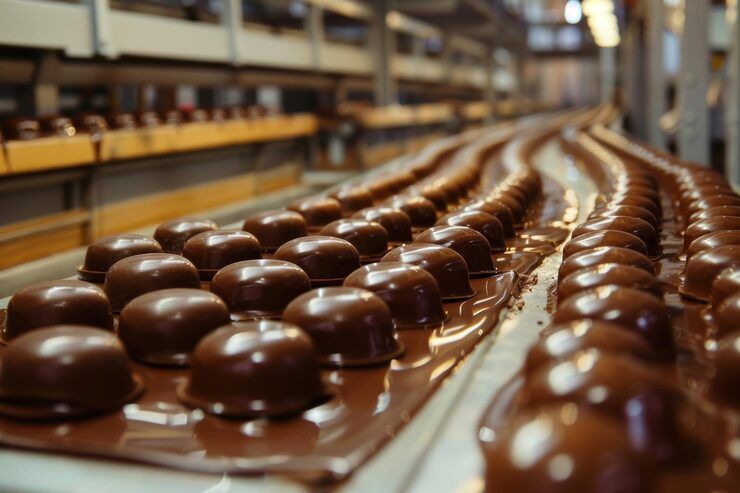
Chocolate coating machines, commonly called chocolate enrobing machines, are food-processing systems designed to cover products with a controlled layer of chocolate or compound coating.
The technology is used for products such as biscuits, wafers, cookies, nuts, fruits, confectionery centers, snack bars, cakes, and other food products. Depending on the machine configuration, the coating can cover the entire product or only selected surfaces.
A typical chocolate coating line combines chocolate melting, tempering, pumping, curtain coating, bottom coating, cooling, and product handling. Larger industrial systems can integrate these stages into a continuous production line.
How Chocolate Enrobing Works
The basic process starts with prepared chocolate being maintained at a controlled temperature. The product then travels through the coating section on a conveyor.
Chocolate can flow over the product as a continuous curtain while additional chocolate may be applied to the bottom. Excess chocolate is removed or returned to the circulation system.
The coated product then enters a cooling tunnel, where the chocolate solidifies under controlled temperature conditions.
Typical stages include:
Chocolate melting
Tempering or temperature conditioning
Product feeding
Top coating
Side coating
Bottom coating
Excess-chocolate removal
Cooling
Chocolate solidification
Product collection
Main Machine Components
Industrial chocolate coating equipment can contain:
Chocolate melting tanks
Tempering units
Holding tanks
Pumps
Coating curtains
Conveyor systems
Blowers or vibration systems
Cooling tunnels
Temperature sensors
PLC controls
Chocolate circulation systems
Product-transfer mechanisms
The exact configuration depends on the type of chocolate, product dimensions, coating thickness, production rate, and required process controls.
Why Chocolate Coating Machines Matter Today
Chocolate coating machines are important because they provide controlled and repeatable application of chocolate across a wide range of food products.
Manual dipping can produce variations in coating thickness, appearance, and production speed. Automated enrobing systems provide greater control over temperature, coating flow, conveyor movement, and cooling conditions.
Industrial Applications
Chocolate coating systems are used for:
Biscuits
Wafer products
Cookies
Protein and cereal bars
Nuts
Dried fruits
Confectionery centers
Cakes
Ice-cream products
Bakery products
Specialty chocolate products
The technology is particularly relevant to high-value industrial searches such as chocolate enrobing machines, industrial chocolate coating machines, chocolate processing equipment, automatic chocolate coating equipment, and confectionery manufacturing machinery.
Why Tempering Matters
Chocolate contains cocoa butter, and controlled crystallization is important for producing a stable finished coating.
Properly tempered chocolate can develop:
Smooth surface appearance
Appropriate hardness
Good snap
Stable structure
More consistent gloss
Reduced fat-bloom risk
Incorrect temperature control can result in dull surfaces, unstable texture, poor setting, or other quality problems.
Coating Thickness
Coating thickness depends on factors such as:
Chocolate viscosity
Product temperature
Conveyor speed
Curtain flow
Airflow
Product geometry
Chocolate temperature
Bottom-coating configuration
| Process Variable | Effect on Coating |
|---|---|
| Chocolate temperature | Influences viscosity and flow |
| Conveyor speed | Influences coating exposure |
| Curtain flow | Influences chocolate application |
| Airflow | Helps control excess coating |
| Cooling temperature | Influences setting |
| Product geometry | Affects coverage |
| Chocolate formulation | Influences flow and crystallization |
Recent Developments in Chocolate Coating Technology
Chocolate processing continued to evolve during 2025 and 2026 as manufacturers focused on automation, energy management, food safety, recipe flexibility, and production consistency.
Greater Automation
Modern chocolate enrobing systems increasingly use programmable controls, sensors, automated temperature regulation, and digital monitoring.
These systems can help operators monitor important parameters throughout the coating process. Automated control is particularly useful where consistent coating thickness and temperature are required over extended production periods.
Energy-Efficient Cooling
Cooling tunnels are an important part of chocolate coating because the coated product must reach appropriate temperatures before further handling.
Modern equipment development increasingly emphasizes refrigeration efficiency, airflow management, insulation, and improved temperature control.
Reducing unnecessary energy consumption can be relevant for large confectionery production lines because cooling equipment may operate continuously during production.
Flexible Product Formats
Manufacturers increasingly work with different product sizes, shapes, fillings, and formulations. This has encouraged development of flexible conveyor systems, adjustable coating widths, variable-speed controls, and programmable recipes.
A system configured for small biscuits may require different settings from one used for large snack bars or irregularly shaped confectionery.
Digital Process Monitoring
Industry 4.0 concepts are increasingly being applied to food processing equipment. Connected sensors and control systems can record temperature, production conditions, machine status, and process interruptions.
Data collection can help production teams identify recurring process variations and establish more consistent operating procedures.
Laws, Standards and Policies in India
India provides an important regulatory example because chocolate and chocolate-coated foods fall within the country's food-safety framework.
The Food Safety and Standards Authority of India (FSSAI) maintains standards covering food products, additives, packaging, labeling, and other food-safety requirements. Its current product-standard framework includes the Food Safety and Standards (Food Products Standards and Food Additives) Regulations, 2011.
Chocolate Product Standards
FSSAI's food standards cover cocoa and chocolate products and define categories including chocolate, composite chocolate, filled chocolate, and couverture chocolate.
For example, FSSAI's consolidated regulations specify compositional requirements for different chocolate categories, including requirements involving cocoa solids and cocoa butter for couverture chocolate.
This matters to coating operations because the material being applied must meet the appropriate product specification when the finished food is represented as a regulated chocolate product.
Recent Regulatory Activity
FSSAI's official amendment records show continued updates to the Food Products Standards and Food Additives Regulations, including Amendment No. 84 dated July 10, 2025.
FSSAI also maintains updated packaging and labeling regulations. Its records show a packaging amendment dated March 28, 2025 and a labeling amendment dated August 8, 2025, followed by another labeling amendment dated March 24, 2026.
Food manufacturers should therefore check the current FSSAI regulations when determining ingredient, packaging, labeling, and food-contact requirements.
Machinery and Hygiene
Food-processing machinery should be designed and maintained in a manner appropriate for hygienic production. Surfaces that contact food should be suitable for the intended application and capable of being cleaned effectively.
BIS provides a Know Your Standard platform where manufacturers can search Indian Standards using a product name or keyword. The platform was updated on May 8, 2026.
BIS also maintains food-processing machinery standards and safety-related standards, although the specific applicability depends on the equipment category and machine configuration.
Tools and Resources for Chocolate Coating Machines
Successful chocolate enrobing depends on temperature control, chocolate formulation, conveyor settings, coating thickness, and cooling conditions.
Useful Tools
Chocolate tempering calculators: Help determine temperature stages for different chocolate types.
Coating-thickness calculators: Help estimate chocolate application based on product dimensions and target coverage.
Conveyor-speed calculators: Help relate line speed to coating exposure.
Temperature data loggers: Record chocolate and cooling temperatures.
Viscosity measurement equipment: Helps assess chocolate flow characteristics.
Digital scales: Useful for checking coating weight and production consistency.
Cooling-tunnel monitoring systems: Track temperature and airflow conditions.
PLC monitoring systems: Track machine parameters and operating conditions.
CAD software: Helps develop conveyor and machine layouts.
HACCP documentation templates: Help organize food-safety hazard analysis and process controls.
FSSAI resources: Provide current food-product, packaging, and labeling requirements.
BIS Know Your Standard: Helps identify relevant Indian Standards.
Specifications Worth Comparing
When researching industrial chocolate coating machines, useful specifications include:
Conveyor width
Maximum product width
Production capacity
Chocolate tank capacity
Temperature-control range
Tempering configuration
Coating thickness control
Bottom-coating capability
Cooling-tunnel length
Cooling temperature
Conveyor speed
Chocolate circulation system
PLC controls
Cleaning requirements
Food-contact materials
Machine throughput should not be considered independently. Product size, chocolate formulation, coating thickness, cooling requirements, and changeover procedures can all affect actual production performance.
Frequently Asked Questions
What is a chocolate coating machine?
A chocolate coating machine is food-processing equipment that applies a controlled layer of chocolate or compound coating to products such as biscuits, wafers, nuts, bars, fruits, and confectionery items.
What is an enrobing machine?
An enrobing machine is a type of chocolate coating system in which a product passes through a flowing chocolate curtain. Chocolate can cover the top, sides, and bottom before the coated product enters a cooling section.
Why is chocolate tempering important?
Tempering controls the crystallization of cocoa butter. Proper crystallization contributes to desirable surface appearance, texture, stability, and setting characteristics in many chocolate applications.
What determines chocolate coating thickness?
Coating thickness can be influenced by chocolate viscosity, temperature, conveyor speed, curtain flow, product geometry, airflow, and the configuration of the coating system.
What regulations apply to chocolate products in India?
Chocolate manufacturers in India are subject to FSSAI's food-safety framework, including applicable standards for food products and additives, packaging, and labeling. The specific requirements depend on the chocolate category, ingredients, packaging, and intended application.
Conclusion
Chocolate coating machines combine controlled chocolate handling, product conveying, coating, tempering, and cooling into an integrated food-processing system. Their purpose is to create a consistent chocolate layer across products with different shapes, sizes, and formulations.
Modern systems increasingly incorporate automated temperature controls, programmable settings, sensors, digital monitoring, flexible conveyors, and energy-conscious cooling systems.
Regulatory compliance is another important consideration. In India, FSSAI standards cover chocolate and cocoa products, while packaging and labeling requirements are maintained through separate regulatory frameworks. These rules can change, making current official information important when establishing production procedures.
For organizations researching chocolate enrobing machines, the main technical factors include chocolate formulation, tempering capability, coating width, conveyor speed, coating thickness, cooling capacity, temperature monitoring, hygiene design, automation, and applicable food-safety requirements.
The continuing development of chocolate coating technology reflects a broader movement toward digitally monitored, flexible, hygienic, and resource-efficient food manufacturing. Understanding both the machine process and the regulatory environment is essential for consistent and responsible chocolate production.