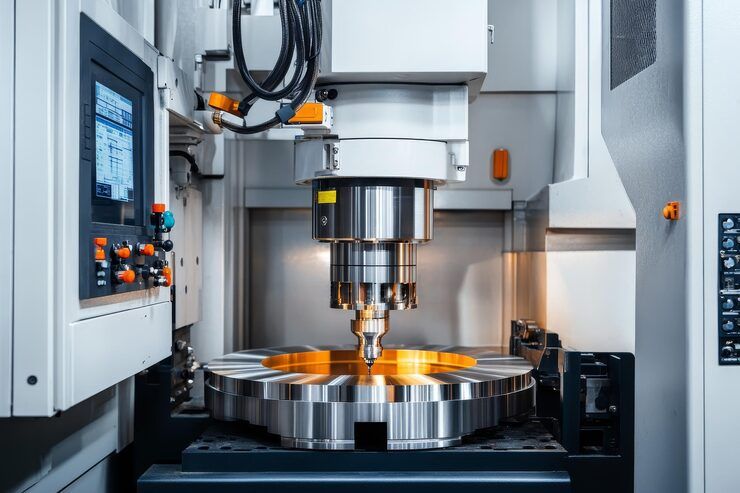
CNC machining is a manufacturing method that uses computer-controlled equipment to shape solid materials into precise components. CNC stands for Computer Numerical Control, meaning machining movements are controlled by programmed instructions rather than being operated entirely by hand.
The technology is widely used for producing components with accurate dimensions, repeatable features, and complex geometries. It can work with materials such as metals, plastics, composites, and selected engineering materials, depending on the machine, tooling, and application.
A CNC machining process typically begins with a digital design. The design is converted into machine instructions that control movements such as cutting, drilling, turning, or milling. The machine then removes material from a workpiece until the required shape is produced.
Understanding CNC machining involves more than knowing how a machine cuts material. The choice of machining process, machine configuration, cutting tools, material, tolerances, and finishing requirements can all influence the final component.
How CNC Machining Works
The CNC machining process generally starts with a computer-aided design, commonly known as CAD. The CAD model defines the dimensions, geometry, holes, surfaces, and other characteristics of the component.
The design is then prepared for manufacturing using computer-aided manufacturing software. CAM software helps create the toolpaths that determine how the cutting tool will move through the material. These instructions are translated into machine-readable code.
Once the program is loaded, the workpiece is securely positioned. The machine establishes the required reference points and begins the programmed sequence. Cutting tools remove material according to the specified toolpaths.
Modern CNC systems can control multiple machine axes simultaneously. This makes it possible to manufacture parts with angled surfaces, curved profiles, pockets, slots, holes, and other complex features.
After machining, the component may undergo inspection to verify dimensions and surface characteristics. Additional finishing processes can also be applied when required by the application.
Common Types of CNC Machining
Different CNC machines are designed for different types of manufacturing operations. CNC milling and CNC turning are two of the most widely recognized processes.
CNC Milling
CNC milling uses rotating cutting tools to remove material from a stationary or strategically positioned workpiece. Milling machines can create flat surfaces, pockets, slots, contours, holes, and complex three-dimensional shapes.
Three-axis milling is suitable for many conventional components, while four-axis and five-axis machining can provide additional movement and access to difficult geometries.
Five-axis machining is particularly useful when several surfaces need to be reached without repeatedly repositioning the workpiece. This can help reduce setup requirements and improve consistency for complex components.
CNC Turning
CNC turning generally holds a workpiece in a rotating chuck while a cutting tool moves against its surface. It is commonly used for cylindrical or rotational components.
Turning can produce external diameters, internal bores, grooves, threads, tapers, and other rotational features. CNC lathes and turning centers are frequently used for shafts, bushings, sleeves, fittings, and similar components.
CNC Drilling
CNC drilling creates holes at programmed positions and dimensions. Drilling may be performed as part of a milling or machining-center operation, allowing multiple features to be produced within the same setup.
Additional operations such as reaming, tapping, and countersinking may be used when a hole requires a specific diameter, thread, or surface condition.
CNC Grinding
CNC grinding uses abrasive wheels rather than conventional cutting tools. It is generally associated with applications requiring precise dimensions or particular surface characteristics.
Grinding can be useful for hardened materials and components where conventional cutting is not the most appropriate finishing method.
Materials Used in CNC Machining
Material selection has a direct effect on machining behavior. Different materials have different hardness, strength, thermal properties, cutting characteristics, and finishing requirements.
Aluminum is commonly machined because it is relatively lightweight and can be processed efficiently. Steel is used when strength and durability are important, although different steel grades can require different tooling and cutting conditions.
Stainless steel provides corrosion resistance and is used in applications where environmental durability matters. Brass and copper are also machinable materials with applications involving electrical, mechanical, and precision components.
Engineering plastics such as ABS, nylon, PEEK, and acetal can be machined for lightweight or electrically insulating components. Material selection should be based on the final application's mechanical, thermal, chemical, and dimensional requirements rather than machining convenience alone.
CNC Machining Accuracy and Tolerances
One of the major reasons CNC machining is widely used is its ability to produce repeatable dimensions. However, the achievable tolerance is not determined by the CNC machine alone.
Material behavior, tool condition, machine rigidity, workholding, temperature, programming, cutting parameters, and inspection methods can all affect dimensional accuracy.
A component should therefore be designed with realistic tolerances based on its functional requirements. Extremely tight tolerances may require specialized equipment, additional machining operations, controlled environmental conditions, or more extensive inspection.
Good engineering practice is to specify tighter tolerances only where they are necessary for the component to function correctly.
CNC Machining Applications
CNC machining is used across many manufacturing industries because it can accommodate both relatively simple and highly complex components.
In automotive manufacturing, CNC processes can produce engine components, brackets, housings, shafts, and precision mechanical parts. Aerospace applications often require components with carefully controlled dimensions and complex geometries.
Medical and laboratory equipment can also use machined components where dimensional consistency and material characteristics are important. Electronics manufacturing uses CNC machining for enclosures, heat-management components, fixtures, and structural parts.
Other applications include industrial machinery, robotics, energy equipment, consumer products, tooling, prototypes, and specialized mechanical assemblies.
Advantages of CNC Machining
CNC machining provides several important manufacturing advantages. Once a suitable program and setup have been established, the process can repeatedly produce similar components with consistent tool movements.
Computer-controlled operation also makes it possible to manufacture geometries that would be difficult to reproduce manually. Digital design files can be modified and adapted for different component versions, which supports flexible manufacturing workflows.
Another important advantage is process control. CNC equipment can integrate programmed speeds, feeds, tool movements, and machining sequences, helping manufacturers establish a repeatable production method.
CNC machining is also useful for prototyping because a digital design can be translated into a physical component without creating a dedicated mold for many applications.
Limitations and Considerations
CNC machining is not suitable for every manufacturing requirement. Because it works primarily by removing material, designs that involve substantial material waste may require another manufacturing approach.
Complex components can also require multiple setups, specialized tooling, advanced programming, or additional finishing operations. These factors can increase production complexity.
Material selection is another consideration. Some materials are significantly more difficult to machine than others because of hardness, heat generation, work hardening, abrasiveness, or other characteristics.
Part geometry should also be considered during design. Deep cavities, narrow internal features, very thin walls, and difficult-to-access surfaces can introduce machining challenges.
Designing Components for CNC Machining
Designing with the machining process in mind can make production more straightforward. Features should be accessible to appropriate cutting tools, and unnecessary complexity should be avoided when it does not contribute to the component's function.
Internal corners deserve particular attention because standard cutting tools are generally cylindrical and naturally produce rounded internal corners. Designing appropriate corner radii can make machining more practical.
Hole sizes, wall thicknesses, depths, threads, and surface requirements should also be evaluated before manufacturing begins. A clear technical drawing or properly defined digital model helps communicate the intended design accurately.
CNC Machining vs. Other Manufacturing Methods
CNC machining differs from processes such as injection molding, casting, forging, additive manufacturing, and sheet-metal fabrication.
Machining removes material to create the final geometry, while additive manufacturing builds components layer by layer. Injection molding forms material inside a mold, making it particularly different in its production approach.
The appropriate manufacturing method depends on factors such as component geometry, material, production volume, dimensional requirements, surface requirements, and design complexity. CNC machining can be especially useful when precise subtractive manufacturing is appropriate or when a component requires features that are difficult to create through other methods.
Conclusion
CNC machining is a versatile manufacturing technology that combines digital design, computer-controlled movement, cutting tools, and carefully selected machining parameters. Its ability to produce repeatable and accurately defined components makes it useful across automotive, aerospace, medical, industrial, electronics, robotics, and many other fields.
Understanding the differences between milling, turning, drilling, grinding, and multi-axis machining helps in selecting an appropriate process. Material properties, tolerances, geometry, tooling, inspection, and finishing requirements should also be considered from the beginning of the design process.
For anyone learning about CNC manufacturing, the most important principle is that successful machining depends on the relationship between the design, material, machine, tooling, programming, and required component performance. A well-planned CNC process can turn a digital design into a precise physical component while maintaining consistency throughout manufacturing.