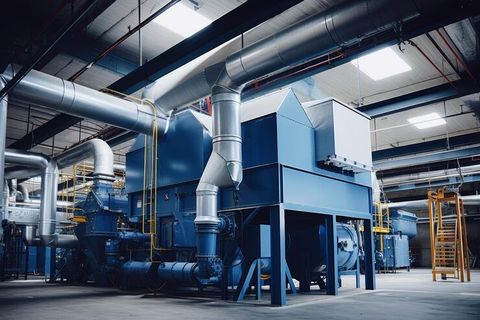
Dust collection systems are engineered arrangements used to capture, transport, filter, and contain airborne particles generated during industrial processes. A dust collection system may include hoods, ductwork, fans, filters, separators, and collection containers, depending on the application.
Understanding dust collector types, dust collection system design, filtration methods, and industrial uses helps organizations manage airborne particles and maintain controlled work environments. The appropriate arrangement depends on dust characteristics, airflow requirements, process conditions, and applicable safety rules.
Context – What Is a Dust Collection System?
A dust collection system is a form of local exhaust ventilation designed to capture particulate matter close to where it is generated. OSHA defines a dust collector as a device or combination of devices that separates dust from air handled by an exhaust ventilation system. A typical exhaust arrangement can include a hood or enclosure, ductwork, dust-collecting equipment, an exhauster, and a discharge stack.
Industrial dust can come from cutting, grinding, sanding, mixing, crushing, conveying, drilling, woodworking, food processing, mineral handling, pharmaceutical production, and other operations. Particle characteristics vary considerably. Some dust is relatively coarse, while fine particles can remain suspended in air for extended periods.
Common dust collector types include:
| Dust collection type | Basic principle | Typical application |
|---|---|---|
| Baghouse collector | Fabric filters capture particles | Large industrial processes |
| Cartridge collector | Pleated filter media captures fine dust | Manufacturing and machining |
| Cyclone separator | Centrifugal force separates larger particles | Pre-separation and bulk dust |
| Wet scrubber | Liquid interacts with airborne particles | Selected industrial processes |
| Electrostatic precipitator | Electrical forces collect particles | Certain high-volume applications |
| Central vacuum system | Airflow transports particles to a central collector | Multiple collection points |
A dust collection system design normally considers airflow, duct diameter, pressure losses, filter characteristics, fan capacity, particle size, moisture, temperature, and the physical layout of the facility.
Importance – Why Does Dust Collection Matter?
Dust control matters because airborne particulate matter can affect workplace conditions, equipment operation, product processes, and environmental emissions. Certain materials can also create fire or explosion hazards when combustible particles become suspended in air and encounter an ignition source. OSHA specifically identifies dust collectors, ducts, and processing equipment as areas requiring attention when combustible dust hazards exist.
The importance of a properly engineered system extends across several groups:
- Operators working near dust-generating equipment
- Maintenance and engineering teams
- Facility and environmental managers
- Industries handling combustible particulate materials
- Organizations subject to workplace or air-quality requirements
Effective collection begins at the source. Capturing dust near the point of generation can reduce its movement into surrounding areas. OSHA guidance also emphasizes routine housekeeping, inspection of dust residues, suitable collection equipment, and methods that do not unnecessarily disperse combustible dust.
A collection system should not be considered a replacement for housekeeping or hazard assessment. OSHA notes that poorly designed pneumatic collection arrangements can create a false sense of security, making proper engineering and ongoing housekeeping important.
Recent Updates – Trends and Developments
Recent developments in dust collection focus on filtration efficiency, monitoring, energy management, fire protection, and more structured approaches to combustible dust.
One significant development is the publication of NFPA 660, the 2025 standard covering combustible dusts and particulate solids. NFPA identifies the standard as a consolidation of requirements previously addressed in several combustible-dust standards, including NFPA 652, NFPA 654, and NFPA 484.
Modern dust collection systems increasingly incorporate:
- Differential-pressure monitoring across filters
- Automated filter cleaning
- Sensors for airflow and equipment condition
- Improved filter-media designs
- Variable-speed fan control
- Explosion protection and isolation measures where applicable
- Digital maintenance records and condition monitoring
Environmental requirements are also evolving. In the United States, the EPA strengthened the annual primary PM2.5 National Ambient Air Quality Standard from 12.0 to 9.0 micrograms per cubic meter in 2024, while retaining the existing 24-hour PM2.5 and PM10 standards.
These changes do not mean every industrial dust collector must meet a single universal specification. Requirements depend on the material, process, location, emissions source, workplace conditions, and applicable jurisdiction.
Laws or Policies – Relevant Rules and Regulations
Dust collection requirements vary by country and industry. Organizations should identify the rules applicable to their facility rather than relying on a general equipment specification.
In the United States, OSHA regulations include ventilation requirements under 29 CFR 1910.94 for certain operations involving dust, including abrasive blasting, grinding, polishing, and buffing. OSHA also identifies housekeeping, emergency planning, fire prevention, hazardous locations, and hazard communication provisions that can apply to combustible-dust situations.
For construction activities, OSHA 29 CFR 1926.57 addresses ventilation where hazardous substances such as dusts are generated. It describes local exhaust ventilation as an engineering control intended to prevent harmful dispersion and specifies requirements concerning exhaust equipment and operation.
Respirable crystalline silica has additional requirements. OSHA's construction standard includes provisions for exhaust, housekeeping, exposure-control plans, and other control measures.
In India, the Occupational Safety, Health and Working Conditions Code, 2020 includes provisions concerning precautions to prevent inhalation of dust, fumes, gases, or vapours and maintaining adequate ventilation in workplaces or confined spaces.
India's Air (Prevention and Control of Pollution) Act, 1981 provides a broader legal framework for preventing and controlling air pollution, including regulation of air pollutants.
For combustible dust, NFPA standards can provide important technical guidance in addition to legally applicable requirements. NFPA 660 is particularly relevant to facilities handling combustible dusts and particulate solids.
Tools and Resources – Useful References
Reliable technical resources can help engineers and facility teams understand dust collection principles and applicable requirements.
Useful resources include:
- OSHA ventilation and combustible-dust publications for workplace safety information.
- EPA particulate-matter resources for air-quality standards and regulatory background.
- NFPA publications for combustible-dust fire and explosion protection principles.
- CPCB publications for India's air-pollution regulatory framework.
- Engineering airflow and pressure-drop calculations for evaluating duct and filter requirements.
- Manufacturer filter documentation for media compatibility, temperature limits, and cleaning methods.
A useful design review should document the dust characteristics, collection points, required airflow, duct arrangement, filtration method, fan requirements, discharge arrangement, maintenance access, and relevant hazards.
FAQs – Dust Collection System Guide
What is a dust collection system?
A dust collection system captures airborne particles at or near their source, transports them through ductwork, separates the particles from the air, and manages the collected material.
What are common dust collector types?
Common types include baghouse collectors, cartridge collectors, cyclone separators, wet scrubbers, and electrostatic precipitators. The appropriate type depends on particle characteristics and process conditions.
How is dust collection system design determined?
Design normally considers dust properties, airflow, capture requirements, duct layout, pressure losses, filter characteristics, fan capacity, temperature, moisture, and applicable safety requirements.
Can one dust collector handle different industrial processes?
A central system can sometimes serve multiple collection points, but compatibility must be assessed. Different dust types may have different filtration, temperature, chemical, moisture, and combustible-dust characteristics.
Why is combustible dust an important consideration?
Some combustible particles can create fire or explosion hazards when dispersed in air under suitable conditions. OSHA recommends appropriate hazard assessment, housekeeping, ignition control, and engineering measures for relevant facilities.
Conclusion – Dust Collection System Guide
A dust collection system combines source capture, ductwork, airflow, filtration, and collection equipment to control airborne particles in industrial environments. Its design should reflect the material being processed, process conditions, facility layout, workplace exposure considerations, and applicable regulations.
Different dust collector types serve different technical purposes. Baghouse and cartridge systems are commonly associated with filtration, cyclones with particle separation, and wet systems with processes where liquid-based particle capture is appropriate.
For industrial facilities, system planning should also consider inspection, housekeeping, filter condition, airflow performance, and combustible-dust hazards where relevant. Regulations and technical standards vary by location, so current requirements should be reviewed before designing or modifying a system.