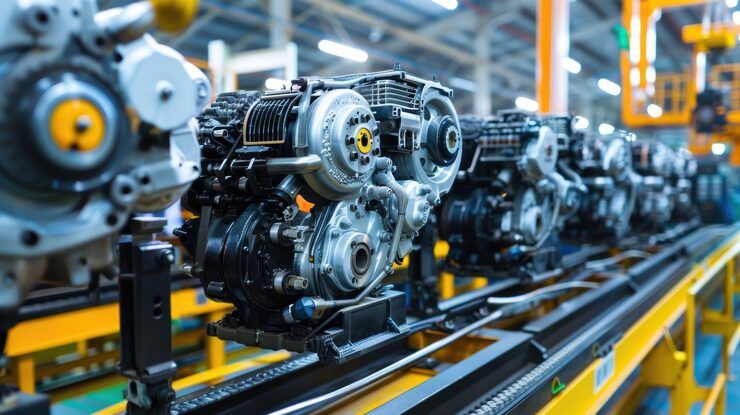
Gearbox assembly lines are organized manufacturing systems used to assemble the components that transfer mechanical power between a driving source and a machine. A gearbox changes rotational speed, torque, and sometimes the direction of movement. It is an essential part of automobiles, industrial machinery, agricultural equipment, wind turbines, robotics, and material-handling systems.
A typical gearbox contains gears, shafts, bearings, seals, a housing, and lubrication components. These parts must fit together accurately to support reliable operation. Even a small dimensional error or incorrect assembly sequence can create vibration, excessive noise, overheating, or premature component wear.
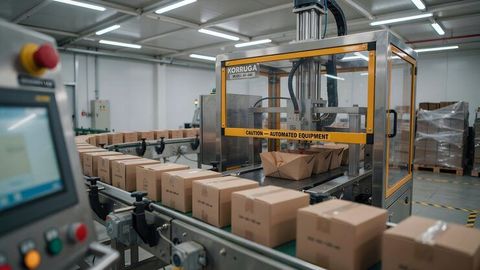
An assembly line divides the manufacturing process into a series of connected workstations. Each station performs a defined task, such as installing bearings, positioning gears, tightening fasteners, or conducting final inspections. Depending on production requirements, the line may use manual workstations, semi-automated equipment, robotic systems, or a combination of these approaches.
Modern gearbox manufacturing combines mechanical engineering, industrial automation, precision measurement, digital monitoring, and quality management. The objective is to produce consistent assemblies while maintaining traceability, workplace safety, and dependable mechanical performance.
Main Components of a Gearbox Assembly Line
A gearbox assembly line generally includes several interconnected elements:
Component preparation: Gears, shafts, bearings, and housings are cleaned and inspected before assembly.
Positioning and handling systems: Fixtures, conveyors, lifting equipment, and robotic manipulators move components between workstations.
Precision assembly equipment: Presses, alignment tools, fastening systems, and specialized fixtures support accurate installation.
Lubrication equipment: Metering systems apply the specified lubricant where required.
Inspection instruments: Sensors and measuring devices verify dimensions, clearances, torque, and component positioning.
End-of-line testing equipment: Test stations evaluate operational characteristics before the gearbox proceeds to its next production stage.
The exact arrangement depends on gearbox design, production volume, component size, and the required level of automation.
Why Gearbox Assembly Lines Matter Today
Gearbox assembly lines play an important role in modern industrial production because mechanical power transmission is necessary across numerous sectors. Automotive manufacturers rely on transmission assemblies, while factories use industrial gearboxes in conveyors, mixers, pumps, cranes, and automated production equipment.
Renewable energy is another important application. Wind turbines use gearboxes in certain drivetrain configurations to adapt rotor speed to generator requirements. Industrial gearboxes also support mining equipment, agricultural machinery, packaging systems, and heavy-duty material handling.
Improving Precision and Product Consistency
Gear teeth must engage correctly, bearings need suitable fits, and shafts must remain properly aligned. Assembly lines help standardize these operations through controlled procedures, calibrated tools, and repeatable fixtures.
Automated fastening systems can record tightening parameters, while electronic measurement equipment can identify deviations before a unit leaves the production area. These controls reduce the likelihood of assembly errors and make quality results easier to document.
Supporting Productivity and Operational Planning
A well-designed assembly line establishes a planned sequence of operations and helps production teams identify bottlenecks. Manufacturers can monitor cycle time, workstation utilization, equipment downtime, and defect rates.
Important performance indicators include:
Cycle time per gearbox.
First-pass yield, representing units that pass inspection without rework.
Overall equipment effectiveness (OEE).
Defects per unit or per production batch.
Unplanned downtime and maintenance frequency.
Material consumption and energy use per completed assembly.
These measurements help engineers determine whether production capacity, equipment reliability, and inspection processes meet operational requirements.
Reducing Mechanical Failures
Incorrect bearing preload, poor lubrication, contaminated components, and improper gear alignment can contribute to gearbox failure. Assembly controls address these risks by checking critical parameters at suitable stages.
For example, vibration testing can reveal certain mechanical irregularities, while temperature monitoring during a controlled test can help identify abnormal friction. No single test detects every possible defect, so manufacturers generally combine dimensional inspections, process checks, and functional testing.
Recent Developments in Gearbox Assembly Technology
During 2025 and 2026, gearbox manufacturing continued to reflect broader industrial trends involving connected machinery, robotics, predictive maintenance, and digital production management. The precise adoption rate varies by industry, factory size, and equipment investment.
Smart Manufacturing and Digital Monitoring
Industrial Internet of Things (IIoT) technology connects sensors, assembly equipment, and production software. Data from fastening tools, presses, inspection stations, and test benches can be collected to monitor process stability.
Digital dashboards help supervisors identify recurring defects, investigate downtime, and compare production results across shifts. Digital work instructions can also guide operators through different gearbox configurations while recording completed steps.
Robotics and Flexible Automation
Robots are increasingly relevant to repetitive or physically demanding assembly activities, including component handling, machine tending, and selected fastening operations. Automated guided vehicles and autonomous mobile robots can support internal material movement where suitable.
Flexible assembly cells are particularly useful when a facility produces multiple gearbox variants. Rather than building an entirely separate line for each configuration, manufacturers can use programmable equipment, interchangeable fixtures, and controlled assembly recipes.
Artificial Intelligence and Predictive Maintenance
Machine-learning systems can analyze historical sensor readings, vibration patterns, temperature data, and equipment alarms. These systems may help identify changes associated with developing machinery problems.
However, predictions depend on data quality, suitable models, and appropriate validation. Artificial intelligence does not eliminate the need for physical inspections, engineering judgment, or established maintenance procedures.
Electrification and Changing Drivetrain Requirements
The growth of electric vehicles has influenced transmission design and production planning. Many electric drivetrains use simpler reduction gear arrangements than conventional multi-speed transmissions, although some applications use more complex gearing.
Manufacturers must account for different noise, vibration, durability, lubrication, and efficiency requirements. Precision finishing, cleanliness controls, and acoustic testing can therefore be important in selected electric drivetrain assembly processes.
The following table summarizes these developments and their practical applications.
Technology | Application | Main consideration |
|---|---|---|
Industrial IoT sensors | Live process monitoring | Data reliability |
Robotic assembly | Repetitive handling and fastening | Safety and integration |
AI-based analytics | Defect detection and maintenance planning | Model validation |
Digital work instructions | Guided assembly and traceability | Accurate revision control |
Automated test benches | Performance and noise evaluation | Test repeatability |
Energy monitoring | Tracking electricity consumption | Consistent measurement |
These technologies are not mandatory for every factory. Their usefulness depends on production needs, technical complexity, and the ability to integrate them with existing systems.
Laws, Regulations and Industry Standards
Gearbox assembly lines are affected by machinery safety regulations, occupational health requirements, environmental rules, and quality management standards. The applicable requirements depend on the country, the type of equipment, and whether the facility manufactures industrial gearboxes, automotive transmissions, or complete production machinery.
Machinery Safety and Risk Assessment
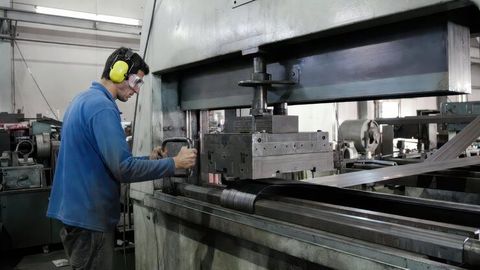
Manufacturers must consider hazards associated with moving machinery, rotating shafts, hydraulic presses, electrical systems, robotic equipment, and automated conveyors. Safety measures may include physical guards, emergency stops, interlocks, lockout procedures, and appropriate operator training.
Internationally recognized machinery safety principles, including ISO 12100, provide a framework for identifying hazards and reducing risks during machinery design and operation. Factories should also evaluate applicable electrical safety and machinery control standards.
Quality Management and Automotive Requirements
ISO 9001 provides a general framework for quality management systems, including process control, documentation, corrective action, and continual improvement. Automotive manufacturers and qualifying suppliers may also work under IATF 16949, which establishes additional quality management requirements for the automotive supply chain.
These standards can support consistent gearbox assembly through documented procedures, inspection records, process monitoring, and traceability. Their applicability and certification requirements depend on the organization and its customer obligations.
Regional Regulations and Environmental Controls
In the European Union, Regulation (EU) 2023/1230 establishes machinery safety requirements and is scheduled to apply generally from 20 January 2027, replacing the Machinery Directive 2006/42/EC. Manufacturers preparing machinery for the European market should assess the applicable conformity assessment and documentation requirements.
In India, factories must consider applicable occupational safety legislation, factory rules, electrical safety requirements, and environmental regulations. Requirements may vary according to the facility, its location, and the manufacturing activities performed.
Common compliance considerations include:
Machine guarding and emergency-stop arrangements.
Safe handling of lubricants, cleaning chemicals, and industrial waste.
Noise exposure and workplace ventilation.
Equipment inspection and maintenance records.
Product testing, technical documentation, and component traceability.
Energy consumption and environmental reporting where applicable.
Compliance should be evaluated against current local legislation rather than assumed from a general international standard.
Tools and Resources for Gearbox Assembly Lines
Manufacturing engineers use a combination of engineering software, measurement instruments, production dashboards, and maintenance systems to plan and monitor gearbox assembly operations.
Engineering and Production Planning Tools
Computer-aided design (CAD): CAD software helps engineers create gearbox components, assembly drawings, fixtures, and workstation layouts. Three-dimensional models can help identify interference between parts before physical assembly begins.
Manufacturing execution systems (MES): MES platforms track production orders, workstation progress, component batches, inspection results, and assembly history. They help connect shop-floor activities with broader production planning.
Programmable logic controllers (PLCs): PLCs coordinate automated machinery, sensors, actuators, conveyors, and safety-related control functions where appropriately designed.
Statistical process control (SPC): SPC tools analyze process measurements over time. Control charts can help identify unusual variation in dimensions, fastening torque, or other critical assembly parameters.
Inspection and Testing Equipment
Useful instruments and systems include:
Torque transducers and calibrated electronic fastening tools.
Coordinate measuring machines for dimensional verification.
Dial indicators and alignment gauges.
Gear measurement instruments for tooth geometry and accuracy.
Vibration analyzers and acoustic measurement equipment.
Temperature sensors and lubricant monitoring instruments.
End-of-line dynamometers and functional test benches.
The equipment selected should match the gearbox design, measurement tolerances, and test requirements.
Maintenance and Performance Calculators
Production teams can use basic calculations to understand line performance.
Metric | Calculation | Purpose |
|---|---|---|
Cycle time | Available production time ÷ units produced | Measures production pace |
First-pass yield | Units passing initially ÷ units tested × 100 | Measures initial quality |
OEE | Availability × performance × quality | Evaluates equipment effectiveness |
Defect rate | Defective units ÷ total units × 100 | Tracks quality problems |
Downtime rate | Downtime ÷ planned production time × 100 | Measures production interruptions |
For example, if a line produces 400 gearboxes in 800 minutes of production time, its average cycle time is two minutes per gearbox. This calculation does not account for product mix, scheduled breaks, or differences between individual workstations.
Frequently Asked Questions
What is a gearbox assembly line?
A gearbox assembly line is a sequence of workstations where gears, shafts, bearings, housings, seals, and related components are assembled into a complete power transmission unit. The line may use manual, semi-automated, or fully automated processes.
Which industries use gearbox assembly lines?
Major applications include automotive manufacturing, industrial machinery, agriculture, mining, wind energy, material handling, and robotics. Each industry may require different gearbox designs, assembly procedures, and quality checks.
How does automation improve gearbox assembly?
Automation can improve repeatability, control component positioning, record fastening parameters, and reduce repetitive manual handling. Its effectiveness depends on suitable equipment integration, accurate programming, maintenance, and process validation.
Which quality checks are important during gearbox assembly?
Common checks include dimensional verification, bearing installation, shaft alignment, fastening torque, lubrication quantity, rotational resistance, noise, vibration, and leakage. Not every gearbox requires the same tests; the inspection plan should reflect its design and operating requirements.
What factors should engineers consider when planning an assembly line?
Engineers should evaluate production volume, gearbox variety, component dimensions, workstation cycle times, quality requirements, material flow, worker safety, maintenance access, and future production changes. These factors help determine the appropriate balance between manual operations and automation.
Conclusion
Gearbox assembly lines are an important part of modern mechanical manufacturing, connecting precision engineering with repeatable production processes. Their performance depends on accurate component positioning, controlled fastening, proper lubrication, effective inspection, and reliable functional testing.
Industrial automation, digital monitoring, robotics, and predictive maintenance are creating new ways to improve process visibility and production consistency. However, these technologies must be supported by sound engineering practices, trained personnel, preventive maintenance, and appropriate safety controls.
Manufacturers that understand gearbox assembly technology, monitor meaningful performance indicators, and follow applicable regulations can make better decisions about production planning and quality management. As industrial machinery and drivetrain designs continue to evolve, adaptable assembly systems will remain important for producing reliable mechanical power transmission equipment.