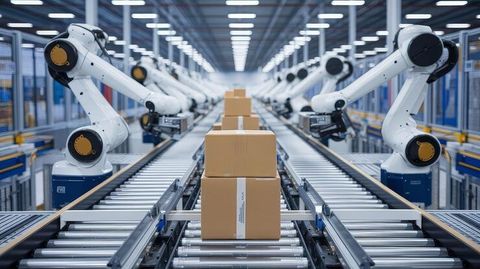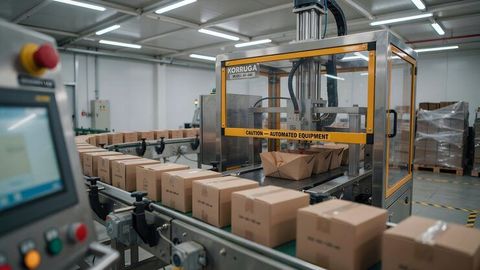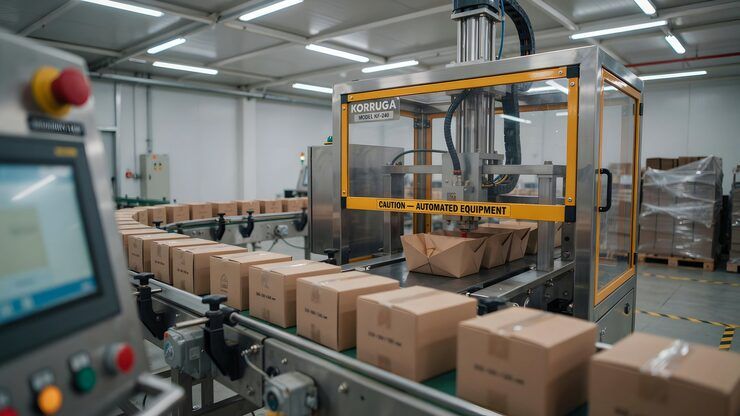
Packaging machines play an important role in modern manufacturing by preparing products for storage, transportation, distribution, and retail presentation. These machines can fill containers, seal packages, wrap products, apply labels, form cartons, and protect goods against contamination or damage.
Selecting the right packaging machine requires an understanding of the product, packaging material, production volume, available workspace, operating requirements, and applicable regulations. A machine designed for liquid products, for example, may not be appropriate for powders, fragile components, or irregularly shaped items.
The most suitable equipment is not necessarily the fastest or most automated option. It is the machine or integrated packaging line that consistently meets the manufacturer's production requirements, quality standards, and operational constraints.
Understanding Different Types of Packaging Machines
Packaging equipment is available in several categories, each designed for particular products and packaging formats.
Filling machines: Measure and dispense liquids, powders, granules, pastes, or other materials into containers.
Sealing machines: Close packages using heat sealing, induction sealing, adhesive systems, or other appropriate methods.
Form-fill-seal machines: Form packaging from rolls of material, fill it with a product, and seal it in an integrated process.
Wrapping machines: Enclose individual products, groups of products, or pallets with protective packaging.
Cartoning machines: Place products into cartons and close the packaging.
Labeling machines: Apply product identification, ingredient information, barcodes, or other required labels.
Vacuum packaging machines: Remove air from suitable packages before sealing to support specific preservation requirements.
Case-packing machines: Arrange packaged products into shipping cases for distribution.
Some production facilities use individual machines, while others integrate several units into an automated packaging line.
Understanding Your Production Requirements
Before selecting equipment, manufacturers should define the actual requirements of their production process.
Important questions include:
What type of product will be packaged?
What is the required output per hour?
Which packaging formats are necessary?
What materials will be used?
How frequently will products or package sizes change?
How much factory floor space is available?
What hygiene and quality standards apply?
How will the equipment connect with existing production machinery?
Documenting these requirements helps narrow the available machine configurations and reduces the risk of selecting equipment that cannot meet operational expectations.
Why Packaging Machine Selection Matters
Packaging equipment influences production throughput, product consistency, material consumption, workplace safety, and the reliability of the distribution process.
Production Efficiency
An appropriately selected machine can help reduce repetitive manual work, maintain consistent package dimensions, and improve coordination between production stages.
However, actual output depends on the complete process. A high-speed filling machine may not increase overall production if the labeling, inspection, or carton-packing stage operates more slowly.
Product Protection and Quality
Packaging protects products against handling damage, moisture, contamination, and other environmental factors when the packaging system is designed appropriately.
Different industries have different requirements. Food and beverage manufacturers may need hygienic filling and sealing systems, while electronics manufacturers may require packaging that protects components against static electricity or physical impact.
Labor and Operational Planning
Automation can reduce certain repetitive tasks, but it also introduces requirements for machine setup, programming, maintenance, operator training, and troubleshooting.
Manufacturers should evaluate the complete operating process rather than assuming that greater automation automatically produces better results.
Key Factors for Selecting Packaging Equipment
Product Characteristics
Product properties determine which machine technology is appropriate.
Liquids may require volumetric, gravimetric, or flow-meter-based filling systems. Powders may require auger fillers or other dosing technologies. Fragile products may need gentle handling mechanisms, while corrosive substances may require compatible contact materials.
Production Capacity
Production capacity should be assessed in relation to actual demand and the entire production line.
Manufacturers should distinguish between a machine's stated maximum speed and its sustained operating output. Changeovers, cleaning, maintenance, product variation, and rejected packages can reduce actual throughput.
Packaging Material Compatibility
The machine must be compatible with the intended containers, films, cartons, closures, and other packaging components.
Material thickness, sealing temperature, package dimensions, surface properties, and barrier requirements can influence performance.
Automation and Integration
Packaging systems may be manual, semi-automatic, or fully automatic.
| Automation Level | General Characteristics | Typical Consideration |
|---|---|---|
| Manual | Operator performs most packaging tasks | Lower process complexity |
| Semi-automatic | Machine performs selected operations | Balance between operator input and automation |
| Fully automatic | Multiple operations run through integrated controls | Greater integration and maintenance requirements |
| Integrated production line | Packaging connects with upstream and downstream equipment | Coordination across the complete process |
Maintenance and Reliability
Routine maintenance can include cleaning, lubrication, inspection, calibration, and replacement of wear components.
Before choosing equipment, manufacturers should understand maintenance intervals, spare-parts availability, technical documentation, and the skills required for safe operation.
Recent Trends in Packaging Machinery
Packaging technology continues to develop in response to changing material requirements, automation needs, energy efficiency, and environmental concerns.
Automation and Smart Manufacturing
During 2025 and 2026, manufacturers continued emphasizing connected packaging equipment, machine-vision inspection, sensor-based monitoring, and production data analysis.
These technologies can help identify filling inconsistencies, detect defective seals, monitor equipment performance, and improve production traceability. Their effectiveness depends on correct configuration, reliable data, and integration with existing factory systems.
Artificial Intelligence and Machine Vision
Machine-vision systems can inspect package dimensions, labels, closures, and visible defects. Artificial intelligence can support pattern recognition and analysis of recurring production problems.
Such systems can assist quality control, but they still require validation against the manufacturer's inspection criteria and acceptable defect limits.
Sustainable Packaging Materials
Manufacturers are increasingly evaluating recyclable materials, lightweight packaging, material reduction, and packaging formats designed to improve resource efficiency.
Equipment compatibility remains important because alternative films, paper-based structures, and redesigned containers may behave differently during forming, filling, and sealing.
A packaging change should therefore be tested for mechanical performance, product protection, shelf-life requirements, and compatibility with existing machinery.
Flexible Production Lines
Shorter product runs and more varied package formats have increased interest in machines that support quicker changeovers and adjustable settings.
Features such as recipe storage, tool-free adjustments, and modular equipment can simplify certain changes, although the benefits depend on product variety and operating procedures.
Laws, Standards, and Regulatory Requirements
Packaging machine selection must account for the regulations applicable to the country, industry, product, and packaging material.
Machinery Safety
In the European Union, machinery safety requirements are governed by the applicable machinery legislation. Regulation (EU) 2023/1230 establishes a new framework that generally applies from January 20, 2027, replacing the Machinery Directive 2006/42/EC from that date.
Manufacturers and equipment integrators should determine which requirements apply at the time the machinery is placed on the market or put into service.
Important safety considerations include emergency stops, guarding, electrical safety, moving parts, risk assessment, and operator instructions.
Food Packaging Requirements
Food packaging equipment may need to comply with hygiene and food-contact material requirements.
In the United States, the Food and Drug Administration regulates relevant food-contact substances and food packaging under applicable federal requirements. In the European Union, food-contact materials are subject to Regulation (EC) No 1935/2004, with additional requirements applying to particular materials and uses.
Manufacturers should verify that equipment design, cleaning procedures, and packaging materials are suitable for the specific food application.
Packaging Waste and Environmental Policy
Packaging regulations increasingly address recyclability, material use, waste prevention, and producer responsibility.
The European Union's Packaging and Packaging Waste Regulation (EU) 2025/40 entered into force in February 2025 and generally applies from August 12, 2026, subject to specific provisions and transitional arrangements.
Companies operating in regulated markets should assess how packaging design and material choices affect compliance. Requirements vary by jurisdiction and product category.
Tools and Resources for Packaging Machine Selection
A structured evaluation process can improve the quality of an equipment decision.
Production Capacity Calculator
A simple calculation can estimate the nominal production requirement:
Required hourly output = Daily production target ÷ Scheduled production hours
For example, a target of 24,000 packages over eight scheduled production hours requires an average output of 3,000 packages per hour before accounting for downtime, rejected packages, and changeovers.
Actual equipment capacity should include a suitable allowance for these operational factors.
Equipment Comparison Checklist
| Evaluation Factor | What to Examine |
|---|---|
| Product type | Liquid, powder, solid, fragile, or irregular |
| Output requirement | Packages per minute or hour |
| Packaging format | Bottles, pouches, cartons, bags, or cases |
| Material compatibility | Film, container, closure, and sealing properties |
| Automation | Manual, semi-automatic, or automatic |
| Quality control | Inspection, rejection, and traceability |
| Safety | Guards, emergency stops, and risk assessment |
| Maintenance | Cleaning, calibration, and spare components |
| Compliance | Applicable industry and regional requirements |
Useful Technical Resources
Manufacturers can consult equipment manuals, packaging-material specifications, machine safety standards, product testing records, and applicable government regulations.
Factory acceptance testing and sample packaging trials can also help verify whether a machine handles the actual product and packaging format consistently before full-scale implementation.
Frequently Asked Questions
Which packaging machine is best for a manufacturing business?
The appropriate machine depends on the product, packaging format, production target, material compatibility, available space, and applicable regulations. There is no single machine suitable for every manufacturing process.
How is packaging machine capacity calculated?
Capacity is commonly expressed in packages per minute or hour. Actual output should account for setup, cleaning, changeovers, maintenance, and rejected packages rather than relying only on the stated maximum speed.
What is the difference between automatic and semi-automatic packaging machines?
Semi-automatic machines require operator involvement in selected steps, while automatic machines perform more operations through programmed controls. The right choice depends on production requirements, product variation, and available technical resources.
What safety features should packaging equipment have?
Relevant features may include machine guards, emergency stops, interlocks, electrical protection, clear operating instructions, and suitable access controls. The required safeguards depend on the machine's design and intended use.
How can manufacturers evaluate packaging machine performance before installation?
Manufacturers can conduct product trials, review technical specifications, measure throughput, assess package quality, and verify material compatibility. Factory acceptance testing can help confirm that equipment meets agreed requirements before implementation.
Conclusion
Selecting the best packaging machine requires a clear understanding of the product, packaging format, production capacity, material compatibility, maintenance needs, and regulatory obligations.
Developments in automation, machine vision, flexible production, and sustainable packaging are expanding the available options. However, effective equipment selection depends on verified performance and compatibility with the complete manufacturing process.
By defining production requirements, comparing technical specifications, conducting packaging trials, and reviewing applicable safety and environmental regulations, manufacturers can make more informed equipment decisions and establish a reliable packaging operation.