Industrial reactors are specialized process vessels designed to facilitate controlled chemical or physical reactions at an industrial scale.
They are widely used in chemical manufacturing, pharmaceuticals, petrochemicals, polymers, food processing, biotechnology, and other process industries.
Depending on the reaction, industrial reactors may operate in batch, semi-batch, or continuous modes. Temperature, pressure, mixing, residence time, material compatibility, heat transfer, and reaction conditions are important factors when selecting a reactor system.
What Are Industrial Reactors?
An industrial reactor is a process vessel where one or more controlled reactions take place under defined operating conditions.
A reactor system can be designed to manage:
- Chemical reactions
- Polymerization
- Hydrogenation
- Neutralization
- Esterification
- Oxidation
- Reduction
- Crystallization
- Fermentation
- Dissolution
- Other specialized processes
The reactor design must match the chemistry, materials, operating conditions, and production requirements.
How Do Industrial Reactors Work?
Although reactor designs differ, most systems follow a controlled sequence.
1. Material Feeding
Reactants are introduced into the reactor through controlled feed lines, pumps, valves, or automated dosing systems.
2. Mixing
An agitator or other mixing mechanism distributes the reactants and helps maintain uniform conditions throughout the vessel.
3. Reaction
The materials react under controlled temperature, pressure, concentration, and residence-time conditions.
4. Heat Transfer
Heating or cooling systems regulate the reaction temperature.
5. Monitoring
Sensors measure important process parameters such as temperature, pressure, level, and sometimes pH or other formulation-specific properties.
6. Product Discharge
After the desired reaction stage is completed, the resulting material is transferred for separation, purification, storage, or further processing.
Types of Industrial Reactors
Different reactor configurations are designed for different processes.
Batch Reactors
Batch reactors process a defined quantity of materials during each production cycle.
Ingredients are charged into the vessel, processed for a specified period, and then discharged.
They are commonly used when:
- Formulations vary
- Production runs are relatively discrete
- Flexible processing is required
- Reaction conditions need close control
Continuous Stirred-Tank Reactors
Continuous stirred-tank reactors, commonly known as CSTRs, continuously receive feed material while processed material exits the vessel.
Agitation helps maintain relatively uniform conditions within the reactor.
They are used for suitable continuous chemical processes where steady-state operation is practical.
Plug Flow Reactors
Plug flow reactors process material continuously through a tubular or pipe-like reactor.
The reactants move through the reactor while the reaction progresses along its length.
They can be suitable for processes where controlled residence time and continuous operation are important.
Semi-Batch Reactors
Semi-batch reactors combine characteristics of batch and continuous operation.
One or more ingredients may be added gradually while the primary material remains inside the vessel.
This configuration can help control reaction rate, heat generation, concentration, or product formation.
High-Pressure Reactors
High-pressure reactors are designed for reactions that require elevated operating pressure.
They may be used for suitable hydrogenation, synthesis, polymerization, and other specialized chemical processes.
Pressure-vessel design, sealing, instrumentation, and safety systems are particularly important.
Glass-Lined Reactors
Glass-lined reactors combine a metal structural vessel with a chemically resistant glass lining.
They are commonly used when corrosion resistance and chemical compatibility are important.
Stainless-Steel Reactors
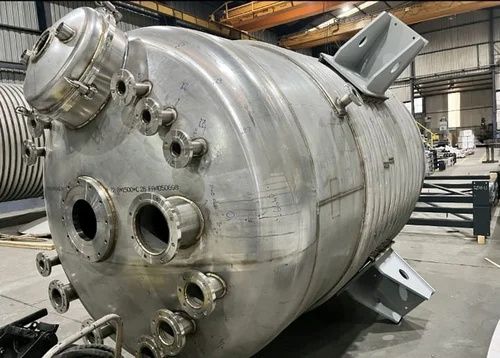
Stainless-steel reactors are widely used across chemical, pharmaceutical, food, and other process industries.
The specific stainless-steel grade should be selected according to the materials and operating environment.
Key Components of Industrial Reactors
| Component | Main Function |
|---|---|
| Reactor Vessel | Contains the reaction |
| Agitator | Mixes process materials |
| Motor | Drives the agitator |
| Heating/Cooling Jacket | Controls temperature |
| Baffles | Improve mixing patterns |
| Feed Lines | Introduce reactants |
| Valves | Control material flow |
| Sensors | Monitor process conditions |
| Pressure System | Controls or contains pressure |
| Control Panel | Manages reactor operation |
| Discharge Outlet | Removes processed material |
Additional equipment may include condensers, coils, dosing systems, vacuum systems, sampling ports, and filtration components.
Reactor Materials of Construction
Material selection is critical because the vessel must withstand chemical and physical operating conditions.
Stainless Steel
Stainless steel is widely used because of its mechanical strength, cleanability, and resistance to many process environments.
Glass Lining
Glass-lined surfaces can provide strong resistance to many corrosive chemicals.
Nickel Alloys
Specialized alloys may be selected for demanding corrosive or high-temperature applications.
Specialized Linings
Other lining materials may be used when process chemistry requires additional protection.
Material selection should consider chemical compatibility, temperature, pressure, abrasion, cleaning conditions, and mechanical requirements.
Temperature Control in Industrial Reactors
Temperature can strongly influence reaction rate, selectivity, product properties, and safety.
Industrial reactors may use:
- Heating jackets
- Cooling jackets
- Internal coils
- Heat exchangers
- Thermal-fluid systems
- Steam systems
- Refrigeration systems
Temperature sensors continuously or periodically monitor the process.
Automated control systems can adjust heating or cooling according to predefined process parameters.
Pressure Control
Some reactions require controlled pressure, while others need vacuum conditions.
Pressure-management systems may include:
- Pressure sensors
- Control valves
- Relief devices
- Vacuum systems
- Gas-feed systems
- Condensers
High-pressure reactor systems require appropriately engineered pressure boundaries and protective systems.
Mixing and Agitation
Mixing is important for maintaining uniform temperature and concentration.
Agitator configurations can include:
- Propellers
- Pitched-blade turbines
- Rushton turbines
- Anchor agitators
- Paddle agitators
- Helical agitators
The appropriate agitator depends on viscosity, solids concentration, gas dispersion requirements, vessel geometry, and reaction characteristics.
High-Viscosity Reactions
High-viscosity materials may require anchor, helical, planetary, or other high-torque mixing configurations.
Gas-Liquid Reactions
Gas dispersion requires appropriate impeller geometry and gas-introduction arrangements to achieve the required mass transfer.
Applications of Industrial Reactors
Industrial reactors are used in many industries.
Chemical Manufacturing
Reactors can support the production of:
- Specialty chemicals
- Solvents
- Resins
- Acids
- Alkalis
- Intermediates
- Chemical formulations
Pharmaceutical Manufacturing
Reactors can be used for suitable synthesis, formulation, crystallization, and intermediate-processing operations.
Pharmaceutical applications require carefully controlled process conditions and appropriate equipment materials.
Petrochemical Processing
Specialized reactor systems can be used in selected petrochemical processes involving controlled temperature, pressure, catalysts, and feed materials.
Polymer Manufacturing
Industrial reactors are important for polymerization processes.
Reactor configuration influences heat removal, viscosity management, residence time, and polymer properties.
Food and Biotechnology
Suitable reactor and vessel systems are used for processes such as:
- Fermentation
- Enzyme reactions
- Cultivation
- Food ingredient processing
- Biochemical production
Hygienic design and contamination control are particularly important in these applications.
Important Industrial Reactor Specifications
Working Volume
Reactor capacity may be specified by:
- Liters
- Cubic meters
- Gallons
Both total vessel volume and usable working volume should be considered.
Operating Temperature
The required temperature range determines the heating and cooling system and affects material selection.
Operating Pressure
Pressure requirements determine vessel design, instrumentation, valves, seals, and safety systems.
Agitator Speed
Mixer speed affects circulation, mass transfer, heat transfer, and reaction uniformity.
Heat-Transfer Capacity
The heating or cooling system must be capable of handling the reaction's thermal requirements.
Material Compatibility
The vessel and wetted components must be compatible with the reactants, intermediates, cleaning chemicals, and final products.
Batch vs Continuous Reactors
| Factor | Batch Reactor | Continuous Reactor |
|---|---|---|
| Feed Method | Charged by batch | Continuous feed |
| Product Removal | After or during batch | Continuous |
| Process Flexibility | Generally high | Suited to stable processes |
| Residence Time | Batch-defined | Flow-dependent |
| Production Mode | Discrete | Continuous |
| Automation | High potential | High potential |
Neither configuration is universally appropriate. The choice depends on reaction kinetics, production requirements, formulation changes, heat-transfer needs, and process control.
Automation in Industrial Reactors
Modern reactor systems can incorporate automation to maintain controlled operating conditions.
Automation may manage:
- Temperature
- Pressure
- Agitator speed
- Feed rate
- Liquid level
- pH
- Vacuum
- Heating
- Cooling
- Reaction time
- Discharge
PLC-Based Control
Programmable logic controllers can coordinate pumps, valves, motors, sensors, heaters, cooling systems, and alarms.
Recipe Management
Recipe-based systems can store predefined processing parameters for different products or reaction stages.
Data Monitoring
Industrial control systems can record process parameters for quality management, troubleshooting, and process analysis.
Industrial Reactor Safety
Safety is an essential consideration in reactor design and operation.
Potential hazards can involve:
- High temperature
- High pressure
- Vacuum
- Flammable materials
- Corrosive chemicals
- Toxic substances
- Exothermic reactions
- Mechanical movement
Safety systems may include:
- Pressure-relief devices
- Emergency shutdown systems
- Temperature alarms
- Pressure alarms
- Interlocks
- Appropriate ventilation
- Containment systems
- Grounding and electrical protection
Safety design should be based on the specific process hazards and applicable industrial requirements.
Quality Control in Reactor Processing
Quality control can include monitoring both the reactor and the resulting product.
Important parameters may include:
- Temperature
- Pressure
- Reaction time
- Agitator speed
- Feed rate
- Concentration
- pH
- Viscosity
- Particle size
- Product composition
Sampling and laboratory analysis can help verify that the reaction has reached the required endpoint or product specification.
Common Industrial Reactor Problems
Temperature Variation
Poor mixing, inadequate heat-transfer capacity, sensor problems, or incorrect control settings can result in uneven temperature.
Pressure Fluctuation
Pressure instability may be associated with feed conditions, gas flow, condensation, valve operation, or reaction behavior.
Inadequate Mixing
Incorrect agitator selection or insufficient power can result in concentration and temperature gradients.
Corrosion
Incompatible materials can deteriorate when exposed to aggressive chemicals.
Foaming
Certain reactions and formulations can generate excessive foam, potentially affecting vessel capacity, sensors, and downstream processing.
Seal Leakage
Mechanical seals and gaskets can degrade because of temperature, pressure, chemical exposure, or mechanical wear.
Maintenance of Industrial Reactors
Routine maintenance helps maintain equipment integrity and process reliability.
Typical activities include:
- Inspecting vessel surfaces
- Checking agitators
- Inspecting mechanical seals
- Checking bearings
- Testing temperature sensors
- Inspecting pressure instruments
- Checking valves
- Examining piping
- Inspecting heating and cooling systems
- Testing safety devices
- Cleaning product-contact surfaces
Inspection frequency should be based on equipment specifications, operating conditions, process hazards, and applicable inspection requirements.
How to Select Industrial Reactors
Reactor selection should start with the reaction and process requirements.
Consider:
- Reaction type
- Reactant characteristics
- Working volume
- Required temperature range
- Operating pressure
- Heat-transfer requirements
- Viscosity
- Mixing requirements
- Residence time
- Material compatibility
- Corrosion resistance
- Batch or continuous operation
- Automation
- Cleaning requirements
- Safety requirements
- Available installation space
For complex reactions, pilot-scale testing and process engineering analysis can help establish appropriate reactor characteristics.
How to Evaluate Industrial Reactor Manufacturers
When evaluating industrial reactor manufacturers, consider their engineering capabilities and equipment configuration.
Important factors include:
- Reactor technology
- Vessel capacity
- Pressure rating
- Temperature range
- Materials of construction
- Agitator design
- Heating and cooling systems
- Automation
- Instrumentation
- Safety systems
- Surface finish
- Testing and inspection procedures
- Technical documentation
- Maintenance requirements
The manufacturer's ability to understand the reaction chemistry and process conditions is an important part of equipment evaluation.
Frequently Asked Questions
What are industrial reactors used for?
Industrial reactors are used to carry out controlled chemical, biological, or physical processes such as synthesis, polymerization, hydrogenation, neutralization, fermentation, crystallization, and other industrial reactions.
What are the main types of industrial reactors?
Common types include batch reactors, continuous stirred-tank reactors, plug flow reactors, semi-batch reactors, high-pressure reactors, glass-lined reactors, and stainless-steel reactors.
What materials are used to manufacture industrial reactors?
Common materials include stainless steel, carbon steel, glass-lined steel, and specialized alloys. Selection depends on chemical compatibility, pressure, temperature, corrosion, and process requirements.
Why is temperature control important in industrial reactors?
Temperature can influence reaction rate, product properties, selectivity, heat generation, and process safety. Appropriate heating and cooling systems help maintain the required operating range.
How do I select an industrial reactor?
Evaluate the reaction chemistry, working volume, temperature, pressure, mixing requirements, heat-transfer needs, material compatibility, residence time, process mode, automation, cleaning, and safety requirements.
Conclusion
Industrial reactors are fundamental components of many chemical, pharmaceutical, petrochemical, polymer, food, and biotechnology processes. They provide controlled environments where reactions can take place under defined temperature, pressure, mixing, and residence-time conditions.
Batch, continuous, semi-batch, high-pressure, glass-lined, and stainless-steel reactor configurations address different process requirements. Reactor performance depends on vessel design, material compatibility, agitation, heat transfer, instrumentation, and process-control strategy.
Modern industrial reactor systems can integrate PLC controls, automated dosing, temperature regulation, pressure monitoring, recipe management, safety interlocks, and process-data collection. Careful engineering, appropriate material selection, and regular inspection are important for maintaining reliable and controlled reactor operation.