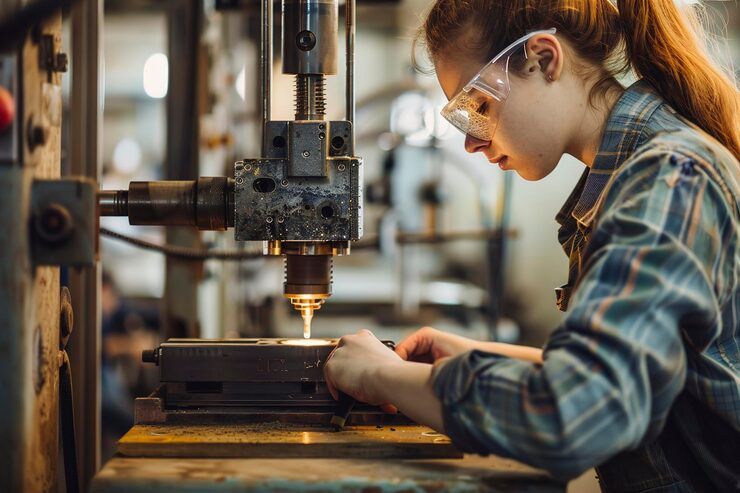
CNC machines are an important part of modern manufacturing because they allow machines to produce components with controlled movements and repeatable accuracy. The term CNC stands for Computer Numerical Control, meaning that a computer-based control system directs the movement of a machine according to programmed instructions.
Unlike conventional machines that rely heavily on manual operation, CNC equipment can automatically control cutting, drilling, turning, milling, and other machining movements. This makes CNC technology useful for producing everything from simple components to complex parts used in automotive, aerospace, electronics, medical equipment, construction, and industrial machinery.
For someone learning about CNC machines, it is helpful to understand not only what they are, but also how they operate, the different machine types, their applications, and the factors that affect their performance.
What Is a CNC Machine?
A CNC machine is a manufacturing machine controlled by programmed digital instructions. The instructions tell the machine where to move, how quickly to move, and what machining operations to perform.
A typical CNC system includes a computer numerical control unit, machine structure, motors, drive mechanisms, cutting tools, and a workholding system. Depending on the machine, additional components such as automatic tool changers, coolant systems, sensors, and measurement equipment may also be included.
The basic concept is straightforward:
Digital program → CNC controller → Machine movement → Cutting operation → Finished component
The program contains commands that are interpreted by the controller. The controller then sends signals to motors and other machine components to create the required movements.
How Do CNC Machines Work?
CNC machining generally begins with a digital design created using computer-aided design (CAD) software. The design represents the required shape and dimensions of the component.
The CAD design may then be processed using computer-aided manufacturing (CAM) software. CAM software helps generate machining instructions based on the selected machine, cutting tools, material, and manufacturing requirements.
The general process involves several stages:
1. Creating the Digital Design
An engineer or designer creates a 2D or 3D model of the required component. The model defines dimensions, shapes, holes, curves, surfaces, and other features.
2. Preparing the Toolpath
The manufacturing software determines how the cutting tool should move around or through the workpiece. Different toolpaths may be required for rough cutting, finishing, drilling, or contouring.
3. Generating Machine Instructions
The toolpath is converted into machine-readable instructions, commonly using G-code and related commands. These instructions specify movements, speeds, tool operations, and other machining functions.
4. Loading the Program
The program is transferred to the CNC controller. The operator checks the setup, tools, workholding, material, and machining parameters before starting production.
5. Machining the Workpiece
The controller coordinates the machine's axes and cutting tools according to the programmed instructions. The machine removes material until the desired shape is produced.
6. Inspection
The finished component can be measured to confirm that its dimensions and features meet the required specifications.
Main Types of CNC Machines
CNC technology is used across many machine designs. The most common types include CNC mills, lathes, routers, plasma cutters, laser machines, and machining centers.
CNC Milling Machines
CNC milling machines use rotating cutting tools to remove material from a stationary or controlled workpiece. The cutting tool can move along multiple axes to create slots, pockets, holes, contours, and complex surfaces.
Milling is commonly used for metals, plastics, composites, and other engineering materials.
CNC Lathes
CNC lathes are primarily designed for turning operations. The workpiece rotates while a cutting tool moves against it.
They are commonly used to produce cylindrical components such as shafts, bushings, pins, threaded parts, and other rotational components.
CNC Machining Centers
Machining centers combine multiple machining functions within one automated system. Many include automatic tool changers, allowing different tools to be used during a single production cycle.
They can perform operations such as milling, drilling, tapping, boring, and contouring.
CNC Routers
CNC routers are frequently used for cutting and shaping materials such as wood, plastic, foam, composites, and certain lightweight materials. They are widely associated with furniture manufacturing, signage, cabinetry, and sheet-material processing.
CNC Plasma and Laser Machines
CNC plasma machines use a controlled plasma arc to cut electrically conductive materials. CNC laser machines use a focused laser beam for cutting, engraving, or marking depending on the equipment and material.
These systems are particularly useful when automated cutting of sheet or plate materials is required.
Important Components of a CNC Machine
Understanding the major components makes CNC technology easier to learn.
CNC Controller: The controller interprets programmed instructions and coordinates machine movements.
Machine Structure: The frame, table, bed, and other structural components support the machining process.
Spindle: The spindle rotates the cutting tool or, in some machine designs, the workpiece.
Drive Motors: Motors provide controlled movement to the machine axes.
Linear Motion System: Ball screws, linear guides, or other mechanisms help convert motor movement into precise machine motion.
Cutting Tools: Different tools are selected for drilling, roughing, finishing, threading, and other operations.
Workholding System: Fixtures, chucks, vises, clamps, and other devices hold the material securely during machining.
Coolant System: Depending on the process, coolant can help manage heat, improve tool life, and remove chips from the cutting area.
What Are CNC Machines Used For?
CNC machines are used when manufacturers need controlled and repeatable machining operations. Their applications vary significantly by industry.
In the automotive industry, CNC machining is used for components such as engine parts, transmission components, brackets, housings, and precision fittings.
In aerospace manufacturing, CNC equipment can produce complex components from materials that require carefully controlled machining processes.
In medical manufacturing, CNC machines can be used to manufacture precision components and equipment parts where dimensional consistency is important.
In electronics and industrial equipment, CNC machines can produce enclosures, mounting components, connectors, fixtures, and mechanical parts.
CNC technology is also used in prototype development because digital designs can be converted into physical components without creating dedicated tooling for every individual part.
Benefits of CNC Machining
One of the main benefits of CNC machining is repeatability. Once a suitable program and setup have been established, the machine can perform the same sequence repeatedly under controlled conditions.
Other important benefits include:
- Reduced dependence on continuous manual machine movement
- Consistent machining operations
- Ability to produce complex geometries
- Support for multi-axis machining
- Efficient production of repeated components
- Digital integration with CAD and CAM workflows
- Ability to work with many engineering materials
- Easier reproduction of established machining programs
However, CNC machining does not automatically guarantee perfect results. Machine condition, tooling, material properties, programming, workholding, calibration, and operator setup can all influence the final component.
CNC Machines and Automation
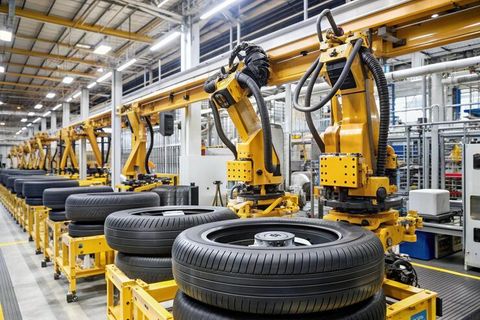
CNC machining is closely connected with modern manufacturing automation. A CNC machine can be integrated with automatic tool changers, robotic material handling, probing systems, sensors, inspection equipment, and production-management software.
More advanced manufacturing environments may connect several machines to centralized systems for monitoring production information and machine conditions.
This development is sometimes described as part of smart manufacturing, where machines, software, sensors, and production data work together to improve process visibility and control.
What Should You Consider When Learning About CNC Machines?
A beginner does not need to understand every technical detail immediately. A useful learning path is to first understand coordinate systems, machine axes, cutting tools, workholding, basic G-code concepts, and machining operations.
After that, it becomes easier to understand subjects such as feeds and speeds, toolpath strategies, multi-axis machining, CNC programming, CAD/CAM integration, and process optimization.
It is also important to distinguish between different CNC machines because a CNC lathe operates differently from a CNC milling machine or router. The machine's design determines the type of work it can perform efficiently.
Conclusion
CNC machines have transformed modern machining by combining computer-controlled movement with mechanical cutting processes. They can perform precise and repeatable operations across a wide range of manufacturing applications.
Understanding CNC technology starts with the basic relationship between digital design, programming, machine control, tooling, and material removal. From CNC mills and lathes to machining centers, routers, plasma systems, and laser machines, each type serves different manufacturing requirements.
For beginners, learning the fundamentals of CNC operation provides a strong foundation for exploring CAD/CAM software, CNC programming, machining processes, automation, and advanced manufacturing technologies.